Exercises for at home
What can you do yourself if you suffer from tailbone problems?
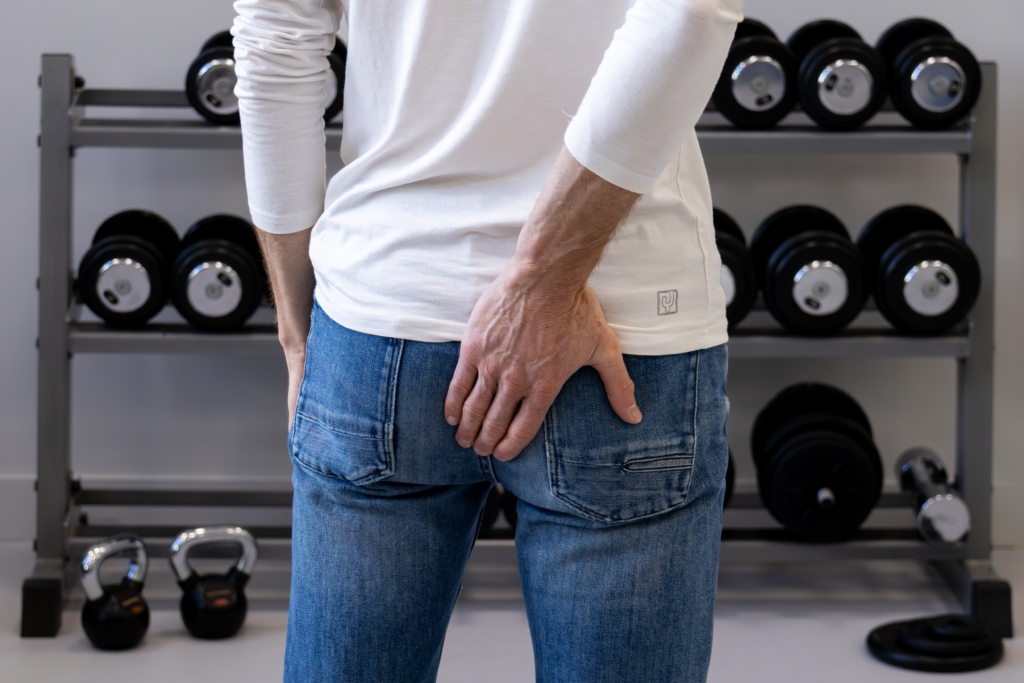
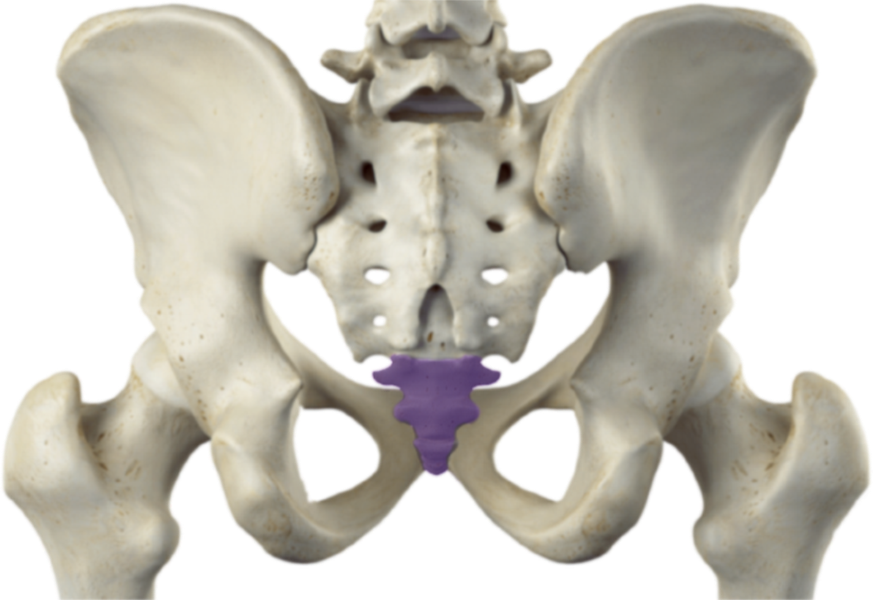
The tailbone is the part of the spine that is most difficult to exercise. Excerises directly for the tailbone(s), don’t really exist. The well intended exercises I often encounter of trainers or therapists, mainly focus on the area around the tailbone. The mobility of the joints of the tailbone itself, is not practiseable because the individual bones that form the tailbone are inpossible to actively move one to another like that is the case in other parts of the spine or most other joints in the body. In other words; we as humans are unable to wag our tail.
The complaints related to the mobility of the joints of the tailbone, where the problems mostly arise from, are not solvable by doing exercises. Specific exercises can bring more freedom and relaxation for the tensed structures around the tailbone. This can often bring a relief in tension and pain and support recovery. Also avoiding pressure on the tailbone can help the selfhealing capacity of the area.
On this page you will find multiple exercises that you can do at home to influence your problems in a positive way and are mainly aimed at relaxing the pelvic floor and connecting with the epainful area.
Relax the pelvic floor muscles
The muscles of the pelvic floor directly attach at the tailbone. A lot of people have an increased tension in their pelvic floor muscles (often due to stress). A dysbalance in the pelvic floor musculature like an increased or asymmetrical tension (that also can be caused by a dysfunction or dysposition of the tailbone), can trigger tailbone pain because more force is applied to it. The ‘bekkenfysiotherapeut’ is the specialist in training and relaxation of these muscles, but there are some simple exercises you can do yourself already and can help a lot.
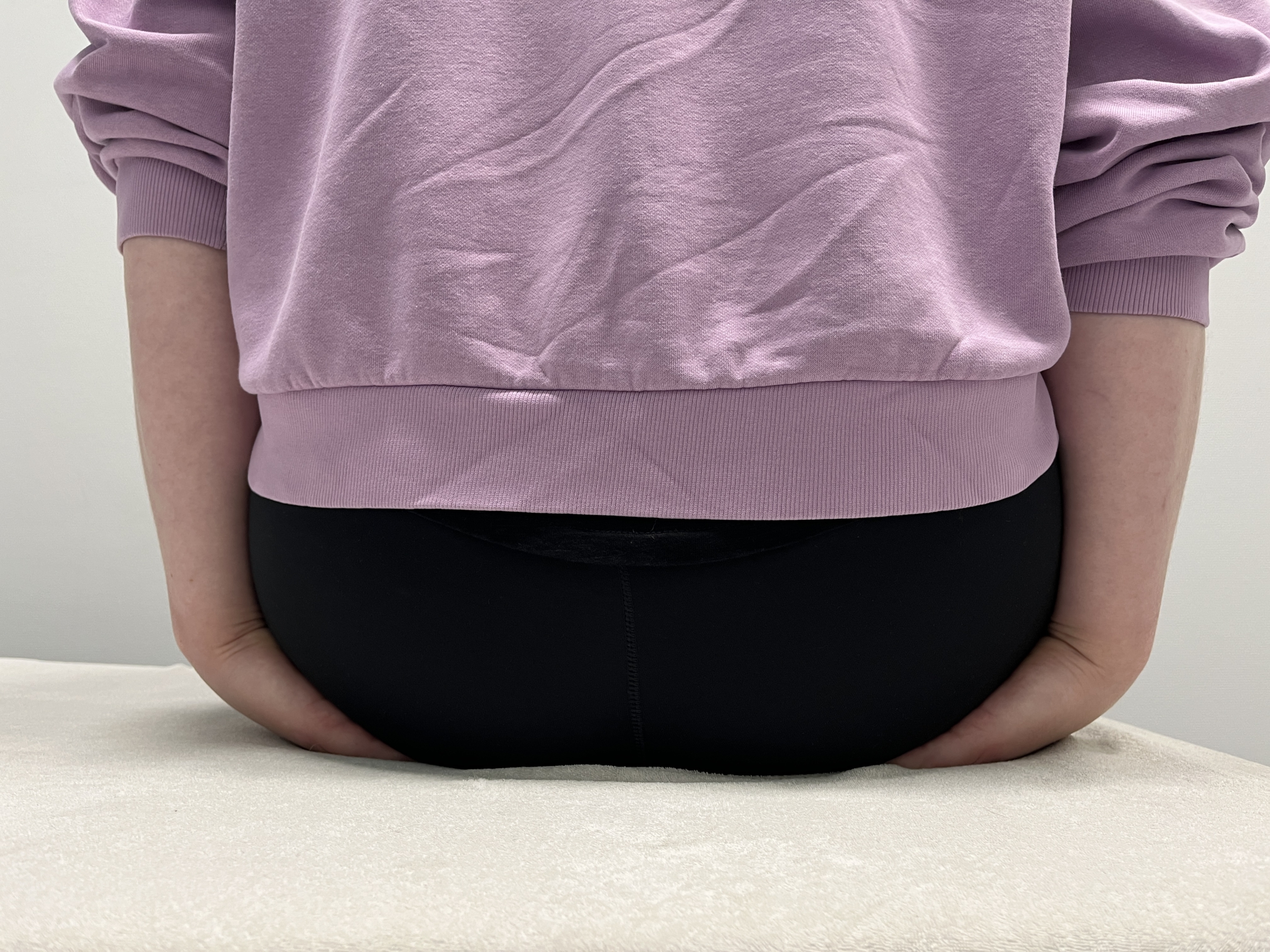
A good relaxing exercise for this area, is the following. Sit down on the palms of your hands with your fingers pointing towards each other and the tips just at the inside of the sitting bones. The fingers of the left and right hand don’t touch each other. This helps you to ‘sit wide’ and this relaxes the pelvic floor muscles.
Now try to let go of tension in the pelvic floor musculature. Most people have no idea where to locate them and to feel that, so you can softly contract them. You do this by pulling your vagina inward a little (or lift the genitals if you are a man) and do the same with the anus. Then try to consciously relax the muscles again as much as possible. If you notice that your whole body moves up a bit by the contraction, you are activating your superficial and bigger buttocks musculature. That shouldn’t be the case and the focus should be directed solely on the deeper the pelvic floor muscles.
Very important: the emphasis with this exercise is on the relaxation. Let this fully occur and in between just slightly contract the muscles. If you got the feel of it, you don’t have to contract them in between, it is just a means to an end. If you contract them too much for multiple times, it can lead to an increase of the pelvic floor tension.
Do this relaxation as often as you think of it and it can be done in all postures.
While relaxing, you can also try to ‘let the tailbone go’ completely and to breathe towards the pelvic floor for an extra effect. More about this in the next exercise.
Relax the pelvic floor through touch and breathing
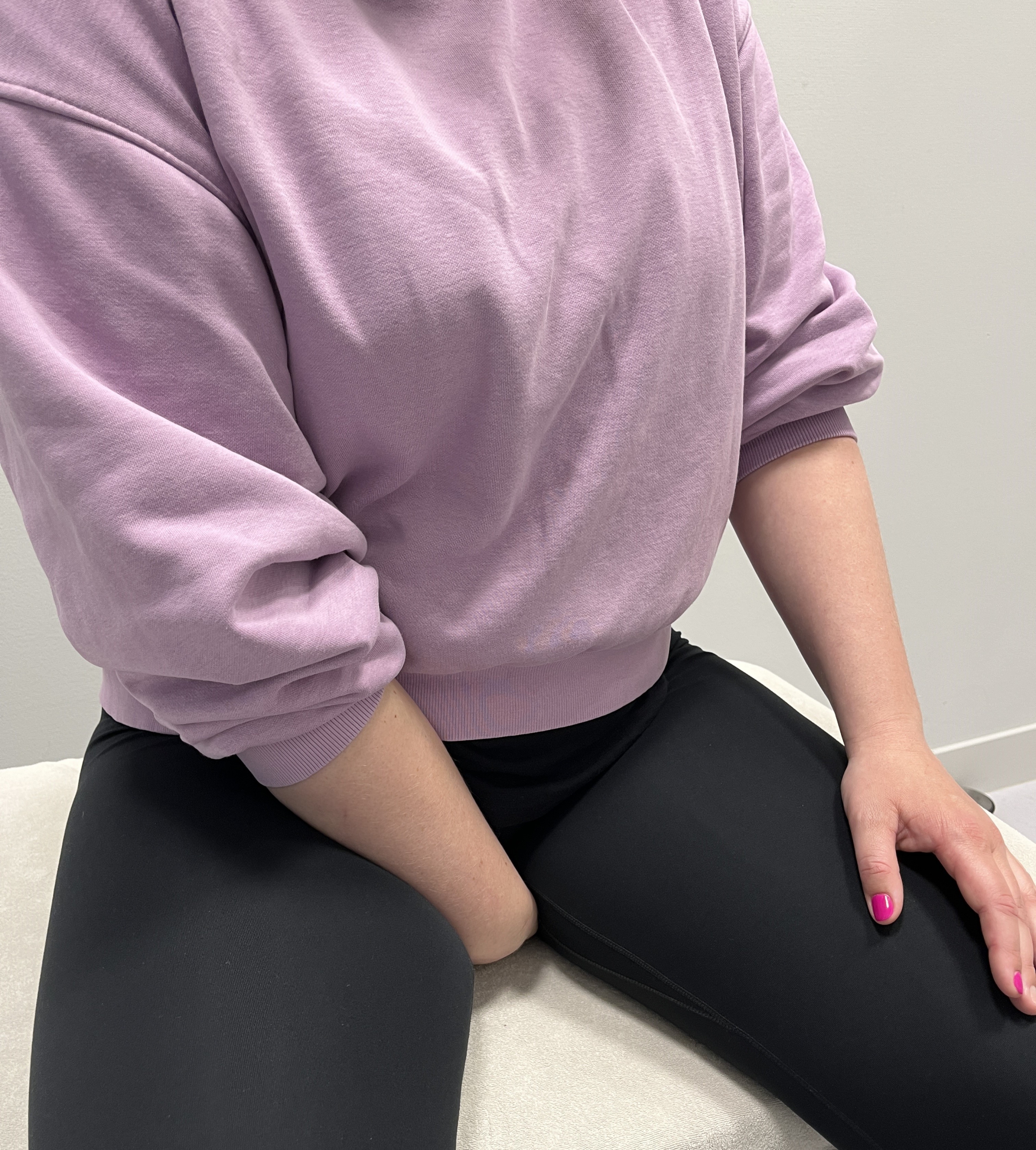
You can also help to relax the pelvic floor muscles by awareness and especially also by directing the breath towards it.
A good exercise for this is to sit on your hand and to bring your attention to that hand. The pelvic floor musculature is right above the perineum, the bit of skin that is located between the genitals and the anus and so right where the hand is. See if you are able to connect with that area through your hand.
Then find out if the opposite is also possible, if you are able to feel your hand with your perineum/pelvic floor. This is often a completely different sensation and directs even more attention towards it.
Then you can also aim the breath towards the hand. Not by forcing it, but to use the hand as an invitation for your breath. If you manage to breathe all the way through the belly to the pelvic floor so you can feel the breathing motion with your hand, there is definitely attention and relaxation in the pelvic floor. Breathe through the nose, this makes it easier to breathe low into the body.
Relax the total pelvic area with belly breathing
Every young child breathes towards the belly. Many times we adults have unlearned because of the stress we experience and we are ‘living in our heads’. In both cases the breathing moves upwards in the body. Breathing low has many benefits. Next to that it is our natural way of breathing, it also quickly brings calm and balance into our system, also in the pelvic area.
There is a very simple exercise to get to belly breathing.
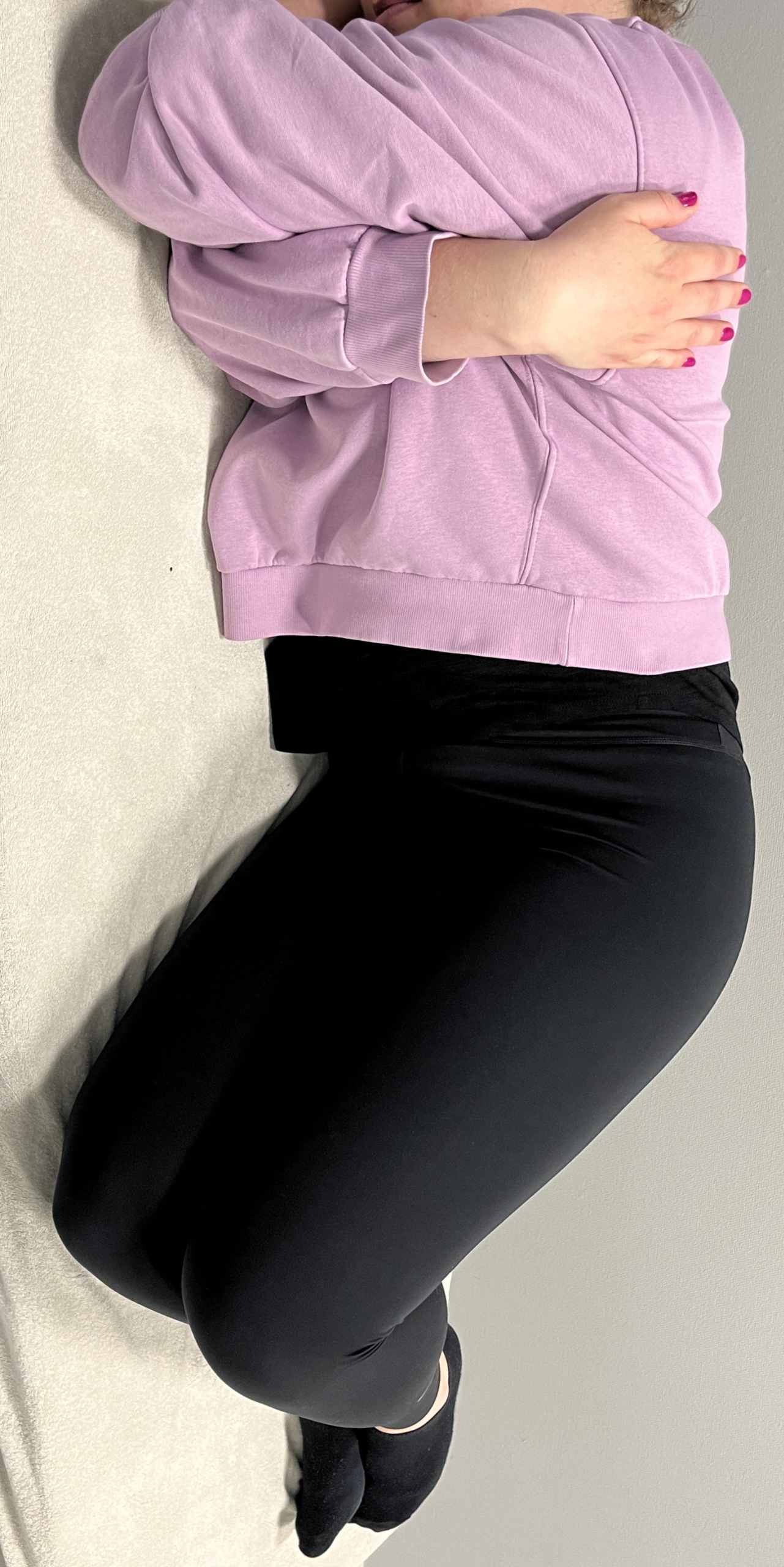
- Lie down on your right side and pull the knees a bit up so you are in a stable posture.
- Place the left hand underneath your neck so your fingertips rest on the backside on the vertebrae.
- The right arm is now brought underneath the left arm and the right hand is placed on the backside of the armpit or the shoulder blade.
- Bring the elbows close to the chest and then let them relax on the surface below.
- Relax your face, jaws and hands and fingers. Breathe through the nose and leave the breathing to the body and let it breathe the way it wants to breathe.
- Notice that you will automatically start to breathe towards the belly. Because you actually give yourself a hug, it is harder to expand in the chest and the breathing movement will move to a lower place. This way the breathing matches a more calm and relaxed state.
- Feel if you can bring the breath so low that the perineal area, the region between the anus and the reproductive organs, moves along. In this way you massage and relax the pelvic floor muscles.
- With every exhale let all the tension and restlessness in you slide off, physically as well as mentally.
The more you practise this, the more the belly breathing will become natural again. It will also bring you a more structural relaxation of the pelvis and pelvic floor.
Stretch the deep pelvic floor muscles
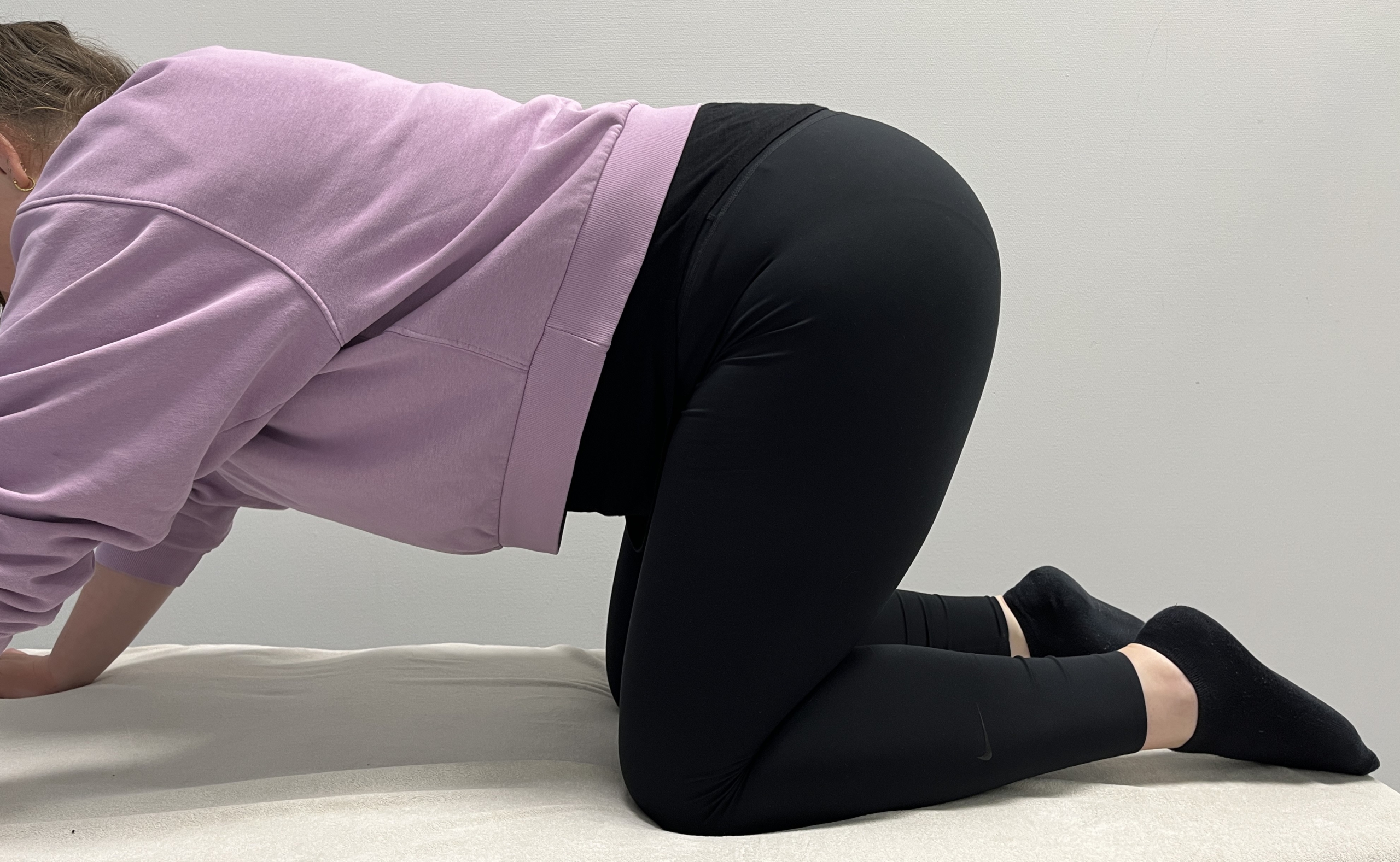
The deep pelvic floor muscles, like of the anus, pull directly on the tailbone and can easily trigger existing tailbone problems. By stretching them you can create some relaxation of these forces.
Sit down on your hands and knees and make sure that your knees and feet are spread apart, and you would be able to sit in between of your feet if you wanted. The arms aim forward, like in the child’s pose in yoga. Now you can stretch the deep pelvic floor muscles by aiming with the anus to the back and also sides by moving to the left and right. You will feel when there is stretch and stay there if you find it. By bringing your pelvis a bit up or down to the floor, or arching or hollowing your back a bit, you can often further increase the stretch.
The wide kneeled child’s pose (all the way down and with the knees and ankles wide apart), can also be very pleasant to get some stretch on the pelvic floor.
Squat-sitting
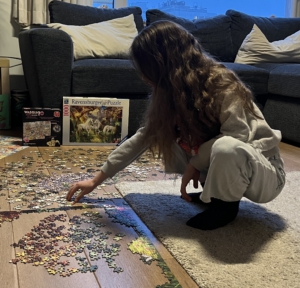
The squat-sit is a very natural way of sitting that is still often seen in a lot of Asian and African countries. Where kids are capable of sitting like this comfortably and for longer periods of time, most adults in the modern societies have a hard time to even get into the position. This is mostly the result of a lack of physical activity and mainly local stiffness because we are sitting so much in chairs.
The squat-sit is not only a very natural pose, it is also ideal for tailbone pain. On the one hand it stretches the often stiffened up back side of the lower back and pelvis, on the other it relaxes the pelvic floor. It is for a reason that this is also the ideal pose for in the toilet, because the exits in the pelvic floor can open maximally.
To be comfortable in this pose, mostly some exercise is needed. The harder it is at the beginning, the more you can gain. If it is easy from the start, try to be in this pose as much as possible. For exercising this pose that we as kids all were able to have comfortably, it is important to build it up gradually. Not only in time, also how you practise the pose. The following aspects are important in the practise:
- Sit with the buttocks on the heels or lower part of your lower legs
- Make sure your knees are wide so you would be able to work with your arms in between your legs
- Have your feet flat on the floor for optimal stability
- RELAX
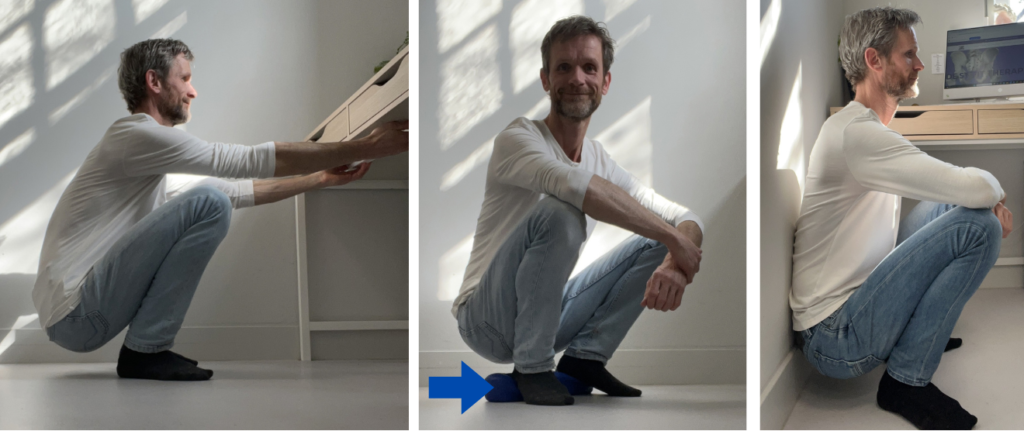
For most people it is not easy to be relaxed in this pose or even get into it, so it has to be built up gradually. Important is that from the start onwards you find a relaxed end-position where especially the pelvic floor feels loose and free. If you are sitting tensed on flat feet and hoovering with your buttocks above the lower legs, there will be tension in the pelvic floor and buttocks and this is straining for the tailbone. Gradually build it up by first sit more on the front of the feet with a support under it like a rolled up towel (and also on a somewhat softer surface like a couch it is often easier), or by tightly holding on to something stable like a couch or table so you kind of hang into the pose. Another option is to sit like this leaning with your back against a wall or the front of the couch. Make sure you are stable because especially with tailbone pain, you want to prevent falling over backwards. And again, relaxation of the pelvic floor and buttocks is essential.
It is something that must be trained and is probably not for nothing also a yoga pose, named the garland pose, or the Malasana. It is fully normal that in the beginning it’s all but comfortable and again, this indicates there is a lot to win here. Important is that you experience stretch, but without straining yourself. So challenge yourself but don’t overdo it. This means that you stretch until where it feels challenging but don’t trigger any irritation.
If you experience any problems in your knees, you can place a flat pillow or towel between your upper leg and calf so the flexion is less endrange, and do that on both sides so it stays symmetrical for the pelvis and pelvic floor. When you experience pain under the foot the achilles tendon or your ankle, then place a rolled up towel under your heels. If you feel irritation in the hips, pelvis or lower back, then make sure the legs are sufficiently spread and also use a support under the heels. Build it up a bit more gradually and practise shorter. You can start with a few seconds and build from there to several minutes and so on. In this way your muscles, ligaments, fascia and other structures can adjust to the requested length.
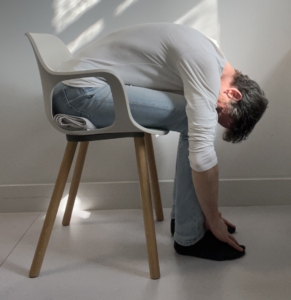
For problems in the ankles, knees or hips, you can also try an alternative position where you bent over forward while sitting on a chair. Because you lean forward, the pressure is off the tailbone (make sure your trousers are not to tight) and the tailbone can be extra relieved by placing a small and flat rolled up towel underneath the sittingbones (as in the picture), so the tailbone is just behind this elevation from the surface below. This pose is less natural than the squat-sit, so it is always useful to keep training yourself to become comfortable in that pose.
If despite adjustments the squat-sit stays too straining, then this excercise is not suitable for you. Always listen to your body and it’s limits. This exercise is also not recommended in the following cases:
- Prolaps of the intestines
- The first 2-6 months after labour
- When pelvic floor problems arise during the exercise like hard to not lose urine or a heavy feeling in the pelvic floor (also when it is afterwards)
And as mentioned, with other problems that are triggered by the exercise. The alternative pose in the chair is less straining and has less restrictions.
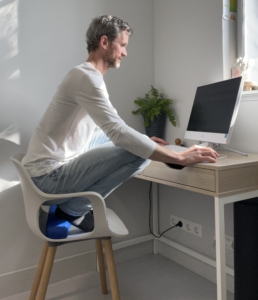
If you manage to train the squat-sit without straining yourself, then practise it as often as possible until sitting in squat pose becomes comfortable. You can also incorporate it into daily activities. I work regularly in this pose nowadays. In this pose you can also do activities on the floor like folding laundry, playing with a kid or watching television.
Again: it is essential that the pelvic floor and buttocks are relaxed during the exercise and you don’t feel you have to work hard or are tensed during the exercise. A support under the heels or holding on to a table can already solve that. Extra relaxation you can achieve by consciously breathing towards the pelvic floor and expanding this area during every inhale, and letting go even more with every exhale.
This exercise is also great for other pelvic pain or lower back issues. Breathe towards the sensitive area and by the movement of the breath, you sort of internally massage the injured area. By narrowing the space between the knees or even putting the legs together (especially also in the above mentioned alternative with sitting bended forward on the chair), you can make this effect bigger because the belly can’t expand forward anymore and you have to ‘breathe towards the back’. If you find it hard to breath towards the injured area, you can also do this and breath towards the belly and the movement in the body will find it’s way.
Exercise to connect with your tailbone
This exercise is about connecting with your tailbone area. The better you are able to do that and can experience what is going on there, and that is often more than just the painful sensation, the better you can understand what the body needs and how to support it in the recovery. Also there is the universal law that where attention goes, energy flows. Try this exercise and experience what t does for you. If it feels beneficial, use it to your advantage and as often as you like, with or without the video.
Relaxation in a guided exercise

Would you like a more extended version for relaxation and connecting with the tailbone?
I recorded two audio’s especially for the tailbone that will guide you through this. You can find them here.
Exercise for the first chakra
The chakras are located in the middle of your body and the first chakra, also called the root chakra, is exactly where the tailbone is. Especially with issues connected to feeling at home in and around yourself, and feeling safe, it could be that in the first chakra it ‘doesn’t flow freely’, like they say in the easterm approach. This can also be linked to problems in this area and also for the tailbone.
Working with energy and the chakras can be abstract for a lot of people. That is why I recorded this concrete and tangible exercise for you. Sinking into the body and becoming more ‘incarnated’ or grounded, need the opposite of airy-fairy. Here you will find an instruction video that I recorded about it and below some additional explanation about the various steps with at the bottom the audios you can use during the exercise.
1) Contact with the surface below
The lowest chakra represents contact with the earthly. To help you with this, it often helps to make contact the surface below with bare feet. So for this exercise, take off your shoes. If possible is is even more helpful to stand with your feet on grass or soil because that helps to become more grounded in the body.
2) Manually connecting with the pelvic area
Another way to activate energy in parts of the body is through touch. The tailbone is located in a region where not everyone feels comfortable touching themselves. See what works for you in the safe, private setting of your home. By touching the skin by rubbing or stimulating tapping, you can awaken the tailboen area. This includes the buttocks, groin, lower abdomen and perineum (the soft area between the genitals and anus), but you may also include the anus and genitals if you feel comfortable with that.
Make this phase as long as you wish and as long as you feel activation.
3) Stretch and relaxation
The next step is activation through stretching and relaxation. For this, go into a squat position (sitting at the front of your feet) or if you can, a full squat (with feet flat) and try to rest your buttocks completely on your calves/heels. Then consciously relax the pelvic floor, the area directly above the perineum, by consciously relaxing it and letting go and breathing into it.
Only continue to the next step when you feel more freedom and activity in the region.
4) Movement through shaking/dancing/stomping
The next phase involves moving the body in order to create a shift in your energy. A very good and a pleasant way to do this is by shaking the body. Do this by repetitively bending your knees slightly at an activating rhythm. Make sure your knees move together on both sides, rather than alternating, so that the movement is felt even more in the body and mainly pelvis. Feel that you are shaking from your pelvis and that from this area you are shaking everything loose and downwards off of you. In the video, I demonstrate how you can do this.
Sound and tones can also help you create space in a particular region. In Eastern traditions, basic tones or mantras are often used for this. For the first chakra, the sounds Nam Lam are suitable, which address the masculine and feminine energy in this lower region. You can hear the pronunciation of these sounds in the video. You might even feel it vibrating around your first chakra with these tones. You can add these tones to the shaking or also while touching or stretching the area.
Music can also help to activate this region. Didgeridoo sounds and drums are often very suitable for this purpose, and I have selected a few audio tracks for you, with the links included below. You can also follow the shaking by dancing. Make sure your attention stays low in your body and you emphasise on your legs. Stomping is also often very helpful to bring your attention down and to let the energy flow there.
Choose the for you matching input
Perhaps all of them work for you, or maybe just one or two. Try them out and follow the sequence, or choose whatever suits you best. Also experiment to see whether you prefer using tones or music, or doing it without. The key is to focus your attention on your lower pelvic area and allow it to loosen and flow there. If you succeed, you will naturally create space in this region, and any form of stagnation you reduce or remove in this way, will support the recovery of your tailbone area. Do the exercise for as long as you want and continue until it feels freer.
As promised, here are a few music tracks that can support you in this process. Below you’ll find four up-tempo numbers by the Highlight Tribe, featuring didgeridoo and drums, which are perfect for the loosening up by shaking or dancing. See if you can really feel it in your lower pelvis.
And if you have a track that matches this yourself, feel free to use that of course.
And very important: enjoy the process!
Disclaimer: please be aware that connecting your attention to areas where there is potentially stored tension, can lead to an emotional release. If you experience this then that is a good sign, if it is too strong or overwhelming than seek guidance by a qualified coach or therapist.