
Tailbone pain
In most cases the movements of the tailbone are not optimal

Tailbone pain almost always presents itself as a local pain at the tailbone, the os coccygis. The official name is coccydynia, which translates as pain at the tailbone.
However small the tailbone is, the pain can lead to a lot of problems and restrictions in daily life.
On this page I want to share knowledge and give insights about the tailbone and tailbone problems.
The tailbone is not just one bone
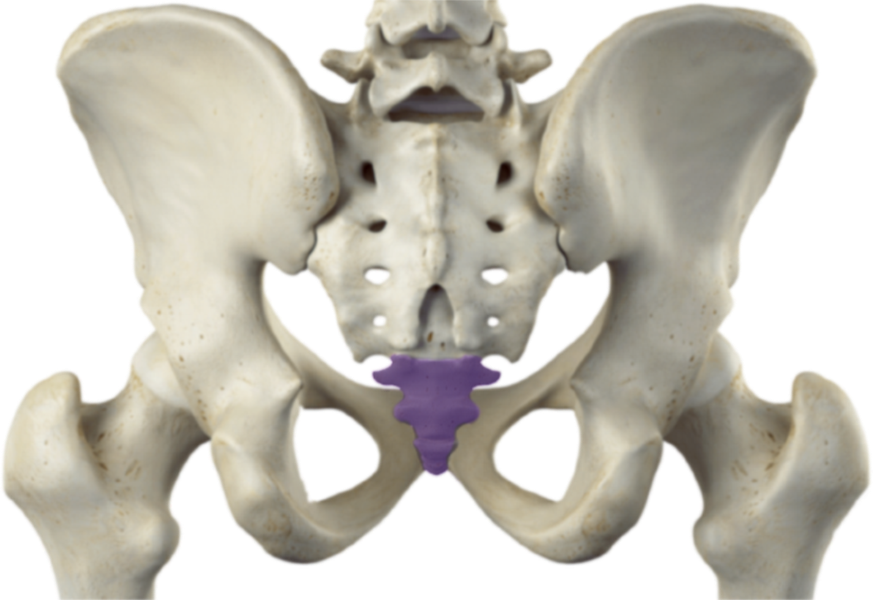
The tailbone is the lowest part of the spine and consists of a few small vertebrae. The name tailbone or coccyx is a bit deceiving because it indicates it is just one bone, and this is what also many doctors and therapists assume. The tailbones mainly move in the connection to the sacral bone that lies above it and the joint below. It is probably called the tailbone because this is where our tail would be if we had one, or are the remains of it if we actually did have one.
There are quite some people that think the tailbone is located at the level of the belt. It is actually all the way down, at the bottom of the pelvis, just a little bit behind the anus.
Do I have tailbone problems or is something else going on?

Quite regularly I see people who come to me for coccyx complaints, but who do not actually have a tailbone problem. Firstly, because people often point to a place much higher up, usually at the level of the belt or at the pelvic joint. The coccyx is a very specific spot in the body. The pain occurs almost always precisely at this spot and can be provoked by pressing on it or when sitting in a slouched position.
If you are unsure, these are the characteristics of a coccyx complaint:
- Local pain at the tailbone itself
This is just behind and above the anus, either in the middle or just a tiny bit besides it (no more then a fingerwidth. Sometimes people refer to their tailbone at the lowest lumbar vertebra (at the level of the belt) or the pelvic joint (between the lower back and the coccyx and not in the middle but a bit more to the left or right of the centre). As a test you can place your hand on the back of the pelvis with the tip of the middel finger positioned on the anus. With a tailbone problem, the pain should be somwhere under your hand. It is certainly possible that the complaints are not limited to the spot of the tailbone and may also be present in the region, but without this local pain, it is questionable whether the problem is actually with the coccyx. - The problems are provocable by direct pressure on the tailbone
Pressing with a finger on the painful spot of the coccyx increases or provokes the complaints. If this is not the case or if pain at the tailbone occurs when pressure is applied elsewhere, it is questionable whether it is a coccyx problem. - There is pain with direct loading on the tailbone: sitting slouched
Pain almost always occurs when pressure is applied to the coccyx, as with sitting slouched. If this is painless and you can roll backwards from a slouched sitting position until you are lying on your back when sitting on the floor (or another firm surface), then it is questionable whether it is a coccyx problem. Another indication for tailbone pain is that the complaints often disappear when people stand or walk. The getting up from sitting is often painful, but once standing and walking, the complaints quickly reduce. Sometimes people experience tailbone complaints while standing or walking, but this is never the only or main activity in which the pain manifest.
Next to the above, also prolonged sitting (mostly on harder chairs but sometimes mainly on soft surfaces), rising from sitting and riding a bike is often mentioned as painful. To a lesser extent, people complain about tailbone problems when lying on the back and sometimes with toilet visits and sexual intercourse.
Of the hundreds of patients I have seen with tailbone complaints, 99% met these three criteria. If one of the three is missing, it is questionable whether there really is a coccyx problem, even if there is pain in the coccyx region. Not quite sure? Feel free to make an appointment with me at the practice or online so together we can look at what is going on.
Tailbone problems are in most cases a biomechanical problem
Since the groundbreaking research of the French physician Dr. Maigne in the ’90s, there has been a consensus among experts and in the literature that coccyx complaints are usually the result of movement dysfunctions. The opinions differ on what the exact problem is there, but it is generally clear that there are usually no structural issues such as tumors, abscesses or structural dislocations or malalignments. The problem also rarely lies in the anatomy or shape of the coccyx itself. This is also the reason why standard static X-rays or MRI scans almost never provide clarity regarding the issue, and why Dr. Maigne introduced dynamic X-ray imaging, which offers insight into the mobility and specific movements of the coccyx.
What I usually observe is that the complaints most often arise from reduced mobility and/or a deviated position of the tailbone. Because of this the tailbone can’t function optimally and is in sitting exposed to more pressure than usual. A reduced mobility of the tailbone can also lead to an change in functioning of the pelvic floor musculature, which are important for urinating and defecating and for the stability of the pelvis. It can even lead to a change of functioning in the regions around the tailbone, like the pelvis, the intestines, the lower back and the groin and even work its way up to the neck or down to the feet.
There are several causes of tailbone pain
I have seen patients with tailbone problems between 9 and 81 years old. They were mainly female, although only in a small amount of cases pregnancy and labor were responsible for the onset of the problems.
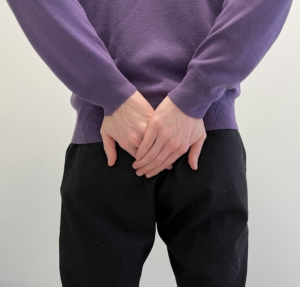
Problems at the tailbone can start because of multiple reasons. Classically it is because of falling on the butt, like my daughter demonstrates here in this video. The problems can also occur after a long time of sitting in a non-optimal way or after childbirth. Although the biggest group of patients I saw, had no idea what caused the problems.
As mentioned before, there is not a lot of knowledge in the medical and therapeutic world about the tailbone and tailbone pain. Therefore I started to gather data myself the last few years.
This is what I encountered as the reasons that people mentioned as the start of their problems:
De onsets for tailbone pain
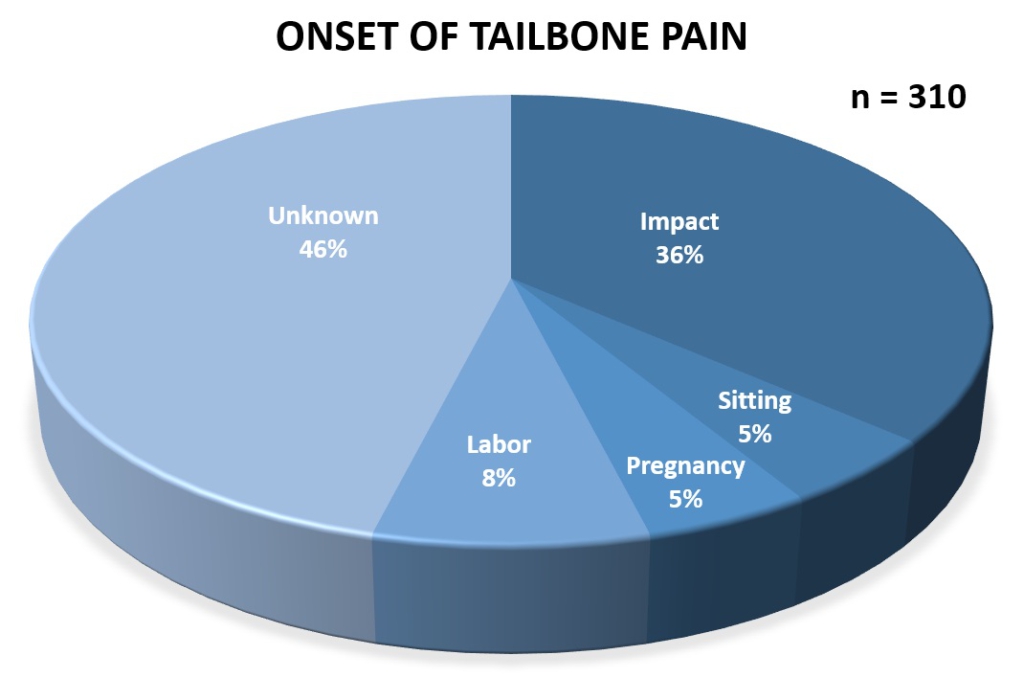
In the literature often is referred to an increased mobility or instability of the tailbone as the most important reason for tailbone pain. This can be a logical explanation after a traumatic event like falling down or child birth, but as been shown in the statistics here, it can’t explain the problems for at least around half of the patients. In the (physio)therapeutic practice we also encounter an underlying disrupted biomechanics in the joints of the tailbone, but rather in a reduced mobility that is often accompanied by a sidewards misalignement of the tailbone.
Problems due to a reduces mobility and a disposition to one side is hardly recognised in the literature as a probable cause for tailbone pain, although it can be found in almost every patient we examine. This discrepancy with the literature can be explained because almost all research is being done by physicians and they have from their educational backgrounds less focus on biomechanics, where this is the specific expertise of us therapists. This inspired me to write a scientific review about the qualities and shortcomings of the current paradigm about tailbone pain, what has a direct influence on the choice for treatment.
Where most therapists and doctors barely have any knowledge about tailbone problems, it also is understandable that the physician that does know more about it still doesn’t advise the option of physiotherapy for the patient. The biggest part of the hundreds of patients that consulted me for their tailbone problems, found me after doing the research about the treatment options themselves.
Last but not least there are also other explanations for tailbone problems. Therefore we must look beyond the regular medical and paramedical care en to a more holistic approach. The pelvis and especially tailbone area are very sensitive for the influence of stress and mainly unsafety. This aspect, where Easten medicine has more to offer than Western healthcare, is hardly being addressed in the courses about tailbone pain and I personally always take into account as a potentially important factor of influence for tailbone problems. More about the holistic approach of tailbone pain you can find on the page Treatment.
Tailbone pain can be treated
Even though most doctors and therapists are not aware of treatment options for tailbone problems, they are often very well treatable. You can find more about this on th erelated page.
More info abut coccyx pain
If you like to have more detailed information about tailbone problems, you can watch the video’s I share on my Instagram account. They are only in Dutch unfortunately. You can find them also here on my website through this button: