
The Tailbone Podcast: Sary van der Hasselt – Osteopath
It is rare that it is only a tailbone issue,
we have to look at the whole system
Our guest in this episode is Sary van der Hasselt
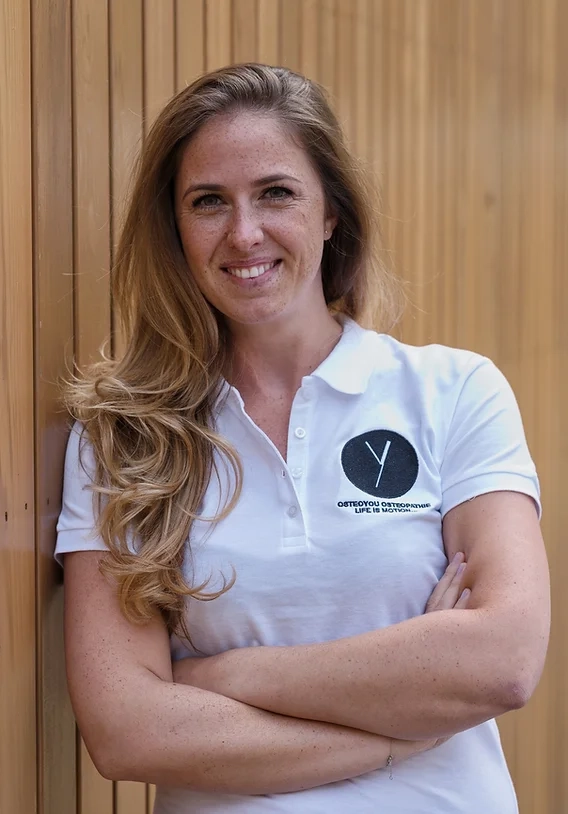
Sary is born and raised in Belgium and has a mastersdegree in osteopathy. Nowadays she lives in and works in the Netherlands and is co-owner of an osteopathy clinic that has several locations. She also teaches at the International Academy of Ostepathy, and through the years has specialised in pelvic problems. A big part of the patients she sees, consult her for tailbone pain.
Sary is my personal go-to when my therapy isn’t effective or doesn’t help sufficiently and there doesn’t seem to be a problem that needs medical attention. This is because she approaches the problem in a different way then physio’s and she can defenitely do things I can’t. Because I have a different skill set, her is very complemetary to what me and pelvic physio’s do. Next to the mechanical aspect like the joints and muscles, she as an osteopath also examines and treats the neurological, vascular, visceral and fascia components of problems. In this episode she will explain how she works and what components she sees that are connected to tailbone problems.
As you will hear, Sary is very knowledgable in the theoretical and the practical part of treating tailbone pain and is another true expert on the topic.
You can find the podcast in the menu under Podcast as well as the links to the platforms where it is posted.
Resources
During this episode, Sary gave us two exercises regarding tailbone pain.
1. Squat-sitting
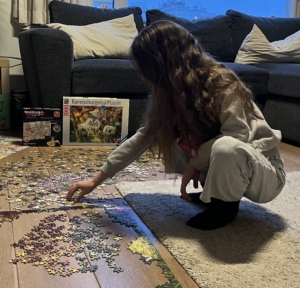
First and foremost, her favorite exercise: squat-sitting. The deep squat pose is sitting with your buttocks on your calfs/heels, the hips open and the feet as flat as possible on the floor. It is a great posture and stretch for the lower back, the back of the pelvis, the pelvic floor and the back fascia. It is also a very natural way of sitting that still normal in many Asian and African countries, or wherever people live more traditionally. We in the industrialised countries are often so used to sitting in chairs that we are not capable of getting into this pose anymore, although as kids we all were capable of doing so.
As the pictures here show; my daugther has no problems with it, where I need to have some support to prevent falling over:
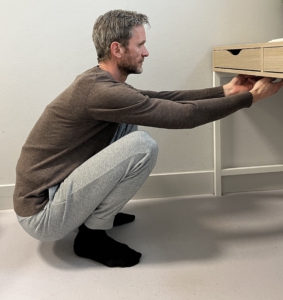
These are the instructions:
- Sit with your buttocks on the back of your lower legs
- Put the feet as flat as possible on the surface below
- Make sure that the hips are open, so the knees are spread and not close to each other
- If you are not comfortable or stable straight away, make sure you hold on to something so you don’t fall backwards, which especially with tailbone pain is something you want to prevent
- Don’t torture yourself! Stretch is normal in the beginning, but respect any pain and adjust to that by more support, releasing the stretch on these structures and limiting the time in the pose.
It is a great stretch for often stiffened up and tight areas in and around the pelvis.
It is not too suitable for people that have prolapses (often accompanied by a heavy feeling in the pelvic floor) or the first 2-6 months after delivery. When you feel it is too strainious on your pelvic floor and you have a hard time contain your urine for example, this exercise is probably too early for you; your pelvic floor must be able to hold it. Also take care when you have any knee, hip, pelvic, lower back or other problem or restriction. Be mindful of that what your body is capable of and what not and follow its feedback.
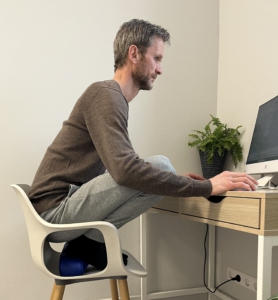
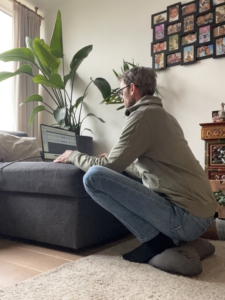
Built it up slowly to get used to the pose and the ligaments, fascia, muscles and all other structures can adapt to a less shortened position again. While training it, start somewhat more on the front of the feet if the stretch is too much for your fascia under the foot and slowly work to more flat contact with the floor. Because it can be quite straining, try the pose first for maybe just seconds at a time and then slowly built up to a level where it finally actually becomes pleasant and relaxed. When you are a bit used to it and more stable in it, you can easily integrate this posture into your daily life by performing activities in squat-sit.
I actually edited some of this episode in this pose and as you can see, with something under my heels until my body is flexible enough to do without.
2. Knees wide
Sary also advised not to cross the legs or squeeze the knees while sitting. Optimal for the pelvis and structural tension is that the hips are open and the knees a bit wider apart. So sit a bit more ‘unlady-like’ to help your pelvis. While lying in bed, you can put a pillow between the knees to reduce pelvic ension if you have pelvic issues.
To open up the pelvis and hips, Sary also shared an exercise. For this you are on your back, with the knees bend and the soles of your feet together so your knees are spread to the sides. This pose is in yoga also known as the reclined butterfly pose. Put a pillow or towels underneath the knees to support the legs a bit, but make sure you feel the stretch in the muscles on the inner side of the thighs, the adductors, that can be tight if you squeeze or cross your legs often.
Therapy by Sary
Sary works at the OsteoYou and at their clinics in Amsterdam-Zuid and Hendrik-Ido-Ambacht. If you are interested in consulting Sary, you can find here here.
Get in touch
In you have any questions about anything in and outside of this episode, comments or requests, let me know! You can email me through the contact field below or directly at roel@roelwilbers.nl.