8tracks icon Behance icon Blogger icon CodePen icon Delicious icon DeviantArt icon Dribbble icon Etsy icon Facebook icon Flickr icon Foursquare icon GitHub icon Google+ icon Instagram icon Last.fm icon LinkedIn icon Myspace icon PayPal icon Pinterest icon SoundCloud icon Stack Overflow icon StumbleUpon icon Tumblr icon Twitter icon Vimeo icon YouTube icon Yelp icon
DE STIT THERAPEUT

The Tailbone Podcast: Expert Talks

10. Elif Gürkan – Medical Doctor

Dr. Elif Gürkan is an experienced Turkish physician that worked in several different countries. She runs her own clinic in Istanbul now and a true specialist on tailbone pain. Elif also is one of the organisers and speakers of the upcoming 5th International Symposium on Coccyx Disorders in Turkey. Next to having experienced tailbone pain herself, she was one of the pioneers on this topic in her country. She treats tailbone patients for over 25 years now and saw over 3000 patients. In this episode she shares her knowledge, experience and wisdom with us about tailbone pain. We will go into where tailbone pain comes from, what is the underlying mechanism and her experiences treating it through manual mobilisations and injections.

Jump to transcript


With the right knowledge and experience,
tailbone pain is not a very complicated problem
to treat and solve in most cases

– Elif Gürkan

Our guest in this episode is Dr. Elif Gürkan. She is an experienced Turkish physician that worked in several different countries. She runs her own clinic in Istanbul now and a true specialist on tailbone pain. Next to having experienced tailbone pain herself, she treats tailbone patients for over 25 years and was one of the pioneers in her country on this topic. She trained with Dr. Maigne, a name that came by multiple times in the podcast and is one of the ‘godfathers’ in the field of tailbone diagnostics, treatment and research.

Now, over 3000 patients further, she shares her experience and wisdom with us. We will go into where tailbone pain comes from, what is the underlying mechanism and her experiences treating it through manual mobilisations and injections. Elif also is one of the organisers of the upcoming 5th International Symposium on Coccyx Disorders in Turkey, where she will be presenting about manual therapeutic techniques and teach a workshop.

More about that you will learn in this episode and we will of course also dive into the topic of her speciality: tailbone pain and how to diagnose and treat it. She will share with us her extensive knowledge and experience.

You can find the podcast in the menu under Podcast as well as the links to the platforms where it is posted.


Extra’s

During this episode you heard Elif talk about a lot of topics and here is some extra information and links.


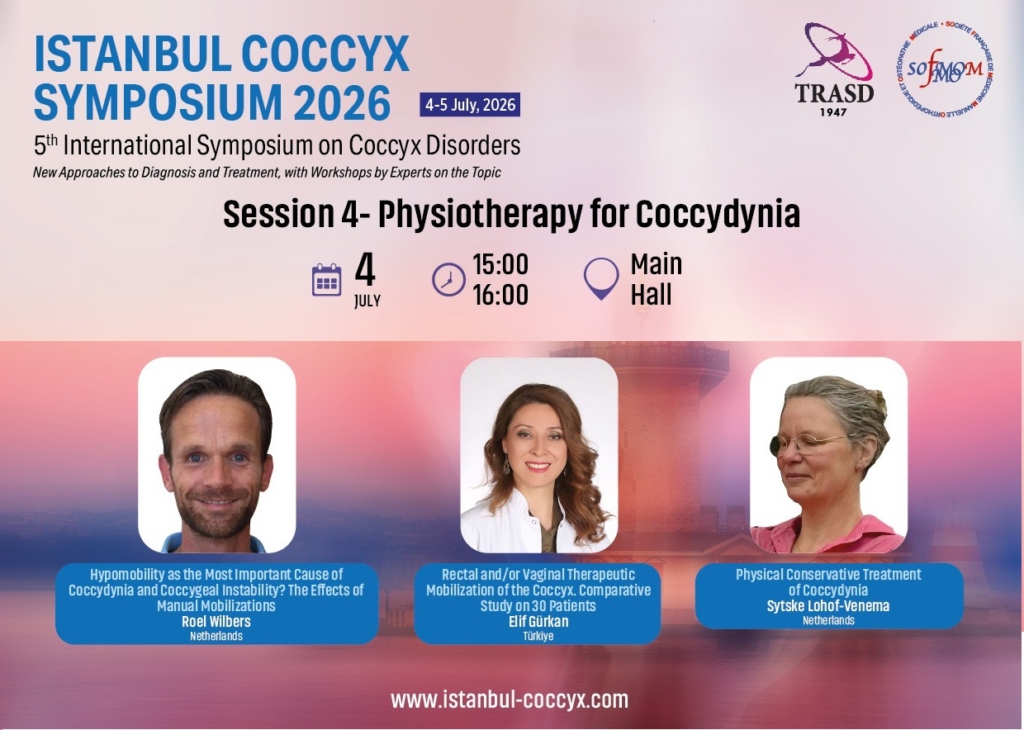
5th International Symposium on Coccyx Disorders : July 4-5. 2006 in Istanbul-Turkey

The place where the absolute elite experts gather to share their knowledge, research findings and experiences.

All the info you can find over here: https://www.istanbul-coccyx.com/en

Exercises

Elif shared two exercises what people wit tailbone pain can do.
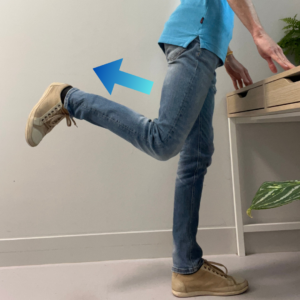

Glute strengthening

This very simple exercise wil help you to activate the glute musculature. Stand in front of a table and flex the knee of one leg. Now move the leg backwards so you extend in your hips. In this way the glutes are activated and this can be benificial to help you with your tailbone pain.

Make sure to train both sides. As with all exercises for muscle activation, make sure you feel the muscle tiring and that there is no pain in the tailbone during or after the exercise.


Squat sitting
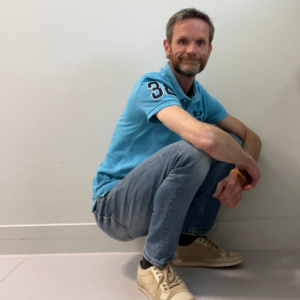
Short moments (7-9 seconds) of sitting in this position is beneficial for the tension around the tailbone. In this position you can gently push a little bit downwards towards the anus, just as you would when defecating on the toilet. Make sure you don’t make it a strong push; all is in order to relax the pelvic floor.

This exercise was also mentioned by Sary in episode 7 and in that episode we dive deeper into this exercise.

I also in detail present it on my website and you can find this on this page.


Pillow for tailbone pain

Finally Elif mentioned what are good and less recommended pillows to sit on when you have tailbone pain. She shared this one:
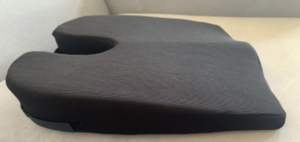
Wedge shaped with tailbone space

The pillow has a hole in the back where the tailbone is and instead of the doughnut or ring shaped ones (often advised but less effective), leaves space for back support and supports the sitting bones. This one is also wedge formed, so less thick at the front side. This helps to easier sit straight up.

The choice for the best tailbone pillow can be a very personal one in my personal experience. I have several in my practise to people can try them, and I recorded a video about the several options of tailbone pillows some time ago. It is in Dutch but might still be useful to see if you don’t master the national language on my Instagram page through this link.


Consultations by Elif

You can find the clinic of Elif by clicking here.


Get in touch

In you have any questions about anything in and outside of this episode, comments or requests, let me know! You can email me through the contact field below or directly at roel@roelwilbers.nl.

Transcript

Roel Wilbers

0:04 Welcome to The Tailbone Podcast.

0:06 My name is Roel, and as your host, I bring you only experts list for most doctors and therapists unknown problem.

0:12 Let's dive in with today's episode.

0:16 All right, welcome everybody to a new edition of The Tailbone Podcast Expert Talks.

0:20 And today we're starting the series where we interview doctors.

0:25 And I'm happy that I found a doctor as willing as our guest today, because I checked a few doctors and some doctors didn't reply me, others they were too busy,

0:34 others didn't have interest, but I found three very, very experienced doctors to have this podcast with.

0:39 And to start off with today, we have Dr. Elif Gürkan.

0:43 And she is an experienced Turkish physician that graduated from the medical faculty in 1993.

0:51 After that, she completed a specialty training for physical therapy rehabilitation and participated in academic studies, research and certificate programs in many institutions, also in the US and France.

1:03 Nowadays, she works in her own private clinic in Istanbul, where she sees multiple types of patients.

1:09 On her website, she lists her specializations, physical therapy and rehabilitation of musculoskeletal system diseases and surgery.

1:17 The second one, manual treatments, osteopathic and mobilizing manipulative approaches to the spine like lower back and neck.

1:24 Third one, the pain treatments with traditional physical and medical therapies, acupuncture, osteopathy and injections under imaging methods.

1:32 Also, posture examination and treatment of posture disorder and developing customized postural insoles.

1:39 On the top of her list of specialties though, is the treatment of tailbone pain.

1:43 Elif is very experienced and already saw thousands of patients with this disorder and they visit her from all over the country.

1:50 She treats them to a wide variety of methods, as we will learn in this episode, and integrates both Western medicine and the Eastern methods.

1:58 Me and Elif got in touch because she's one of the organizers of the upcoming fifth International Symposium on Coxic Disorders in Turkey.

2:05 Here, I will be sharing a stage with her, addressing the treatment through the manual therapeutic techniques.

2:10 Next to her presentation, she will also teach a workshop at this symposium, and where it will be my first appearance, Elif has visited and presented at previous editions as well.

2:20 That will be in July, and today, I'm very happy you are joining us for this episode with Elif.

2:25 It's also a good transition from the therapist you heard so far to the doctors, because next to the medical interventions, she also uses therapeutic techniques.

2:34 Welcome to this podcast episode, Elif.

2:36 It's a pleasure to have you with us today.

Elif Gürkan

2:38 Thank you very much, Roel.

2:39 Very nice to be with you on this podcast.

2:42 Thank you for your invitation.

2:44 I hope I can express all my experience and my ideas about coccidinia, which means tailbone pain, to you and to the people who listen to us.

2:56 As you have presented me, I have graduated from the medical school quite long time ago.

3:01 This was 1993.

3:03 After that, I wanted to specialize in physical medicine and rehabilitation.

3:09 Then I was interested in musculoskeletal part of it, mainly pain and sports injuries and spinal problems and shoulder knee problems, you know, like orthopedic pain,

3:21 let's say, and the rehabilitation of these people.

3:25 By time, I wanted to progress myself in other countries and I wanted to learn what we are doing in our country, or can we do better for the people?

3:35 What is the actual or the recent data?

3:39 So I went to the United States and France and to many countries to learn more and share my ideas with other colleagues and learn from them.

3:49 So in one of these visits, I met Dr. Main.

3:53 In fact, to learn osteopathic medicine, I went to France.

3:57 And at those times, he had started to work on coccidinia in the year of like 1999.

4:04 And he kind of invented the dynamic coccyx x-rays for people who have tailbone pain.

4:12 So he asked me if I'm interested in this topic.

4:16 I was a young doctor then I told to myself, how many patients can come with tailbone pain?

4:22 This is very rare.

4:23 I said, let's wait some time and I learned osteopathy and, you know, mobilizations, manipulations, manual medicine.

4:31 Then I, it took me like one, two years to deal with coccidinia because I was going to Paris from Istanbul at least for five times a year.

4:41 And after two years, I said, let's see what he's doing.

4:45 So he was kind enough to tell me everything.

4:48 And that time my French was progressing to understand him better and the French patients better.

4:54 So, you know, in medicine, it's very important to listen to the patients first, what their complaints.

5:02 So it started like that, this tailbone story for me.

Roel Wilbers

5:07 Nice, I didn't even know you were actually training under Dr. Menier, wow, in France.

Elif Gürkan

5:11 Yeah.

Roel Wilbers

5:12 Just for the listeners, Dr. Menier is one of the godfathers, I think, of tailbone pain.

5:16 He's also organizing this World Symposium and he is the one who published, I think, most clinical studies, easily most clinical studies about tailbone pain starting in the 90s.

5:26 And he really contributed a lot to the field.

5:28 And I mentioned Dr. Menier several times in earlier podcast episodes as well.

5:32 It's really nice we get first hand information by you.

5:35 So you learned in France and you got connected to tailbone pain and then you brought it to Turkey.

Elif Gürkan

5:40 Yes, by time, you know, of course, my interest in tailbone pain increased and I have seen that people really suffer from tailbone pain.

5:49 And till now, it's been like 26 years, I have seen more than 3000 patients.

5:55 I do specific injections to these people and it has been more than 1000 patients that I have done these injections to.

6:03 I think I brought this topic to Turkey also or I made it more popular in Turkey.

6:07 So now many doctors are interested and many physiotherapists are interested in this topic now.

6:13 So it's good to start something in a new era and make people interested in this because this helps patients a lot.

6:21 They need somebody to listen to them.

6:24 Still, it's not known enough because it's a very specific area.

6:28 You know, tailbone is the last part of the spine.

6:32 So in medicine, it's one of the last topics to be investigated and to be studied on.

Roel Wilbers

6:40 Yeah, I think every medical professional, but also therapist recognizes that mostly our education stops at the sacrum.

6:49 And the tailbone, it was not mentioned in any of my educations, except for the specific ones that I did.

6:55 I don't know if you recognize that, because what did you know about tailbone before you met Dr. Menyer?

Elif Gürkan

7:01 I think, yeah, I just knew that it was composed of three or four small bones, and you know, it's just behind the anus and the last part of the inner rectum.

7:11 And the most popular thing about coccidina in our times was it had a big, big component of psychosomatic pain, and it was almost more than, you know,

7:23 50% of the patients are psychiatric patients.

7:27 Now we understand that it's not the truth.

7:29 That's very important.

7:30 When something is not known, we are afraid of it.

7:34 We cannot come closer.

7:35 When we know better, our mind is more clear, and when we solve the problems, then we are not afraid of these problems.

7:42 So in fact, maybe like 50 years ago, doctors were kind of reluctant to deal with this pain because these patients were coming and going, coming and going,

7:52 and they were always saying the same things, same words.

7:56 Then you think that this is like a psychosomatic problem and a kind of obsession that they may have some family problems, sexual problems.

8:07 Because of the location of the coccyx in the pelvic floor, these people were kind of unlucky to express their complaints, their pain.

8:17 And when something is not solved, the body cannot decrease the pain.

8:22 It becomes a chronic pain.

8:24 If you cannot help the person at the beginning, then for certain patients, not all of them, the intensity becomes more and more and more.

8:32 And it's a really difficult case then.

8:36 So what we are trying to do today is to help the patients at the early periods, which is very important.

Roel Wilbers

8:45 I think I recognize very well what you're, I think, expressing is that when in Western medicine, when we don't understand it physically, then it's probably non-physical, right?

8:55 Instead of like something that we don't understand yet.

8:57 I think you expressed it very well.

8:59 And I think even in the 1900s, it was definitely seen as a hysteria or something.

9:04 Also because a lot of females had it, where male doctors have even less knowledge about, right?

9:09 So it was connected to the psycho-emotional part of things.

9:12 And happily enough, also through the work of Dr. Mania and yourself, we now know it's definitely in the body and structural, and there's something to do about it.

Elif Gürkan

9:21 Yeah, absolutely.

9:23 It's very important to understand these patients because before it becomes a chronic pain problem, which we call in medicine hypersensitization in the brain.

9:32 For example, for the shoulder problems, if your shoulder is very painful, even though there is a small problem inside the tendinitis, if you don't treat it, and if you have some sleep problems at the same time,

9:43 and some maybe small problems psychological, then it becomes easily a frozen shoulder.

9:48 We know it.

9:49 So it's the same thing for all the musculoskeletal system, which is completely implemented with the neural structures.

9:56 The body is a very griffed composition, so everything is united and everything is overlapped.

10:03 So that's the difficult part of our jobs.

10:07 I try to explain to my patients, everything is by layers and layers.

10:10 When we, for example, make pressure on the gluteal, on our buttocks, we may press many, many structures at the same time, not only the muscle, not only the sciatic nerve,

10:20 not only the tendon.

10:21 So we have to know the anatomy very well and explain to the patients why we doing many tests, why this is not very easy.

10:30 And we have to sometime ask for MRIs and or look at the structures with ultrasonography.

10:36 So when we have specific areas to work with, then we are quicker to make a diagnosis.

10:42 For example, for tailbone pain, we have to always ask the patients to point with their finger the place of the pain, which is very important because, for example,

10:52 in Turkish, tailbone is a big area.

10:55 In Turkish, it means also the sacrum, not the tailbone itself.

10:59 As Dr. Mayne also has recommended us, please ask your patients to show the place of the pain with their index finger because it's really important that they may sometimes show the upper area,

11:11 which is the lower back in medicine.

11:13 We call it like L5S1 space they may show.

11:16 So this is a completely different case.

11:19 They may sometimes overlap.

11:21 People may have low back pain and tailbone pain together at the same time.

11:26 But when we explain these to the patients, they understand very well and the patients help us about the diagnosis and treatments.

Roel Wilbers

11:34 Yeah, I recognize this as a therapist as well.

11:37 I mean, I have, I think one out of 30 that comes in and I said, can you point me, that's the first question I ask you, where's your pain?

11:43 And sometimes it's there at L5S1, that's where the belt is.

11:47 And then you say like, okay, this is not tailbone.

11:50 I can still help you, but unfortunately, you drove two hours to see me and you could have gotten this around the corner.

11:55 But I think what you also had said is, I think it's very nice that I had recently a patient that told me, it's definitely an inconvenient problem,

12:02 but the most inconvenient thing about it is that no one can tell me what is actually going on.

12:07 And in a way, if you have the knowledge, tailbone pain is not different than that's what I got from your story just now, than a shoulder pain or a knee pain,

12:15 which we know much more about and we can much more easily treat and understand.

12:20 And I think what you addressed also very important in an earlier stage, because with every problem, the longer we wait, the more complex it becomes and chronic pain and so on and so on.

12:30 And I think this is what we are kind of missing.

12:32 I think the average that I see people is like 36 months after the onset.

12:37 So they see me after three years on that, which is long.

12:41 And if we could have seen them in the first weeks, probably it would have been easier to treat.

Elif Gürkan

12:46 Sure.

12:47 Yeah.

Roel Wilbers

12:48 Like in every profession, there's only a small percentage of people working in tailbone.

12:51 I already express your doubts when you were a doctor.

12:55 Can I help two people?

12:56 But you see a lot.

12:57 I mean, you saw 3000 people already.

12:59 That's huge.

13:01 Are you the only one in Turkey?

13:02 Are there a lot of doctors or therapists working with that, that you know of in your country?

Elif Gürkan

13:06 Yes.

13:07 Twenty years ago, there were not many people, but the number is increasing day by day, and I'm making presentations in the Congresses and trying to express my experience about this.

13:18 In Turkey, physical medicine and rehab doctors are very hard working and very eager to work on spine and do the manual treatments, also the injections.

13:29 The numbers are increasing day by day, but still for the complicated cases they are sending to me.

13:35 Now, I see mostly of course Turkish people, but also foreign people or Turkish people living in other countries, which find me from the website or social media.

13:45 For example, it's interesting.

13:46 Last night, an Indian person called me and wants to come next week.

13:50 He's going to fly, I don't know, 15 hours to see me in Istanbul, but I told him stop and send me the MRIs and the x-rays and the reports.

13:59 Maybe you don't need to come.

14:01 I have to be sure about to call you here, you know.

14:04 He has a fracture, but we'll see if it is a fracture, because always they think that there is a fracture, but most of our dislocations.

14:12 So I will call him if I can be useful for him, because it's so far.

14:19 To have a specialty in physical medicine and how to examine the people and also at an osteopathic education on it helped me a lot to understand the real diagnosis.

14:31 It's very important in my opinion to make a spinal examination segment by segment and to understand the neurological distribution and the trigger points also,

14:43 the other joints, the groin area, the coxofemoral joints, the sacro-tuberous areas.

14:50 These are very linked to coccidinia.

14:53 Sometimes some people are complaining about the right or left side tailbone pains.

14:59 So these are very important and sometimes more difficult cases in my opinion.

15:03 The ligaments which attach to coxics, the tailbone and the ischial tuberosity, may be really painful.

15:11 You know, they come after some important falls from the stairs or high places.

15:18 And there is a shift maybe in the joints and criliacs and the pubis.

15:24 These are rare cases for god's sake.

15:26 Pure coccidinia is easier to treat in my experience.

15:31 And which is interesting is, only 60% of my patients are traumatic patients.

15:36 40% cannot define a fall or a trauma.

15:40 I think the reason is people are sitting, of course, too long in the last 20-30 years in front of the computer.

15:48 They travel a lot.

15:50 These are the factors of non-traumatic coccidinia, tailbone pain.

15:55 Because it was always thought that you fell and you broke your coccyx or you damaged your coccyx.

16:00 And then you have coccidinia.

16:02 In my experience, this is not the case.

16:06 And people with too much weight, if the body mass index is too high, also they are unlucky about coccidinia.

16:12 If they sit in a wrong position, which is kind of slouching or as if pelvis goes forward, all the weight is on the tailbone.

16:21 So the small articulations of the tailbone cannot resist that pressure.

16:26 And after a certain period, these are many spatially in my experience, the coccyx is dislocated backwards, which is interesting, because people always think that it is always inside.

16:38 So with the dynamic x-rays, which are done in the sitting position, we see a very surprising image.

16:46 In the standing position, the coccyx is in totally in good alignment, everything is in good order.

16:53 And then in the sitting x-ray, the coccyx part of the coccyx is totally backwards.

16:58 When the patient stands up, the patient manipulates the coccyx himself, herself.

17:04 So this is also interesting.

17:06 Even the patients can easily see on the x-rays that the coccyx is dislocated and they are very surprised.

Roel Wilbers

17:13 So a lot of recognition there on what you are saying.

17:16 I recognize that patients come from afar.

17:19 I had three people coming from the Americas that wanted to actually fly to me for therapy.

17:24 Colombia and Canada and Brazil were actually thinking about or willing to come over.

17:29 So this is how rare this is that actually there are experts.

17:33 So I can imagine that you get people from all over.

17:36 What you say now about the dynamic x-rays, maybe just to explain, a dynamic x-ray is developed by Dr. Mania.

17:42 And normally an x-ray or an MRI is made in one position.

17:46 And you cannot tell too much about the mobility of the tailbone because it's a static picture.

17:50 And Dr. Mania, revolutionary, introduced in the 90s, is this dynamic x-ray, making an x-ray standing and one sitting, and you see the difference.

17:59 And you can actually see what the tailbone does in a painful position, which is the sitting position.

18:03 And like you explained very clearly, is that you can see that in the standing position, neutral, it's fine.

18:08 But when you sit down, you see that the tailbone makes a movement or gets into a position which is totally off and very explainable why there's pain.

18:16 Is that correct?

Elif Gürkan

18:17 Yeah, that's very correct.

18:19 And in these x-rays, we have some types.

18:22 And our treatment changes according to the type of this coccyx deformity.

18:28 I mentioned the posterior dislocation, which means dislocation is backwards, not inside, not to the genital organs, but backwards.

18:38 But in some patients, the sitting x-rays show us inside, flexion hypermobility, we call it.

18:45 The coccyx is too much flexed, more than 25 degrees inside.

18:50 So also, this is a very big discomfort for the patient in the sitting position, because first he or she sits, and normally it should only bend forward,

19:00 like 5-10 degrees.

19:03 But in certain patients, if the joint is damaged, there is a hyper laxity.

19:09 Then, when the sitting time increases, the angle of the flexion increases.

19:16 So, it disturbs the soft tissue around the coccyx, which is normal.

19:21 And by time, it causes a local edema and swelling of the soft tissue.

19:27 It's like the teeth problem.

19:28 When we have a teeth problem, the gum is inflamed, is swollen, and it's like the coccyx, the tailbone, is inside the soft tissue.

19:37 And when it is over mobile, too mobile, if your tooth is mobile, you have lots of pain and swelling of your gum.

19:46 Don't we have it?

19:47 So, it is kind of this problem, the tailbone pain.

19:51 Not exactly, but looks like, to explain the patient, because when the patient said, I have a big area of pain, not only the coccyx inside, but then I have to explain why this happens.

20:02 Because when the coccyx moves, it's a spectrum, like all the area around the coccyx is painful.

20:09 We can see it on the very good MRIs now.

20:11 Three Tesla MRIs shows it very well.

Roel Wilbers

20:15 Yeah, especially after having a longer time of pain, the region often gets bigger.

20:20 And I think what you really nicely explain, I'm also very happy to hear it from you, because you have to have a wide view on coccyx pain.

20:27 And it's not just locally where the pain is.

20:30 Like the whole area is involved, like you said.

20:33 And just to be sure, because I think you explained it very good, that the coccyx is not moving correctly.

20:38 And after you do that for a certain amount of time, this can lead to inflammation.

20:42 This is the oedema, right?

20:43 This is fluid, which we see with a swollen ankle.

20:46 And often this is not really recognized that the coccyx is not moving correctly, because most doctors and therapists have no idea that the coccyx moves at all or in what directions.

20:57 And unfortunately, also this dynamic radiography, these pictures are not often made like this.

21:02 And even specialists have a hard time to get a hospital, like you can make x-rays yourself, but we can't to get to a hospital and say like,

21:11 okay, please make these kind of x-rays so we can see something about mobility there.

21:15 Normally it's a static picture and then there's nothing to say about that.

21:20 And it can be either forwards, like you mentioned, or backwards, or even dislocations at the bones itself are not aligned anymore.

21:28 Is that correct?

21:28 Did I?

Elif Gürkan

21:29 Yeah, it's correct.

21:31 We have to say that coccyx problem, tailbone pain comes with sitting first.

21:37 And the pain is worse especially when standing from sitting position.

21:43 That's very important.

21:44 In fact, this is something that we always ask the patients when they first come.

21:49 Do you have pain in the sitting position?

21:51 And do you have pain when you stand from a sitting position after like 20 minutes?

21:57 Do you have to hold the handles of the place you sit to decrease the pain?

22:02 You have to lean your arms when you get up from sitting position to decrease the pain on the tailbone.

22:09 These are very prognostic information because they are the sign of the findings on the dynamic x-rays.

22:17 If the patient says, I have pain, especially in the standing while sitting position, then we always see a radiological problem, a dislocation or very much bending on the x-rays.

22:32 This is an important symptom that people tell us.

Roel Wilbers

22:37 If I stand you correctly to translate this as well, maybe for the listeners.

22:41 If you have pain when going from sitting to standing, or you have like a hard time getting up and to use your armrest of the chair, this often indicates that the functioning,

22:52 the mobility of the tailbone is off.

22:54 This is also what you see on this dynamic x-rays.

22:56 Is that correct?

22:57 Did I understand you correctly?

22:58 Yeah.

Elif Gürkan

22:59 To find the radiological finding in the x-rays, it's very prognostic that it's very normal that the patient, before the x-ray tells us, I have pain when standing from the sitting position.

Roel Wilbers

23:11 Yeah.

23:11 Yeah.

Elif Gürkan

23:12 It's very typical.

23:14 And also, as you said, still it's not easy for me to have dynamic x-rays.

23:19 When the technician changes in the place that I work, I go and again train the radiology technician to make a proper x-ray, which is not difficult, but you have to describe.

23:31 Patients should be in the profile lateral position and sitting, and the lower doses of the lumbar area should be straight.

23:39 They mustn't be in a kyphotic position.

23:42 There are small details, very important.

23:44 Then we can see the dislocation.

23:47 I have to go and describe to every technician myself to find the radiological lesion, we call it, in medicine.

23:54 After that, if you're going to make a manual treatment, you feel the subluxation that you have seen in the x-rays.

24:01 Or if you're going to make an injection, you know where to do after the x-rays and MRIs.

24:07 Even the impar ganglion, we can see on the MRIs, which is inflamed.

24:12 So your therapy or your plan of treatment changes according to those findings.

Roel Wilbers

24:19 So you lean a lot on the imagery.

24:23 That's a very important part of your examination.

Elif Gürkan

24:26 Yes, because my patients are kind of intractable patients.

24:30 If the ones who have not been treated by conservative, we call it with traditional or with precautions or rests or medical treatment.

24:40 They come with me pain with 10 years sometimes, or very acute cases after a fall.

24:45 So I have to make imagery.

24:47 And I have prepared a setup for me in a very close place, a radiology center.

24:53 So I have adjusted my working conditions according to the needs of the patients.

Roel Wilbers

24:59 So when they come to you, just to explain for a patient, what steps do you do?

25:04 So they come to your practice, the x-rays are part of it.

25:08 How does it go when patients come for an intake?

Elif Gürkan

25:10 Okay.

25:11 When the patient enters my office, first we talk and we make certain that the history is a tailbone pain.

25:18 Sitting pain, pain during standing from sitting position, not a swear night pain, not the signs of another illness like an infection or cancer, or other diseases that they have,

25:32 or other spinal problems that they have the previous history of course.

25:37 Then I make the patient to lie down in a prone position and we just open the, you know, the toxics area first to touch the place gently because sometimes if it is,

25:47 you know, very inflamed or broken, we mustn't press too much.

25:51 We have to start from the very distal, close to the anus, which is not very pleasant for the patient, even for the doctor, but you have to see,

26:00 you know, what's going on.

26:01 And slowly we, you know, start from the distal and come to the proximal, to up, you know, upper.

26:07 And then we find the painful spot.

26:10 And mostly the very distal tip of the coccyx is very painful.

26:14 Coccyx is made of four segments for many people, but not all people, because our coccyxes are different.

26:21 Some people may be born with only one piece of coccyx.

26:24 We have lots of variation.

26:26 Some people two, some people three.

26:29 And then, by palpation, you feel those interdiscal spaces we call it, the gaps between the segments.

26:35 And since 15 years, I use an ultrasound for musculoskeletal problems.

26:40 I look with the ultrasound to every patient, and I show the patients how many pieces of coccyx, and your problem is most probably from this joint.

26:49 And sometimes, not very often, but you may see, we call them pilonydial cysts.

26:54 The hair goes back and there's an abscess there.

26:58 But this is very rare, this is a different case.

27:00 But we can see it with ultrasound.

27:02 It's good, the cysts and the surrounding tissues around the coccyx.

27:07 And after that, I make the other spinal examination quickly.

27:12 If it is only a coccyx patients, it's easy, you know, we check the spinal mobility, coccyfemoral joints, the general neurologic reflexes, and the rheumatic history of the patient,

27:23 if there is a rheumatic inflammatory disease in the family and in his background, things like that.

27:29 You know, the general evaluation of the patient with regular medical treatment they take, you know, you have to think of everything.

27:36 If you're going to plan an injection, you have to know that if the patient is taking blood thinners or not, for example, or allergies, very important to local anesthetics,

27:44 you know, to diabetes, because we use some corkizone.

27:48 General medical history and evaluation is very important, because people come at different ages, of course.

27:56 And very young people and very old people are not coming with coccyx pain, which is I now experience.

28:02 They're rare.

28:03 Of course, I had many children and many old people, but if we look at the general statistics, very, very few of my patients are over 65.

28:12 This is interesting also.

28:14 This can be also published as a data.

28:17 This is important.

28:18 There may be some reasons behind it.

28:21 Maybe they are not working anymore in the sitting position.

28:23 Maybe there is osteoarthritis in joints and less pain signals and less inflammation is not causing pain and they are not coming.

28:32 So this is another subject.

28:33 But this is also interesting.

28:35 When you have 30 years with this problem, philosophy starts after 30 years, of course.

Roel Wilbers

28:41 Yes, of course.

Elif Gürkan

28:42 And we are very lucky, as you mentioned at the beginning, to have the fifth International Coccyx Symposium in Istanbul.

28:49 Dr. Main and Dr. Levan Lursinian are the organizers of the first four international symposiums.

28:57 We have done two in Paris, one in your country and one in Germany, but it was online in the pandemic's time.

29:04 Now we are lucky to have it in Istanbul and have you in Istanbul in the first week of July, fourth and fifth days, and which are Saturday and Sunday.

29:14 And there will be very, very experienced people coming from United States and Europe, and with Turkish doctors here, we will have a very academic and very specific symposium.

29:26 I'm very happy to be with you here.

29:30 We are the hosts.

Roel Wilbers

29:32 We talked with John Miles, who was in episode four already about this symposium, but for who is this symposium and what will be presented there, because this is one of the signs that actually tailbone pain is getting more and more attention.

29:44 And people from all over the world, like you mentioned, coming to present their experience.

29:48 So for who is it?

29:50 And if people are interested, how can they find it and maybe attend?

Elif Gürkan

29:54 This is especially on coccyx.

29:57 In the first ones, it was, I think, less detailed.

30:00 In this one, surgeons are coming, for example.

30:02 In the first four, mostly conservative treatments were, 90% of it was rehabilitation injections, manual treatments.

30:10 Now, at least 35% now is talk on surgery.

30:15 So this time will be more detailed on anatomy, workshops, dissections, and practical courses on injections and manual therapy.

30:27 The previous ones did not contain workshops.

30:30 We have the chance to make it in a big university in Istanbul, Marmara University, with my colleague, Dr. Hakan Gündüz, Professor Gündüz.

30:38 And he's like me, a physiatrist, physical medicine specialist, and a pain medicine doctor who established a pain clinic in his university.

30:48 So I'm lucky enough to work with him to organize this with a big team.

30:53 So the other professors in the same university are helping me about this.

30:58 Mainly, the first day will be on again, conservative treatments.

31:02 The second half day will be surgery and in the afternoon we will have four workshops.

31:07 Dr. Main will describe how to read these dynamic x-rays and this will be very efficient for the ones who want to progress themselves in this area.

31:18 I have spent so much time and effort to learn these, so it's good for all people to come to this symposium and learn things in a very compact way.

31:30 It will be a big step if somebody wants to work on this area and we need people who want to work in this area.

31:37 Before there weren't enough people, even Dr. Main was telling me about this.

31:42 I hope the number of doctors and physiotherapists will increase on this because not everybody needs the injections.

31:51 As you're an expert on manual medicine and physiotherapy, you help many people.

31:57 I guess it's important to understand the patient as health professionals specialized in musculoskeletal system.

Roel Wilbers

32:07 If you're a therapist or a doctor interested in this topic, this symposium will be a fresh course in getting to know from the absolute experts around the world how to work with it and to recognize it.

32:18 If you're listening to this and you are interested in it, and you're a doctor or a therapist, then definitely make sure that you check out the symposium in Turkey in July.

32:27 I will post a link to the symposium on the web page with this episode, so it's easy for you to find it.

32:33 You can find this web page in the show notes of this episode.

32:36 I think it's great that this is organized and spread the information, but also learn from each other.

32:41 This is also very cool that there's therapists and surgeons and doctors doing all these different kinds of techniques and having their own experience and sharing this, so we can help patients even better.

Elif Gürkan

32:52 Okay, sure.

32:52 We are inviting all the physiotherapists from the world and the doctors who want to work on this area to Istanbul, to the symposium.

Roel Wilbers

33:01 No, that's great.

33:01 I'm honored to be part of that, so I'm really looking forward to everything I'm going to learn there.

33:06 Thank you for the information giving here.

33:07 And if you're a therapist or a doctor, know that it's there and how to find it.

33:13 I want to circle back to your great explanation what you do when patients come in.

33:17 So you mentioned, you explain stuff, you listen very carefully to the patient, what their problem is.

33:23 You use ultrasound to see and actually make visible what's going on and you also do this dynamic x-rays.

33:30 It's very rare that there's something else going on than the dynamic problems or fractures, right?

33:35 So like osteomyelitis or cordomas which is cancer and stuff.

33:39 But you saw so many people.

33:41 Did you ever encounter these very rare causes of coccidinia that were not in the joints, like for instance cancer and those kind of things?

Elif Gürkan

33:50 Unfortunately, yes.

33:51 I have diagnosed cases about cordoma, prostate cancer which has metastasis to coccyx bone.

33:59 Of course, some colon cancers which have also gone to that area is a metastatic tumour.

34:06 And more than that, many, many benign tumours.

34:09 You know, this area is embryologically an area which we can see many benign tumours.

34:16 They are called notocordial tumours.

34:19 So, for example, last month, the patient came with tailbone gut kiss, which is very rare, a big one.

34:25 And it was very difficult to understand if the pain is coming from this benign tumour or the coccyx, which is very hyperflexed, and the joint was very deformed in the MRIs.

34:36 So I did lots of investigation for it, and we didn't touch the tumour, so it was staying there.

34:43 And I just injected the joint, and totally pain free.

34:47 The patient is pain free in one month.

34:49 And it was very interesting to see that.

34:51 Because you don't have to touch all these benign tumours.

34:53 They can stay there, if they are not responsible for the pain.

34:57 In this patient, the pain was not coming from the tumour.

35:00 There are desmoid tumours, and we have to work with radiologists.

35:05 This is a very specific area.

35:06 That's another specialty to define the type of tumour on the MRI.

35:10 That's their job.

35:11 So, we should always ask patients if there is a pain waking them up in the middle of the night.

35:17 I don't mean the pain when turning, you know, sides, when they have a lumbar disc herniation or coxarthrosis, I mean, coxofemoral joint arthritis or sacroiliitis.

35:28 These patients have pain during turning sides.

35:31 This is something different, especially like 4 or 5 in the morning, you wake up with pain and you know, it's very intense.

35:38 So, this is not a good sign, it's a red flag.

35:40 So, we have to make an MRI for these patients.

35:44 We have some infections, rare infections in that area, which is pilonidal cysts.

35:49 Osteomyelitis is difficult to see because there should be another operation that will come in a metagenious way by blood.

35:57 I don't see osteomyelitis, but I see lots of bone marrow edema.

36:01 It's very common.

36:02 It's also traumatic.

36:04 This accompanies the joint problem.

36:06 Bone marrow edema takes lots of time to heal because you cannot rest that area.

36:12 If it is the bone marrow edema we see in the ankle, you know, the talus bone a lot.

36:17 For example, we give a, you know, brace and the patient uses crutches for like six weeks and everything is okay.

36:23 But coccyx, you cannot rest the coccyx.

36:26 We have to sit, we have to go to the toilet.

36:28 It has to move.

36:30 We sit on them.

36:31 These are the different types of problems other than joint problems.

36:36 And pregnant women, we have to talk about pregnant women.

36:39 I have seen many, many pregnant women and they have pain.

36:43 And I have done rectal treatments to those pregnant women.

36:46 They were very efficient compared to the others.

36:50 I don't know why, maybe it's the physiologic reason why manual treatment is very efficient in pregnant women with coccidinia, unless it's the sacroiliac problem.

36:59 The body is getting ready for birth, of course, normal delivery.

37:04 And the sacroiliac joints are getting loose.

37:06 So that gives lots of pain to patients when they walk.

37:10 But we shouldn't mix it with coccidinia, it's different.

37:13 So when it is coccidinia, it's easy to treat for pregnant women.

Roel Wilbers

37:18 With mobilizations, you say, because...

37:19 Yeah, mobilizations.

37:21 Can you do injections with pregnant women as well?

Elif Gürkan

37:24 If it is a very, very painful case, with no response to rectal manipulations, mobilizations, yes, I talk with the gynaecologist who follow a patient.

37:36 And without an x-ray, of course, by ultrasound, I can make an injection.

37:41 But it's very rarely necessary.

Roel Wilbers

37:44 And I also see personally that manual mobilizations are pretty effective in pregnancy.

37:49 And there's medically less you can do.

37:51 You cannot even make an x-ray.

37:52 I heard Dr. Foy say, we treat with injections also.

37:56 He says like, okay, often with pregnancy, we have often to wait as well until the pregnancy is over.

38:02 But with manual mobilizations, which most doctors don't do, you have an extra asset to treat them with good results mainly.

38:07 Yeah, good to hear that.

38:09 You mentioned this bone marrow oedema.

38:11 Is that something that could also cause the tailbone pain?

38:15 Because this is new for me, and I'm very interested to hear from you that you experienced that.

Elif Gürkan

38:20 Yes, this is the cause of pain in coccidemia.

38:23 Sometimes we cannot see any joint dislocation or hypermobility, and we see the bone marrow oedema in the MRIs.

38:32 And we have to really limit the patients' sitting time, and use proper cushions.

38:38 And we have to explain to these patients why they cannot sit.

38:42 So we find sometimes these tables, you know, going up and down, work in the standing position, if they have to work in front of the computer.

38:51 Use the cushion between the legs when they sleep.

38:54 And for sportive activities, it's important that they don't do certain positions in yoga or pilates.

39:02 I ask them to walk as much as they can, because they have to keep the muscles strong, the core muscles and the inner muscles, the pelvic floor,

39:11 because they cannot do the exercises in the gym in the sitting position.

39:15 So they have to walk as much as they can do cardio exercises.

39:19 So exercise will also increase the pain threshold.

39:24 So I want them to be physically active, because it will take maybe 6 months to heal this bone marrow edema.

39:31 And we give extra vitamin D, calcium, magnesium and some collagen sometimes.

39:37 There are different advices in the literature like ginseng.

39:41 These are the supplements that we should make.

39:44 I don't know, in your country, here it's a culture to boil the bones and to have a natural way of taking collagen themselves.

39:53 They make at home, like they boil it for 8 hours, 10 hours and they know.

39:58 When we say no to these kind of cultural things, they don't like it because they want to do something for their health.

40:05 So we may support these people because nobody knows that science-wise talking.

40:10 We don't know.

40:11 If there's no harm, of course they can do it.

40:13 Other than doing wrong things like they go to some people in the society, then some people go into rectal or external to fix that broken bone, which is very wrong,

40:24 for example.

40:25 So it's good to increase the health care professionals doing these treatments.

Roel Wilbers

40:32 The only way to treat it is conservatly, like taking away pressure, making sure that there's the circumstances for healing, and that can take up to months.

40:40 Do I understand that correctly?

Elif Gürkan

40:41 Yeah, still I do a manual, very light mobilization to decrease the trigger points in the levator anus muscle, the coccygeus muscle, because around that fracture, the connective tissue and the muscles will be very protective to decrease the pain there,

40:59 and they will be very stiff.

41:00 So it's good to kind of make a small massage and work very, very gently on the impar ganglion and the trigger points on the levator anus in my opinion,

41:12 they benefit from it.

Roel Wilbers

41:14 It's very supportive for recovery.

41:16 Yeah, for sure.

41:17 That's also what my experience is.

Elif Gürkan

41:18 It depends on the time of the complaint.

41:20 If it's a very new case, if she has fallen just two days ago, it's broken, you mustn't do rectal mobilization.

41:27 We have to, all of us have to do the right thing on the right time.

41:30 This is a general talk.

41:32 We have to evaluate every patient individually.

Roel Wilbers

41:35 Yeah.

41:36 So you saw the bone marrow oedema, you saw the benign and malignant tumors, right?

41:42 But just for the listener, they're rare, I guess, right?

41:45 Of all these over 3,000 people you saw, it's not like a very common feature, I guess.

Elif Gürkan

41:49 Yeah.

41:50 15 or 20 totally, you know.

Roel Wilbers

41:52 In total patients.

Elif Gürkan

41:53 Maybe more, but cancers are very, very rare.

41:56 The benign tumors are more.

41:58 So as a healthcare professional, we have to know them, but they are really rare.

42:02 People mustn't be worried about this.

42:04 They don't have cancer in coccyx, you know.

42:07 Tailbone pain, I always tell them, because they are very demoralized when they come.

42:11 This is not an important disease.

42:12 Please, we will deal with it.

42:14 We will solve it.

42:15 We will decrease the pain.

42:17 Don't worry.

42:18 This is not a big health issue.

42:19 I'm trying to tell them to give the importance in their brain less to this kind, not to focus on this problem a lot.

42:28 While I talk about fractures is bone marrow edema is a kind of fracture in our view.

42:34 Bone marrow edema is like a compression fracture, in fact.

42:37 So that's why I'm talking about fractures right after bone marrow edema.

Roel Wilbers

42:42 Okay, I understand.

42:44 And it's good just as a reassurance.

42:45 That's why I also ask for the listeners that the chances are not 50% that you have tailbone pain and cancer, right?

42:51 So the fractures, do you see them often?

Elif Gürkan

42:55 Yes, I see them often.

42:57 If you talk about fractures, thanks to Dr. Maine who has classified the fractures also, since he has seen, I don't know, how many thousands of patients, he had to classify them.

43:08 Coccyx is made up of four bones.

43:10 The first bone is broken by direct traumas generally, and the second one is broken indirectly, and the third one is generally broken in normal delivery.

43:21 And also there are sacrum fractures, which are very often, they come to me because they think that this is a tailbone problem.

43:28 For example, people who fall from the horses or in the stairs, repetitive trauma causes sacrum and tailbone pain at the same time.

43:37 Sacrum fractures totally heal by time, if they are not dislocated, if it is not a very big trauma.

43:43 But the coccyx fractures are important because they are not easily seen in the x-rays.

43:49 They may be very slight, very minor, and if they continue to sit and they don't care about it because they think that the x-rays are normal, the doctor hasn't seen any fracture,

44:00 they sit and then it is dislocated after it.

44:04 So after coccyx fractures, people mustn't sit like for one month, not to dislocate from the fractured area.

44:12 That's important.

44:14 And the third type is if a patient has a long coccyx or a stiff coccyx in normal delivery, they may break the last part.

44:23 But a normal coccyx doesn't easily break during normal delivery.

44:28 The congenital structure of the female must be predisposed to fracture.

44:35 As I have seen in these patients, they don't have a real normal coccyx.

44:40 A normal coccyx is flexible and it doesn't break easily during normal delivery.

44:46 I think these fractures are also due to the different types of coccyx cysts.

Roel Wilbers

44:52 What I understand is that you say if it comes by delivery, you see that the coccyx is already positioned in a different way or stiffer or longer.

45:01 They are predisposed.

45:03 I think classically also here, like people have pain with delivery, there's a sound which actually the midwife can even hear, right?

45:11 But with more regular coccyx, the chances are very low.

Elif Gürkan

45:15 Very low, unless they use a forceps.

45:17 It's a mechanical factor, of course, on the coccyx to take out the baby with forceps is a risk factor for normal delivery of fractures.

Roel Wilbers

45:26 Forceps is when you use, just for the listeners, a tool to get the baby out, like a vacuum pump and those kind of things, yeah.

Elif Gürkan

45:32 It may break the coccyx.

Roel Wilbers

45:34 An extra force.

45:35 So I listen to you carefully, you say like you have 60 percent of people that have trauma and 40 percent not.

45:40 So you have to have trauma for fracture, right?

45:42 It's not very likely to break a bone without a trauma.

45:46 And then you have like falling down or delivery.

45:49 Do you have an estimation of how many percent of the patients you see that actually have a fractured coccyx?

45:54 Is that very common or rare?

Elif Gürkan

45:57 It is rarer compared to the dislocations.

46:02 But for example, snowboard is a risk in the wintertime for coccyx fractures.

46:09 Of course, the slippery grounds in the wintertime is more causing these problems, icy or wet surfaces.

46:17 And in the bathrooms, you know, when it is too wet and they slide and just fall on the pelvis, which is very painful, they can break the tailbone and the sacrum.

Roel Wilbers

46:26 The message here is, if I understand you correctly, fractures appear, but mostly, also I think that I read it on your website, it says mostly fracture is feared,

46:36 but the problem in most people is the development of a dislocation in the small bones and not the fracture itself.

46:42 So the mobility component is mostly the biggest problem instead of a fracture.

46:47 That's, I think, what the message is that you're telling the listeners.

46:50 Is that correct?

Elif Gürkan

46:51 Yeah.

46:51 In the society, even among the health care professions, there's a coccyx fracture in this patient.

46:57 Of course, people who are not specialized in this area will say that, but this is not a real fracture.

47:02 Mostly, they are dislocations or hypermobility problems.

47:07 The real, real fractures are different cases, totally different.

47:09 They are new traumas, recent traumas in the last week or in the last 10 days, or this is different.

47:15 Dislocations are coming as you are seeing the patients for many years, many months.

47:21 This is totally different.

47:23 Dislocations are known as fractures in the society, and we have to change this idea.

47:30 We have to explain this to the patients, even to the health care professionals.

Roel Wilbers

47:35 Yeah, I recognize this.

47:37 Actually, if you're a listener, you have your own X-ray or your own MRI, you can actually see if there's an angle in your coccyx, and if it's not straight,

47:45 but there's this angle there.

47:47 Often, they come in and say, this was a diagnosis, a fracture, but you see that it's actually the joint where the angle is, where there's a little bit of space in between the bones.

47:55 And the fracture is when the bone itself is not one bone anymore, so the bone is broken.

48:01 But if you see that the angle is there, where the little black part on the X-ray is, where the joint is, then that's a dislocation, and that's a completely different problem.

48:10 Is that correct, Elif?

Elif Gürkan

48:11 Yeah, of course, that black space is totally normal.

48:14 It's the joint space, the disc space, but if it is dislocated, we can easily see it even in some normal X-rays and very well in the sitting X-rays.

48:26 If there's no pain in that area, we mustn't touch that area.

48:31 That's important.

48:32 People come to you sometimes that they have tailbone pain, they say, and when we examine, we don't find anything.

48:38 Even though it's an abnormal coccyx on the X-rays, on the MRIs, never touch it, because it is not the correct diagnosis.

48:48 When you touch, it should be painful first, and there should be a sitting pain.

48:54 It is not very important that the patient says, I have tailbone pain.

48:59 Maybe there is a discurneation on the L5S1, or there is a pudendal nerve entrapment, we call it.

49:06 The diagnosis is very important, in my opinion.

49:10 We should be like 90% sure on the diagnosis.

49:14 In 10%, it may be difficult, because there can be some extra factors.

Roel Wilbers

49:20 I think what you're saying is very important message here for people.

49:23 If you press on the tailbone and it's not painful, it's very unlikely that there's a tailbone problem, right?

49:29 Is that correct?

Elif Gürkan

49:30 Yes, that's correct.

49:32 Very unlikely.

Roel Wilbers

49:33 And also, if sitting is not painful, it's very unlikely you have a tailbone problem.

Elif Gürkan

49:37 Very unlikely.

49:38 The diagnosis is most probably not correct.

49:40 So we have to make a very good manual examination.

Roel Wilbers

49:45 Fortunately, what I hear like people, they were everywhere already with therapists and doctors.

49:51 I often hear the tailbone was not even touched in a lot of cases.

49:55 And then to have a clear diagnosis, also with this form of information you give us here, if the doctor or therapist didn't touch your tailbone, it's very hard to really make a diagnosis.

Elif Gürkan

50:05 Yeah, that osteopathic education has given us this to understand.

50:10 The manual diagnosis is very important to the history of the patient and the other examinations of the surrounding areas, the other joints, just close to coccyx.

50:22 If it is a referred pain, we call it referred pain.

50:26 You know, if it is coming from the lumbar area, the pain may go to the buttocks, of course, to the sciatic nerve and close to that area.

50:35 So it's very important to touch the coccyx segment by segment.

50:40 The discs we will be able to touch easily.

50:44 But it comes by time, of course, that feeling.

50:47 So we mustn't be afraid to touch the patient's painful places by explaining them what we are looking for.

Roel Wilbers

50:56 For sure.

50:57 Yeah, thank you.

50:58 So this was really, really valuable already.

51:01 I want to move to the treatments.

51:04 There's multiple ways to treat a tailbone.

51:07 And we manual working therapists like me are mainly focused on the mechanical functioning and work with the joints, muscles, and connective tissues.

51:15 And the regular doctor is mostly more focused on the integrity of structures, pain management, inflammation, and mostly treatment medication, often local, through injections or nerve blocks or surgery.

51:26 But the nice thing what I like about you, that is next to just the medical approach or just the medical approach, that you are trained as a medical,

51:34 you also use therapeutic interventions, and this is something that is rare among common doctors.

51:40 So can you tell us what forms of therapy you offer for patients, and also if there's a certain order in which you apply it?

Elif Gürkan

51:47 I believe in natural treatments should be the first line treatments.

51:51 If a patient comes with tailbone pain, first we have to be sure about the diagnosis as we have talked in the previous sections, and then after being sure about the diagnosis that it is a tailbone pain,

52:03 I do a gentle rectal manual mobilization.

52:08 You know, manual treatments are very efficient for certain people.

52:12 If the patient has a recent pain, they are more efficient.

52:16 If the patient is pregnant, they are really efficient.

52:19 And although we can use manual treatment as a complementary treatment to the injections, they can be done consecutively.

52:26 First, I try the manual treatments and I do the injections.

52:30 Sometimes I can do it in the same day because the patients are coming from different cities or different countries.

52:36 But I really believe that we should first try the manual medicine for tailbone pain patients.

52:43 And the effects of manual treatments are in fact is the same as the other spinal problems or the musculoskeletal problems.

52:51 The physiological, neurophysiological effects are almost the same.

52:56 It's not only a mechanical touch.

52:59 If it was only a mechanical touch, it could have a very transient effect.

53:03 But in some patients, we see a long-lasting effect.

53:07 When we touch certain points around the tailbone and on the tailbone, we touch the nerves.

53:13 So this increases the sympathetic activity, which is important part of the autonomic nervous system.

53:20 There is the impar ganglion just in front of the coccyx.

53:24 And when we touch it, we send messages to the spinal cord and the brain.

53:30 Of course, it's very difficult to really find good proofs of manual medicine, but it is really efficient.

53:37 You know, in manual medicine, it's very difficult to make a real study, you know.

53:41 There is no control group.

53:43 That's the missing part of manual medicine, but it is efficient as we know, of course.

53:47 But we cannot measure it, we cannot record it.

53:50 So it's always difficult to see the real effect of manual medicine.

Roel Wilbers

53:56 I fully agree on what you just said, because I recognize that as well.

54:00 You don't have a certain dosage of medication or a blood value from blood work, which you can take and measure.

54:07 So there's a lot of factors in there.

54:10 You start normally mostly with manual mobilizations.

54:15 Just also for the listener, you mentioned the impar ganglion, which is a nerve knot just in front of the tailbone on the upper side.

54:23 This nerve knot is also seen as an important factor in tailbone pain.

54:28 You can inject that, but you can also manually treat that, which I hear from you, all right?

54:33 So this also explains a little bit, because this is something that puzzled me, because in the literature mainly there's mention also after the work of Dr. Mayen,

54:41 that the tailbone is too flexible, too mobile, instable.

54:47 With manual mobilizations, that's also what the doctors often tell me, what you do is actually impossible because you mobilize the joints which are too flexible already to start with.

54:57 So actually it should make it worse, right?

55:00 So how do you see this at the manual therapy actually?

55:03 I have an idea about it myself, but how that the actual manual therapy works?

Elif Gürkan

55:09 In manual therapy of the tailbone, in the rectal root, we first kind of examine the coccyx.

55:16 We can find the painful disc space, the joint.

55:20 I'm telling my patient this is an examination at the same time.

55:23 Totally, it will last 1 minute or 1.5 minutes.

55:27 Of course, this is not pleasant for the patient or the doctor or the physiotherapist, but it's not painful.

55:34 You just feel to go to the toilet, you know.

55:36 That's not pain, but if you are motivated, you can benefit from this more.

55:41 The aim of the treatment is first examine, in my opinion, and then to decrease the tenderness of the muscles, to treat the trigger points.

55:52 And if the joint is very stiff, to decrease the stiffness, if the joint is very mobile, which joint is mobile, then we can try to mobilize the joint before the hypermobile joint.

56:08 It will decrease the load on the hypermobile joint.

56:13 The proximal, we call, the joint before the problematic joint is worked on, is manually relaxed, the problematic joint will be better, will have less pain.

56:25 Also, there is the impar ganglion in front of the coccyx, as I mentioned.

56:29 We can tap on it slowly, and we work on levator animus and coccygous muscle.

56:37 Of course, manual treatment cannot break the adhesions or put the bones all together in alignment, but it has, like the other osteopathic techniques,

56:49 it has an effect on trigger points, and then on the nervous system, and autonomic nervous system especially.

56:58 When we touch these points, we stimulate the human body to have a hypoalgeic effect, that means pain decrease.

57:08 We send messages from the spinal cord to the brain, and this decreases the pain neurotransmitters or cytokines in the blood level.

57:20 And also beta-endorphin is higher.

57:22 When we make a general manual medicine, in other places of the body also, it has the same effect.

57:29 When we do for the coccyx, it's the same thing.

57:33 The original morphine of the body is increased in a small dosage, of course.

57:38 Serotonin and beta-endorphins are increased.

57:41 After we do a manual therapy on the coccyx, I mean, there are two effects.

57:46 Directly touching the places, touching the trigger points mechanically, and also neurochemical effects.

57:53 When all these come together, and this case is in the early period, the patient has an acute story, not a very, very old chronic case, we are very helpful for the patients.

Roel Wilbers

58:06 And for the listeners, this was clear if you're a therapist or a doctor, but what Elif said, and maybe to translate, maybe it's not necessary, but what you said,

58:14 if one joint is too mobile, but the joint before it is stiff, then the other joint has to work extra.

58:21 So this is how you can actually, when something is too flexible, somewhere close, it can be too stiff.

58:26 And with that, mobilizing that one, the more mobile one can have less problems, and even the problems can go.

58:32 And this is actually a theory which I work with as well.

58:35 And also something you said, the less pain by touching, it's actually the same thing what we naturally do.

58:41 If you bump your arm into something and it's painful, what's the first thing we do?

58:46 We rub our arm, we rub the skin, we put our hand over it and we rub it, right?

Elif Gürkan

58:50 Yeah, which is very natural.

Roel Wilbers

58:52 And this is the effect that we see also with touching, like with muscles, with massage, it has a relaxing effect and also pain.

58:58 That's an effect, I think, is that correct?

Elif Gürkan

59:01 Yeah, that's totally correct, yes.

59:03 It's very instinctive and natural that we touch the places that hurts.

59:07 So we do the same thing that the patients cannot do themselves, you know, we are helping them about this.

59:14 The studies show that the early onset coccidinia, tailbone pain and the coccyx, which are in normal mobility, give better response to manual treatments.

59:26 This is something known.

59:28 Sometimes people come with pain, but we don't see an important thing on the x-rays or the MRIs.

59:35 25% of the patients are like this.

59:38 Then manual treatments are more successful in these patients, because nothing is damaged or deformed.

59:45 So this is a good thing to know.

59:47 And when we say these statistics to the patients, they are also adding themselves to the therapy, and there is a bigger placebo effect in this.

59:58 When a patient believes in one treatment, when they come for manual treatment, they benefit more.

1:00:04 That's what I have seen in these 30 years.

1:00:07 So if the patient wants me to make a manual treatment, even though I see that injection is necessary for him on the MRIs, I always do it.

1:00:17 Because partially or totally, they benefit.

1:00:20 Because they may have an experience in the past.

1:00:24 Like 20 years ago, somebody touched me and then I was totally fine.

1:00:28 Please do it to me again.

1:00:30 Okay, I do, because I know how to do and it is totally harmless.

1:00:34 And since I have done many, I know how not to give pain to the patients doing these treatments.

1:00:41 Like 15 years ago, I was chatting with a gynecologist professor and he told me, why don't you do it by the vaginal route?

1:00:51 He said, it's easier for female patients.

1:00:54 I said, it's a good idea.

1:00:55 I don't know if I can really reach the coccyx from the vagina because there is a rectum between.

1:01:02 He told me, yes, yes, you can easily do it.

1:01:04 Okay, that's it.

1:01:05 Because they are doing normal delivery.

1:01:07 They know very well, of course, this anatomy.

1:01:10 I started like that.

1:01:12 Female patients are ready to accept it because, of course, there are two routes and that's less painful.

1:01:19 You can still very good touch the coccyx, the front part of the coccyx, of course, from the vaginal route, but it's a different position.

1:01:27 We call it litotomy position in medicine, in the spine position, and when we do it, we can reach the coccyx.

1:01:35 But when I compared my patients with vaginal and rectal, and I presented in Paris in the Fourth International Symposium, I saw that rectal route had better responses.

1:01:49 Of course, we have to increase the number of patients to say certain things, but you can reach the levator any better from rectal route first to the trigger points.

1:02:00 Second, of course, it's a closer approach to the coccyx from rectal route than to the vaginal route.

1:02:07 If there is a contraindication for rectal route, we may try vaginal one.

1:02:13 If there is a big hemorrhoid or bleeding, or if the patient doesn't want it, we can do it.

1:02:20 But I mostly do rectal route.

1:02:23 If we talk about men and women difference, that's also very different.

1:02:28 Anatomy is different.

1:02:29 Men have very big glute muscles on this area and more stiff.

1:02:34 And psychologically, it's a little bit more difficult for men to accept this.

1:02:39 But they have so much pain that they don't care to have it from an experienced person.

1:02:44 They don't like it during the procedure, but it's a short one.

1:02:49 But they are ready to accept another one if they have some benefit from the first one.

1:02:55 So that means that it is a procedure which is tolerable and worth to try, even for men.

Roel Wilbers

1:03:05 So just also to explain, it's like the listeners heard me talk about the external mobilization.

1:03:10 So that means like even with the clothes on, and the treatment that Elif that you're doing, and also describing right is the internal mobilization.

1:03:18 So that's one finger rectally or with women through the vagina.

1:03:22 And this is where your workshop is going to be about in the next World Symposium as well, the difference between those.

1:03:27 And I know actually nothing about the vaginal ones, and I don't use the rectal ones myself.

1:03:33 But this is where originally the mobilizations also came from, and the first described already like 10 centuries ago, of the interactable mobilizations, where you can put one finger in,

1:03:43 and the other one is on the outside, and you can actually grab the tailbone, which actually has a lot more touch than what I do from externally,

1:03:50 although that also works very well.

1:03:52 And you also mentioned the procedure itself, and this is what a lot of people, I think, want to know, is not painful.

1:03:58 It's just like going to the toilet.

1:03:59 And then also people are open, literally open for it, and also men to have this done.

1:04:06 And you have then good results with this.

Elif Gürkan

1:04:09 Yes.

1:04:10 You know, it depends on your patients referring to you, the time that they came.

1:04:15 You know, if they are too late to come, maybe it is less efficient.

1:04:20 But, you know, I'm a doctor who is seeing patients with intractable, with big pain and long lasting pain because I'm a referred physician.

1:04:29 In general, I'm the fifth or tenth doctor seeing the patient.

1:04:33 So I do these manual treatments to all patients because I examine at the same time.

1:04:40 I like wait for one, ten days if we have the time to see the result.

1:04:45 If there is no result, I switch to injections.

1:04:48 But if there is a good result, like 40, 50 percent, I do it minimum three times.

1:04:53 If the patient is living in my city, it's easy.

1:04:56 But if they are coming from another country, so we have to quickly switch to the second step.

1:05:03 As you said, rectal manual treatment is an internal technique.

1:05:08 The person who is applying it should be experienced.

1:05:11 And do it very slowly at first, and use the other hand for sacral...

1:05:17 I mean, the other hand should be also working to touch the joints, to mobilize, and to grab the coccyx together.

1:05:27 I use my both hands, I think.

1:05:29 And also in the vagina, when I forgot to say, I put the other hand on the sacrum, under the sacrum, and use my right hand to mobilize the coccyx.

1:05:37 So, there are of course many details, but this is not a talk to medical professional.

1:05:43 This is a talk to improve the general knowledge on tailbone pain in the society, I think, in people who have this pain.

1:05:50 This is our job.

1:05:51 We have to spread the knowledge and experience in our symposiums and meetings.

1:05:58 But in general, what we should say is, these are not painful.

1:06:02 First, we should talk and explain.

1:06:04 Even I had to do to the children, the rectal mobilization, not too many, but minimum 10, I think.

1:06:12 When you explain and the parent is here, sometimes the parent is an old patient of mine, they bring their child because he has or she has fallen,

1:06:20 because they don't want that the pain is becoming chronic, like themselves, so they bring the child very early to me.

1:06:27 And when we explain, and this is something like a massage and, you know, the mother is here, the father is here, don't worry.

1:06:35 As a mother also, I can, you know, talk and persuade the patient.

1:06:39 If they don't want, you shouldn't do it, that's for sure.

1:06:43 But when they think that it is good and they will have less pain after it, the children don't care about it, and they don't have any problem after the rectal internal mobilizations.

Roel Wilbers

1:06:55 And also with adults, there's no after effects or like, it's also a treatment that has not a lot of complications, what I read in the literature and what I see myself.

1:07:05 Is that also your experience?

Elif Gürkan

1:07:07 You know, one over a hundred patients may say that I had pain of three days after, but this is so rare.

1:07:16 And again, transient, not permanent, a temporary problem.

1:07:21 You may not know that, there may be internal hemorrhoids that you don't see from outside.

1:07:26 There may be some psychological problems, you know.

1:07:29 At the end, it has no side effect.

1:07:33 Even some patients have told me that this is very light, you should do it stronger.

1:07:38 I said, no, this is my way, sorry.

1:07:40 I don't want to try my strength on your coccyx.

1:07:43 I know where to touch, which anatomic location is necessary to touch.

1:07:48 And this is my way.

1:07:49 If you want, somebody can do it harder, but I don't recommend you.

Roel Wilbers

1:07:55 Yeah, I recognize that, that people are often surprised how subtle the techniques are, that it's not very strong, it's very subtle.

1:08:02 So about the techniques, you mentioned that you first start manually and then go to the second step.

1:08:09 But if you apply manual mobilizations, what are the effects?

1:08:12 How often do you see that you just only need to treat manually to solve the problem?

1:08:18 And how often do you need to see them for the manual mobilizations?

1:08:22 What is your experience there?

Elif Gürkan

1:08:26 Manual treatments also in other joints are also the same.

1:08:30 It's difficult to measure the effect of the manual treatments.

1:08:34 We haven't experienced.

1:08:36 So, my approach is not to touch the same patient before one week, manually.

1:08:43 To see the adaptation of the body to the manual treatment, the muscles, the nerves, the joint itself, and also we want the patient to be more cautious about not sitting too long,

1:08:57 I give a special cushion.

1:08:59 This is a combined treatment.

1:09:01 What I have seen is, if the patient benefits from the first one, it's very important.

1:09:06 I can make it then three times, every ten days.

1:09:11 Then it is enough, I think.

1:09:13 And I say, inform me one month later, if you need one more or not.

1:09:18 But if you have lots of benefit, you can come once a year or every six months, according to your complaints.

1:09:25 When you travel a lot, for example, when you sit a lot, it may come back.

1:09:28 And if you are a responder to manual treatment, we can, of course, repeat it.

1:09:34 It's very easy, you know, it's like physiotherapy, we make all other problems.

1:09:39 You know, people working in front of the computer, we are sometimes calling them everyone at once, because their job is continuing and they are distracting their posture.

1:09:48 So it's the same thing for coccyx.

1:09:51 After three mobilizations in a month, they inform me one month after if they are okay or not.

1:09:58 If they are pain free, then I tell them, just come to me when you want, when you have pain.

1:10:03 But if they are very painful after one month, I may call them for an injection.

Roel Wilbers

1:10:08 How big is this group that is okay after just the manual mobilizations, after this phase?

Elif Gürkan

1:10:14 20-25% is happy.

1:10:17 As I told you, my patients are more severe cases.

1:10:20 This is an important thing also, I think.

1:10:23 If we can all of us give good informations by these channels, then people may come earlier with small pains to the doctors, the physiotherapists who make these mobilizations,

1:10:34 who are experienced, then their pain will be less chronic and less severe.

1:10:40 So it's important to go to the health care professionals after two weeks or three weeks of tailbone pain.

1:10:47 If it doesn't subside in two or three weeks, you can go and have a small, easy, harmless mobilization, external or internal, whatever it is.

1:10:57 I mean, it depends on the experience of the person.

Roel Wilbers

1:11:00 Okay.

1:11:01 So if I understand correctly, your experience is that with 20-25 percent of the people you see, the manual mobilizations are sufficient, and that's three times only, and you think that would be a lot higher if the patients were less chronic or complex that you see now.

1:11:16 Did you understand that correctly?

Elif Gürkan

1:11:18 Yes.

1:11:19 Let's say 20 percent, maybe 25, a little bit optimistic.

1:11:23 Yeah.

1:11:23 They benefit partially or totally.

1:11:25 Yes.

1:11:26 So I can combine sometimes with injections.

1:11:29 It's interesting to see that after the injection, if the patient is not pain free, for example, I can redo a manual treatment and they become okay.

1:11:39 But this is rare.

1:11:40 It may happen.

1:11:41 It may happen.

1:11:42 Yes.

Roel Wilbers

1:11:43 I'm very happy that there's actually a doctor and you're just think about this manual mobilization, and especially because you exactly know what they're about, because you practice them in experience.

1:11:53 That's not common on their doctors, because they're mostly not biomechanically trained.

1:11:58 Also, what not seems to be very common is that doctors are enthusiastic about manual mobilizations.

1:12:03 This is definitely based on recent experiences that I had.

1:12:06 From three different doctors working in a clinic that specializes in tailbone treatments here in the Netherlands, I heard comments that were not too enthusiastic or positive about the mobilization treatment.

1:12:16 The first doctor told me in a personal conversation that this therapy cannot really be effective because the literature states that the tailbone is mostly mobile and therefore manual mobilization should have the opposite effect.

1:12:26 And this of course makes sense and is in line with the common idea about tailbone pain.

1:12:31 On the other hand, it's in contrast with the more than good results that we see, especially in our country where the mobilizations from externally are more known than anywhere else because of the technique developed by Meijne Feldman.

1:12:42 And the results that I experience and I hear also from previous guests in this podcast are often even better and more durable than the medical approach.

1:12:49 And also in line with the description and the literature for over more than 10 centuries by now.

1:12:54 And the other argument the doctor gave me is that there was no scientific basis for this therapy, and that is of course right.

1:12:59 This is true, but this doesn't mean that it's not effective, and I'm working on this research.

1:13:04 From a patient, I heard another doctor that was pretty skeptic about the therapy because it would be impossible to influence the mobility and the position from externally because it's so deep inside.

1:13:13 And that's what she encountered in the surgery she did on it, and she's a surgeon.

1:13:17 And I agree that the position is quite deep, and deeper than I thought when I attended this surgery of a tailbone patient.

1:13:24 But on the other hand, you can pretty well feel the tailbone if you bring your hand towards it from externally, and it's quite easy to move.

1:13:31 So in that way, it's not that much different than moving the vertebrae in the spine, for instance, which are also located deep, but pretty well reachable.

1:13:39 So from that perspective, I think it's not too difficult to influence mobility and position from externally.

1:13:45 And the idea that the position of the tailbone cannot be influenced by mobilizations is also something I hear more often.

1:13:51 And Dr. Foy, an American specialist on tailbone problems described this in his book.

1:13:56 And he says, because the tailbone is not really fixed, it will move back automatically after a manual correction of it.

1:14:02 And that makes sense.

1:14:03 But the approach I personally have, and what I discussed it in Episode 8 elaborately, is that there's not a repositioning, but a mobilization and that the tailbone can find its position by itself again.

1:14:15 And that's in alignment.

1:14:16 That's what nature wants.

1:14:17 And I think if you explain it that way, yes, it can lead to a durable change of position.

1:14:22 So that's my take on that one at least.

1:14:25 If the reason that it's out of alignment is soft, such as stiffness or tension that limits the free movement, then that mobilization influences the position can be much easier to understand.

1:14:35 And that doctor also mentioned that she was kind of skeptical about this therapy, is that she never saw a patient that benefited from mobilizations.

1:14:43 And I can understand, because the people that had a good result, of course, won't visit the doctor anymore.

1:14:49 The same that I don't see people that had an effect of medical treatment before.

1:14:53 And the chances are pretty big that doctors don't see them anymore because the effects of manual treatments are very good.

1:14:59 And this you, of course, have learned already in previous episodes.

1:15:02 And if her opinion is based on physiotherapy and not specifically on therapy with someone has experience and skills in it, then I, of course, can understand, because regular physiotherapy normally won't fix the problems.

1:15:14 And it's also not that the doctors in the clinic see different patients.

1:15:18 I was allowed to see patients with probably the most specialized doctors and surgeons in the Netherlands for tailbone pain and saw the same sort of patients that I see in my practice.

1:15:26 And of course, I sometimes see the more acute and less complicated cases that wouldn't end up in a clinic in the stage they were in.

1:15:32 But the most complex stories I didn't see in a clinic where I was accompanying the doctor, but I saw in my own practice.

1:15:37 And that's people that were in a lot of places already before coming to me and went through all kind of trajectories and were already in hospitals, clinics and even rehab.

1:15:46 And they often were with non-specialized doctors, but I also see them after visiting specialized doctors already for their tailbone problems and the treatment wasn't effective.

1:15:55 Also, quite some of the patients that I see already had injections and 20 percent had at least one injection and almost half of them three or more before they came and see me.

1:16:04 And sometimes surgery was already recommended by the doctor before they came in and to see me for a second opinion.

1:16:10 So I don't think the difference is in the population either.

1:16:13 And I also got this from a patient.

1:16:15 And as a third example of a doctor that wasn't too enthusiastic about the manual mobilization is that she told the patients that she shouldn't come to this treatment of manual mobilization because it would only make things worse.

1:16:26 And perhaps this is based again on the idea in the literature that the coccyx is assumed to be too flexible, but it's not in line with what I see in the practice on a daily basis.

1:16:35 Of the hundreds of patients that I have seen, no patient has ever gotten worse from the treatment.

1:16:39 And in the worst-case scenario, the complaints remain the same as before the treatment.

1:16:42 And as far as I know, in the limited studies on mobilizations that address complications of treatment, they all stated that no negative effects has been found from the treatment by the mobilizations.

1:16:51 It did concern external mobilizations and not the internal ones, but I don't think there's a big difference there.

1:16:57 And I truly find it a pity that there's so little interest with doctors for this manual mobilizations, which can be such a valuable contribution to the field,

1:17:04 because it's so low threshold.

1:17:06 And of course, in two cases, I got the information through a patient, and I don't know exactly what the doctor was thinking.

1:17:11 But if you take a closer look and listen to what specialized therapists think or specialized doctors who apply these mobilizations, which are rare, I think the treatment effects can be pretty easily and reasonably explained.

1:17:23 And hopefully doctors that are interested in this topic are also listening to this podcast, or become maybe more interested when the scientific articles appear.

1:17:30 And as mentioned, I'm one of the people that's working on that.

1:17:32 So, sorry for the long intro there, back to you, Elif.

1:17:35 And I'm very happy that you can comment on this as a doctor that actually works with the mobilization and also has practical knowledge about this, what the above mentioned doctors I know don't have.

1:17:45 So do you recognize that medical colleagues are often skeptical about mobilizations?

Elif Gürkan

1:17:50 The reason maybe they are not focused on it, you know, you have to work on coccidinia first.

1:17:56 And this is another subject which is not given in the medical school.

1:18:00 So you have to learn this first.

1:18:02 And as doctors, we don't want to give any harm to the patient first of all.

1:18:07 So if you don't know something very well, you don't do it.

1:18:10 And the main reason is that I think every doctor in my opinion wants to do the best for the patient.

1:18:16 So if he is not experienced on it, he doesn't want to make it.

1:18:20 But things should change.

1:18:22 If there are people doing it more and more, they can refer the patients to these people.

1:18:28 They don't have to do it, but they can refer to physiotherapists or to doctors who want to do it or who are experienced about it.

1:18:36 Because these ligaments there, for example, that attach the coccyx to the other bones and the muscles, may be stiff or asymmetric according to the sports they make,

1:18:49 according to their sitting positions.

1:18:51 So, it's like neck pain or neck pain.

1:18:53 We can help them with manual treatment, and you can also help them in coccyx.

1:18:59 If they are really worth to try first.

Roel Wilbers

1:19:02 Yeah.

1:19:04 I think it's already great that you, with the severe patients you see, and there's only three treatments that you do, that you already can help a lot of people.

1:19:13 Then the other thing that you do is also injections.

1:19:16 When do you choose for manual therapy, do you also sometimes start with injections?

1:19:21 What makes you decide which therapy to use?

Elif Gürkan

1:19:25 MRIs, in fact.

1:19:27 MRIs are showing us the problems just adjacent to the joints.

1:19:32 The end plates of the joints may be very problematic.

1:19:37 I can even see the impar ganglion very big and swollen.

1:19:40 This is very difficult to heal with manual treatment.

1:19:44 I have seen, for example, like two days ago a patient, she has come to me and I had only one injection six years ago, and she came for Achilles tendonitis,

1:19:54 you know, this time.

1:19:55 So I'm a doctor for other musculoskeletal problems, of course, and I was happy that she was totally pain free with only one injection.

1:20:03 But there are many people that we have to repeat the injections, but about like 40% of them need another injection in nine months or one year.

1:20:14 I think this is the same for Dr. Main or Dr. Faux, I mean for many doctors in the world.

1:20:20 It's not up to us, it's up to the deformity itself.

1:20:25 And some people are lucky, even they get better with only one injection or one manual treatment.

1:20:31 Some are unlucky, we have to see them quite often.

1:20:35 And these injections need to be done under an imaging guidance, image guided injections should be done, because the joints that we want to pass through are like 2 millimeters wide.

1:20:48 So from outside when we go inside, and to pass through those joints which are damaged already, to reach the joint space and the impar ganglion, we need image guidance for being very precise and having all side effects to

1:21:07 respect the surrounding tissues.

1:21:10 For doctors like me, like orthopedicists or physiatrists, we are doing lots of injections to the knees and shoulders and it's not difficult for us to learn this.

1:21:20 I can teach this to younger colleagues easily, but of course there are many details.

1:21:25 For example, you have to empty the rectum before the procedure, things like that, you know, to have a safer and totally sterile injection.

1:21:34 And it doesn't take a long time.

1:21:37 We use a machine of CT guidance with a very low radiation.

1:21:41 We can, with the new CTs...

1:21:43 Luckily, I'm in Istanbul in a very good place, but I have worked with radiologists when I was younger, and I learned lots of things from radiologists.

1:21:52 So I know how to decrease the radiation dose, how to reach the point.

1:21:57 So I have learned how to do it very quickly, but it came by time, of course.

1:22:02 It's not just a minute, but I will teach it to younger doctors and it will go on, I'm sure.

1:22:09 But it's very efficient.

1:22:12 For injections also, when I repeat, for example, three times every year, if the patient comes for the fourth time, I say that operation is closer now.

1:22:22 I will not inject you for all your life, you know.

1:22:26 If there are good surgeons experience, not many, but there are surgeons in our country or in Europe that you can go, you have this operation.

Roel Wilbers

1:22:38 Okay.

1:22:38 So it's not something that people have to live from injection to injection.

Elif Gürkan

1:22:42 Yeah.

Roel Wilbers

1:22:44 So you mentioned a few things like injection under guidance, just to explain for the listeners.

1:22:49 Some doctors inject on feeling and under guidance, this is actually have a machine like an x-ray machine or an ultrasonic machine showing you where the needle is inside,

1:22:58 so it can be more precise.

1:23:00 And what I heard you say is that an injection can be very effective.

1:23:04 And what I learned from Dr. Menier, it's also very important where you inject.

1:23:09 When I was talking to him, he said to me, it's very easy to make injections look bad because people always inject in the same place, for instance,

1:23:17 in a disc.

1:23:18 And then the problem is somewhere else, it won't work or with certain indications that you shouldn't inject.

1:23:23 So you said 40% needs a repeat injection.

1:23:26 Does that mean that 60% of the people that receive an injection with you, after one injection the problem is solved?

1:23:33 Did I interpret that correctly?

Elif Gürkan

1:23:35 At least they didn't come to me again.

Roel Wilbers

1:23:38 Okay, yes.

1:23:38 Do you follow up on them?

Elif Gürkan

1:23:40 When I'm going to make a presentation, I'm calling back most of the patients, trying to call them to have long-term effects.

1:23:47 Yes, 60% don't come back to me.

1:23:49 So I don't know all of them are happy or not.

1:23:52 But let's say, yes, most of them are okay.

1:23:54 Let's say 50%.

1:23:55 Sorry, I cannot give an exact number, but it is difficult to call 3,000 people.

1:24:00 And you can make even some marks.

1:24:02 We cannot find.

1:24:04 Yeah, it would be lovely to have exact numbers.

1:24:07 But I have many times talked on the phone with them that I'm better.

1:24:13 I have some pain when I sit, like three years after the injection.

1:24:16 They didn't call me, for example.

1:24:18 I'm more careful when I go to a concert, for example.

1:24:21 I put the cushion, or in trips, when I'm sitting too long in the car, traveling, I use it, but I'm okay.

1:24:27 I don't need an injection or any therapy.

1:24:30 If I take care of myself, I'm okay.

1:24:32 So that's good to hear, at least.

1:24:33 I'm like 70% better.

1:24:35 30% when I sit too long.

1:24:38 So that's a success, in my opinion.

1:24:40 They don't need any other treatment.

1:24:42 So it's good.

1:24:43 But also one thing I have to mention, we ask them, how much pain do you have?

1:24:48 From one to ten scale, if the patient doesn't have pain more than five, I don't inject.

1:24:55 If the pain is two, even if you don't need any treatment, I say, I do just the manual treatment, but till five or six, I don't inject them.

1:25:04 Let's try the other method.

1:25:06 If the intensity is high, I make an injection.

1:25:09 That's for sure.

1:25:10 Also, it's very logical for the patients.

1:25:12 They want to try the other options, if they have a low intensity of pain.

1:25:16 So we discuss it together and we come to a point.

1:25:20 And also, I ask them to use a proper cushion after the injections.

1:25:25 And two weeks after the injections, I ask them to do some gluteus maximus exercises which are very easy.

1:25:32 The last fibers of gluteus maximus muscle is attaching to the coccyx.

1:25:37 So if it is a hyperflexion, very banded coccyx, if we make a hip extension on the standing position, holding the table for example, you take your back up to up when your knees flex,

1:25:50 banded.

1:25:51 Very easy.

1:25:51 You feel the contraction on the gluteus maximus.

1:25:54 That may help the coccyx backwards because they ask.

1:25:59 And as an expert on this topic, I have to give them an exercise.

1:26:04 The second one is, it's my feeling, because I have broken my coccyx two times.

Roel Wilbers

1:26:09 You are an expert as a patient as well.

Elif Gürkan

1:26:10 Yeah, I have been injected once and it's okay.

1:26:13 I don't have a problem.

1:26:14 And I have still a very bad deformity.

1:26:17 So as a coccyx pain myself, the only thing I cannot do is bicycling for a long time in a bad saddle.

1:26:25 So if the saddle is too hard, it's not nice.

1:26:27 If the saddle is okay, I can still do the cycling.

1:26:30 So I don't want to tell this to everybody, but I am an injected coccyx patient and I don't care about it, you know.

1:26:37 I had three pregnancies and normal delivery, caesarean sections, and it doesn't affect your life.

1:26:44 Don't worry about it.

1:26:45 I try to encourage them.

1:26:46 But you know, everybody is different, so we cannot make a comparison.

1:26:50 The second exercise is sitting in squat, but relaxed position.

1:26:55 Just for seven seconds, maybe five, seven seconds, just try to push the anus outside, like your stool is pressing, but not pushing, just relaxing.

1:27:08 Don't push too much because it can not be good for hemorrhoids.

1:27:11 Just relaxing.

1:27:13 When you have big pain, you can do it, I say.

1:27:16 This is what I am happy with as a coccyx patient.

1:27:20 That's what I feel sometimes.

Roel Wilbers

1:27:22 The nice thing about the squat sitting, people want to know more about it.

1:27:25 We had a longer talk about this with Sadi, with the osteopath, which recommended the exact same exercise.

Elif Gürkan

1:27:31 You think?

Roel Wilbers

1:27:32 Yeah.

1:27:32 So to go in squat sitting, and I use this actually a lot myself, and I will post a link on the web page as well, where I written it extendedly.

1:27:41 You relax the pelvic floor, you stretch the buttocks and stuff, also very good for patients with lower back pain.

1:27:47 And this is, I think, very important what you said, relax the pelvic floor and give a little bit of pressure, but not too much, that you don't strain it too much.

Elif Gürkan

1:27:56 I want my patients to feel, to relax the pelvic floor and relax the anus for seven seconds, not too long.

1:28:05 They can repeat it.

1:28:06 And it's like the pressing of the stool out.

1:28:09 And it relaxes all the tissues, all the muscles there, and pushes back the coccyx, the tailbone, a little bit back, and gives a nice feeling of the pelvic floor to decrease the pain.

1:28:23 It may be repeated three or four times a day, especially when they sit too long, they may just squat.

1:28:29 And the second exercise I mentioned, the glute maximus exercise, extending the leg on the standing position, that's a strengthening exercise.

1:28:39 The other one is a relaxation exercise.

Roel Wilbers

1:28:42 Yes.

1:28:44 And do you recommend this gluteo max for every patient?

1:28:47 Can everybody use this?

1:28:48 Because you said it's mainly also for when the tailbone is flexed too much, bend too much, or is this a safe exercise for everybody to try?

Elif Gürkan

1:28:57 This will not be harmful anyway, but I advise to do hyperflexed ones more.

1:29:03 The ones with hyper extension, the coccyx or the cipicules, we didn't talk about it, but it's time to say it.

1:29:10 The cipicules are the big osteophytes, like it's the thorn of the rose.

Roel Wilbers

1:29:17 It's like the bone spur, right?

1:29:19 Yeah, bone spur.

Elif Gürkan

1:29:20 It has a special name, cipicule in our medical literature, but bone spur.

1:29:25 It is a congenital and also traumatic bony enlargement at that point.

1:29:31 And if the patients give lots of weight, they are slimmer or they use medications for getting slimmer, they lose lots of weight.

1:29:40 We see many patients like that with cipicules, the bony spurs.

1:29:45 So we have to inject that point they need it.

1:29:48 They are not the good responders to manual treatments.

1:29:52 But after that, we can give them the relaxation exercises and all the advices about the cussions.

1:29:59 We never advise donut cussions.

1:30:02 That's important.

1:30:06 Why is that?

Roel Wilbers

1:30:07 I agree by the way, but explain it to the listener.

Elif Gürkan

1:30:10 Yeah, donut cussions are not ergonomic.

1:30:13 There's a gap between the seat and the lower back when you sit on them.

1:30:18 First, it's not good for back pain.

1:30:21 Also, still it touches your coccyx.

1:30:23 There has to be a space empty for the coccyx on these cussions.

1:30:28 Also, another important thing, the feeling, the pressure of the cussion is important.

1:30:32 If it is too soft, it will not have any support.

1:30:36 If it is too hard, it's not good for the sciatic nerves or the other sitting bones will be painful if they sit too long.

1:30:44 So, I can send you a picture and if you want input on this podcast.

1:30:51 The one I use.

Roel Wilbers

1:30:53 Yes.

1:30:53 I think on the pillows, in my practice, I have seven different ones.

1:30:57 It's very individual, but definitely the donuts, often they give more pressure.

1:31:02 Although this is often advised in websites, a lot the donuts shaped pillow, but there's special tailbone pillows where you have a spare on the back.

1:31:10 Yeah, definitely.

1:31:11 It was already great so far.

1:31:14 I have tons of more questions, but I also want to respect your time.

1:31:18 I just want to go to the last two questions to wrap this up for today's talk, which was so valuable.

1:31:23 What is, in your opinion, necessary for further development regarding tailbone problems to come to better care for tailbone patients in the future?

Elif Gürkan

1:31:31 Yes, this is an important question.

1:31:34 To spread more knowledge to the health care professionals first, and to describe what really tailbone pain is.

1:31:44 Even the orthopaedists, I was doing a presentation for the Congress of Orthopaedists.

1:31:49 They were shocked about my experience.

1:31:52 I was also shocked that they were surprised because I thought that orthopaedists are mostly seeing these patients.

1:31:59 They don't infect.

1:32:00 They just give, of course, I'm not blaming anybody.

1:32:03 I want to be understandable.

1:32:05 They haven't worked on it.

1:32:06 I was in a way lucky to meet Dr. Main to learn something else.

1:32:10 And since I was very curious, he told me, are you interested in this?

1:32:14 And then it started like that.

1:32:16 First, as we talked, the early diagnosis is important.

1:32:20 But if you want to ask me what can be done about the coccyx signs more, the anatomy is not very, very clear yet still.

1:32:30 So that's why we're making an anatomy dissection workshop in this symposium.

1:32:36 So for example, the nerves of that area are very interesting.

1:32:40 The pudendal nerve is very close and there are coccygeal nerves on the top.

1:32:45 The coccygeal nerves are upper, so they can be also blocked as the impar ganglion.

1:32:50 So these are new things, but they are very superficial.

1:32:53 We mustn't put cortisone there.

1:32:55 We must be more deep.

1:32:57 There are technical details.

1:32:58 These will progress.

1:33:00 For example, if we do an coccyx injection, maybe we should do a small caudal injection epidural also to cover all the nerves, not to have too many repetitions of the injections.

1:33:12 But there is one thing very important.

1:33:15 When we spread the knowledge, when the patients have more information, they have less pain.

1:33:21 They can struggle with the pain better.

1:33:24 For example, they have to in fact stand up every 20 minutes if they have a very bad coccyx problem.

1:33:30 And they do it.

1:33:31 When we say that this is necessary for too much treatment, we don't want to over treat you.

1:33:37 We don't want to make lots of injections, lots of medications, lots of manual treatments in the rectum.

1:33:43 So you have to also know this problem and take care of your weight, your sitting time, the right furniture to use.

1:33:51 Be active, walking every day.

1:33:54 Try to avoid sedentary lifestyles.

1:33:57 These are very important.

1:33:58 And I'm telling them, when I want to treat your coccyx, I'm trying to treat your heart because you have to walk, things like that.

1:34:05 So we are useful for these patients in this way also.

Roel Wilbers

1:34:09 Your core message here is, I think, we need to have more knowledge out there for therapists and doctors.

1:34:15 And to hear, and I think it became very clear through this episode, you have so much knowledge and there's so much knowledge to share.

1:34:23 And there's so little knowledge for most therapists and doctors.

1:34:27 That should be step one, I guess, then, as an answer to this question.

1:34:30 Let's spread the knowledge because the experts we are surrounded with know a lot, but sometimes we are looking to see that it's totally not mainstream yet.

Elif Gürkan

1:34:38 Yet, yes, it is like that because of the coccyx, which is very, very end of the spine and forgotten place.

1:34:46 And also it's in that area, which is not, you know, like social factors, of course.

1:34:53 It's the place for defecation and genitals are very close.

1:34:58 So it's like a hidden place.

1:35:00 So you don't want to open your coccyx to tailbone to everybody, you know.

1:35:03 You have to trust that person to open your...

1:35:06 Even I was injected and I postponed the injection a little bit because I didn't want to open my coccyx to my colleagues, you know.

1:35:13 It's so, so real.

1:35:14 So I'm trying to make as much as empathy as I can because I felt the same things.

1:35:20 So of course the patient will feel ten times more than me.

1:35:25 I'm a doctor, I'm too objective about physical conditions, but of course patients will be sensitive on this area.

1:35:33 So we have to be understanding first and trustful to the patients.

Roel Wilbers

1:35:41 That's a beautiful statement there, yeah.

1:35:44 And spreading this message, I think the symposium you're wonderfully organizing will hopefully help to get to the field and hopefully this podcast episode, of course, and the rest of the episodes as well.

1:35:56 And you already mentioned the patients and that's a nice bridge to the last question.

1:36:00 What tip or advice do you have for people with tailbone pain?

1:36:03 Because there's a lot of listeners out there probably experiencing themselves having no access to specialized doctors.

1:36:09 Is there any advice, tip or something that you can tell these people?

Elif Gürkan

1:36:13 First of all, don't be afraid.

1:36:16 This is not a very important health problem.

1:36:20 Pain is important, but this will not be in general worse than you face now.

1:36:25 It will be better by treatments.

1:36:27 There are treatments for it.

1:36:29 It's good that we have internet and in your countries you can find people, experts on this place.

1:36:36 Just try to find people who work on coccyx and they will help you I'm sure.

1:36:41 It's not like 20 years ago or 30 years ago.

1:36:45 Try to go to the professionals.

1:36:48 If you have pain one month and don't exceed one month, try to go as early as possible.

1:36:54 Then you will have the best treatment and less treatment.

1:36:58 In fact, the natural methods, the manual methods, work better on non-traumatic tailbone pain, which means if you have fallen, of course, on a hard place, you should go because it can be broken.

1:37:11 What I mean is the pain has started slowly.

1:37:14 It has increased in the weeks, but after one month, you should see a professional.

1:37:20 I'm talking about non-traumatic cases.

1:37:22 For traumatic cases, of course, they should see a doctor for making an x-ray.

1:37:28 If it is not broken, then you can find a person for manual treatment and the advices, because advices are very important.

1:37:37 What kind of cushion you will use, maybe you can use medication for a short time, one week, 10 days, 15 days, and things will be better in a month for traumatic cases.

1:37:48 They will not maybe even need another treatment.

1:37:51 It will resolve on its own.

1:37:53 But if it goes on for non-traumatic cases more than one month, you should certainly see a specialist on this problem.

1:38:02 Especially when you have pain more than five, it's very important to see somebody, not to have a chronic pain.

Roel Wilbers

1:38:10 And the experts are out there.

1:38:11 And if you want to have a good resource for that, there's a wonderful website by John Miles, coxics.org, and he has worldwide listed experts on that web page,

1:38:21 where you can find people maybe close to your house.

1:38:24 And after this episode, if you're in Turkey, and especially in Istanbul, you definitely know where to go.

Elif Gürkan

1:38:29 Yeah, John is great.

1:38:30 John Miles is a great person.

1:38:32 In the symposiums, all of them, he was there.

1:38:35 He made a great website for almost every country.

1:38:38 You can find a specialist working on that topic.

1:38:41 He searched all the literature and the PubMed, and he put many people who made publications on this topic on his website.

1:38:50 Since he's a coccyx patient himself.

Roel Wilbers

1:38:54 John was the guest in the fourth episode.

1:38:57 So if you're now curious about John, he was already on the show.

Elif Gürkan

1:39:00 Yes, yes.

Roel Wilbers

1:39:02 Elif, massive thanks for all your energy, your experience, your wisdom that you shared with us today.

1:39:08 I think this is extremely valuable.

1:39:10 So I want to thank you a lot for your time and willingness to be here and to help people all over the world.

Elif Gürkan

1:39:17 I thank you, Roel.

1:39:18 It's all nice to see you, to meet you yet online, but in two months time, we will be face to face.

1:39:24 I hope this symposium will also be very useful for you.

1:39:28 And I'm happy to reach many people over the world with your great effort to make a podcast like this.

1:39:37 So you're adding to the health of people too much.

1:39:40 Thank you very much.

Roel Wilbers

1:39:42 Thank you.

1:39:42 That's very kind of you.

1:39:44 So after this extensive interview, Elif unfortunately had to run to get to her next appointment.

1:39:49 And I think we could have talked for a lot more time together, but it left some questions unanswered, but she was very happy to answer them later when we were in touch and I don't want to withhold you the answers here.

1:40:01 So a little addition to the interview.

1:40:03 And what I asked her about was the injections first, and what kind of injections that she does.

1:40:09 And she does several different forms of injections, and they are all guided by ultrasound or under CT, so computerized tomography imaging.

1:40:18 So that means, as mentioned in the interview, that there's visual guidance where the needle goes.

1:40:23 And this of course helps you to be specific.

1:40:25 The injections that she does is in the joint, and that's mainly the joint between the first and second coccyx bone, and that's the most mobile, and often there where it's most mobile,

1:40:37 also the irritation and overdoing is most.

1:40:40 And there's a corticosteroid injection in there, so that's a painkiller, but also medication that works on inflammation, and she has good results with that one.

1:40:51 Then there's the Impaganglion, and the Impaganglion is a part of the nervous system, the autonomous nervous system, which feeds the tailbone, and this nerve knot is just in front of the upper part of the tailbone.

1:41:05 And you can also inject here, and that's not with the same corticosteroids, but that's with a local anesthetic, and that's what I call a block of the nerve.

1:41:13 And the block of the nerve is that you actually kind of kill the nerve, and in this way, the nerve doesn't pass the pain signals anymore up to the brain,

1:41:21 so it's not registered anymore.

1:41:23 And it also helps that the dysregulation in the nervous system, which can happen after a longer time of pain, also can calm down a little bit.

1:41:31 And she mentions that she often does this injection when there's a lot of pain and there's a reoccurring pain.

1:41:37 The third injection that she does is at the spiculae, and the spiculae is the medical term for bone spurs.

1:41:44 So that's a little thorny bone axis.

1:41:46 At the end of the tailbone, at the tip, and this can be irritated or inflamed.

1:41:51 And with an injection, it can be treated.

1:41:54 And often the inflammation then goes and the problem also disappears.

1:41:59 And she said if the bone spur is not too big, often this is very effective and the pain can be solved in an injection.

1:42:05 If the bone spur is bigger, then the injection maybe has to be repeated because the pain can come back.

1:42:11 Also what she often sees is that if there's one bone, so that means there's not a lot of separate bones, so the coccyx doesn't have the opportunity to move a lot.

1:42:20 That's also not the best prognosis for an injection because the spur will be triggered again and again.

1:42:26 And also when people have a high body weight, there's also more pressure and more friction on this spur.

1:42:32 And also there the injection can be less effective.

1:42:35 And it's possible that this bone spur is there already from birth on, what they call congenital, but it becomes painful after a certain amount of time.

1:42:43 And she mentioned that when people are like 25 or 30 years, that this problem suddenly comes, although the bone spur was there already.

1:42:50 And she explained this can be because the friction on the bone spur increases, like when people sit more in their daily life or their body weight increases.

1:42:59 And in that way, something that was already there can become painful and irritated.

1:43:04 And then of course, what I mentioned, an injection can help, but it can also be that this friction leads to bursitis.

1:43:10 And bursitis is an inflammation of a bursa.

1:43:13 And a bursa is a little sack just under the skin, which is filled with a little bit of fluid.

1:43:19 And often these form at a spot where there's friction.

1:43:23 And friction is where there's pressure on the skin and it's kind of rubbed.

1:43:27 You understand, I think, what we mean by friction.

1:43:29 And she mentioned that, for instance, when there's a coccyx that doesn't really move very well, and is unable to really move away from pressure, then that there's irritation there.

1:43:40 And this little sack with a little bit of fluid, which is there to kind of manage this friction better, this can be inflamed, and that's what they call a bursitis.

1:43:48 And also there, an injection can be done to help.

1:43:51 Then we also talked about the cogejectomy, and that's the surgery which is being done for people with coccyx pain.

1:43:57 And Elif mentioned that this is a good option if the pain consists to be there, but only 5% of the people need it.

1:44:05 She also mentioned that the results of this surgery are getting better and better, with the more experience that the surgeons have, and it becomes a good option,

1:44:12 but again, only in a few cases.

1:44:15 And she says the indications there for her are when she gave 3 injections, but she has to repeat the injection.

1:44:23 And she says if I have to give more than 3 injections and every 3 months again, then the patient is a candidate for the surgery.

1:44:30 She also mentioned that with a total dislocation, so when the coccyx is very loose, for instance after a trauma, or when there's a big spur, that surgery can be very beneficial and these patients are good responders to the surgical intervention.

1:44:44 But this surgery is not needed in most cases, and only 5 percent of the people she says in the end end up with surgery.

1:44:52 I finally also asked her about the results of her treatments.

1:44:55 And she says in her experience, around 50 percent of the patients she sees are fully problem-free after the therapy.

1:45:02 Around 30 percent is around 80 percent better, and can fully function in life, and don't need further interventions like surgery or anything, but not fully problem-free.

1:45:13 She says 15 to 20 percent of people, they need repeated injections, so the injection is kind of maintained to keep them functioning more or less problem-free.

1:45:23 And as mentioned, 5 percent she sends in for surgery because her therapy is not sufficient to solve it.

1:45:29 So this is the extra additional information that she gave me.

1:45:32 And again, I also love to share with you here.

1:45:35 So this brings us to the end of this episode.

1:45:39 And I hope, as always, this was useful again for you.

1:45:42 A massive thanks to Elif who gave us a lot of information and shared so much wisdom, experience, and also, of course, energy and willingness to help.

1:45:51 And if you want to know more about Elif, there will be a web page connected to this episode.

1:45:56 You can find this link in a show notes connected to this episode.

1:46:00 If there's any questions or comments or anything about this episode or outside of that, please send me an email.

1:46:06 I'm more than happy to hear anything you have to say.

1:46:08 Maybe you have tips, maybe you have advice, maybe you have feedback, or maybe you just really enjoy this show.

1:46:13 And I always love to hear from people that benefit from this because that's what the aim of this podcast is.

1:46:19 And this is the reason, of course, that I'm doing all of this work, to help people out all around the world.

1:46:25 And I'm heart warmed by all the cool emails I got from different continents of people that share that they had so much benefit from this podcast episode.

1:46:32 So if you're one of them, I'm very happy for you.

1:46:34 And if you like, just drop me an email.

1:46:37 And we would love, of course, to hear what you think about this podcast.

1:46:40 And maybe you have even requests or maybe you have questions which you want to leave me and I'm more than happy to answer them.

1:46:46 And I can use them for a Q&A episode which might come up at the end of this series.

1:46:51 But before we get there, there's a lot more coming up and I have some doctors lined up for you after this episode as well.

1:46:57 So thank you for listening, thank you for tuning in.

1:46:59 And I wish you a very nice rest of your day wherever you are.

1:47:06 Thanks for tuning in.

1:47:07 If you're looking for more high quality info, tips or exercises, you can find me at tailbonetherapist.com.