
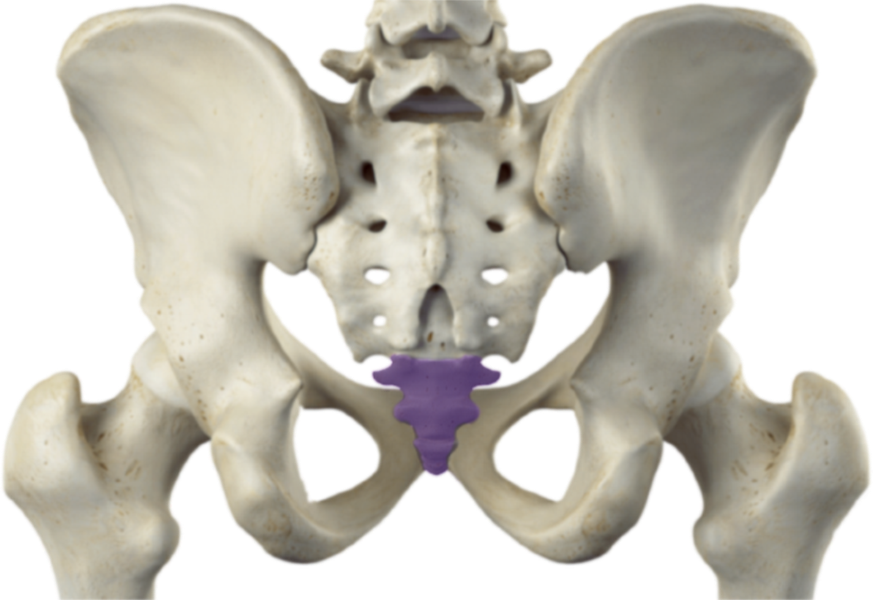
The Tailbone Podcast: Roel Wilbers – Physiotherapist
There are many different ways to approach a tailbone problem
and in almost all cases there is a solution available
Guest in this episode is Roel Wilbers
So, this time is my turn to inform you about tailbone pain. You know me probably as the host of this podcast. Or maybe from my website tailbonetherapist.com (destuittherapeut.nl in Dutch). I work over 25 years as a physiotherapist and musculoskeletal manual therapist, and for the last ten years I specialised in tailbone pain. I did the two courses available in the Netherlands about treating tailbone pain and now launching my own course. With this I like to contribute to the field with new and more manual techniques to treat the tailbone from externally, and also the more holistic approach.
Half of my working days as a physio I only people with tailbone pain and they visit me from all over the country. Next to that I regular have consultations online with people with tailbone pain from abroad. Also I am involved in doing scientific research about the treatment of tailbone pain and will be one of the speakers at the upcoming World Symposium on Coccyx Disorders in Turkey.
In this episode you will hear my take on tailbone pain and what I learned over the years of my teachers and hundreds of patients. Also I will explain how I incorporated my braoder view on health and healthcare and my training in meditation and breathwork into the therapy I offer. In this episode I will provide you also with more background info about how tailbone pain is perceived in the scientific and medical world, what the scientific literature says and how it came about, and also where I think there is something missing in the current explanatory model and approach.

Here I will also introduce to you a for this podcast new expert on tailbone pain: Michael Durtnal. He sadly passed away a few years ago, but I want to share his findings on treating tailbone pain with you and honor al his contributions to the field.
With the info of this richly packed episode, you will get a broader understanding of how to understand tailbone pain, and to make the best choices for yourself in choosing a treatment intervention. For the latter I will dive more into my specialty; the treatment with manual mobilisations from externally and why they work so well but are so rarely applied and advised by doctors.
You can find the podcast in the menu under Podcast as well as the links to the platforms where it is posted.
Resources
During this episode, there were muliple resources mentioned.
1. Michael Durtnall
To start with: the expert I introduce in this episode: the late Michael Durtnall. You can fond more of his work on the website coccyx.org of Jon Miles that I interviewed in episode 4. Click here for the page dedicated to Michael Durtnall.
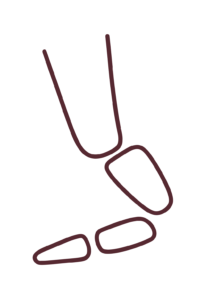
As promised also a visual of what he discovered on many Xrays in sitting position. You see the sacrum as the upper bone and below the in this case three tailbones. The right side is the back, the left side is the belly side. What strikes first is that there is a sharp bend between the second and third bone and this is what is seen as the problem; an increased mobility occuring under pressure from below so an instability. And in some cases it is interpreted not as a joint problem but as a broken tailbone, but as you can see the individual bones are intact.
That the problem is interpreted to be at the sharp angle makes sense because it is here where the pain often also is. But if you look again and can also see, is that the second bone is not flexing forward as you should expect in sitting and the tailbone makes a more or less even curvature forwards, but it is more backwards. Now the bones below get in to trouble because of the pressure below and have to compensate for the lack of flexibility of the bone above. So is it an INcreased mobility where the angle is, or is this the compensation for a DEcreased mobility above. This quite changes the approach of treatment as you can imagine and more about that I explain in the episode, but here the visual. And although it can be as clear as in the picture here (which is of an actual Xray), it is sometimes more subtle, but clearly visible if you look for it. This is almost always missed by doctors unexperienced with tailbone pain so now you know and have Xrays, take a look at if this is the case with your taibone.
2. Exercise
As mentioned I have a lot of exercises and tips on my website.
The tips you can find by clicking here, the exercises over here.
Of course there also was an exercise I gave during this episode, and below you will find a recording of that section so you can easily find it whenever you want:
3. Article
I mentioned the extensive article I wrote about how tailbone is explained now in science and where this model has it’s limitations in my view. I am currently in the process of updating it and when that is doen I will post it here.
4. Course for colleagues
If you are a heathcare practicioner and are interested in learning about tailbone pain and how to treat it yourself, and you have some colleageus that also want to participate, let me know and I am more that happy to arrange a course with you! For more info please send me an email at roel@roelwilbers.nl and we will see how and where to make that happen.
Therapy by Roel
I work in Amsterdam and for appointments you can find me here. I also do online consultations if you want to consult me for your tailbone issues and are not able to come to see my in my practise.
Get in touch
In you have any questions about anything in and outside of this episode, comments or requests, let me know! You can email me through the contact field below or directly at roel@roelwilbers.nl.