8tracks icon Behance icon Blogger icon CodePen icon Delicious icon DeviantArt icon Dribbble icon Etsy icon Facebook icon Flickr icon Foursquare icon GitHub icon Google+ icon Instagram icon Last.fm icon LinkedIn icon Myspace icon PayPal icon Pinterest icon SoundCloud icon Stack Overflow icon StumbleUpon icon Tumblr icon Twitter icon Vimeo icon YouTube icon Yelp icon
DE STIT THERAPEUT

The Tailbone Podcast: Expert Talks

7. Sary van der Hasselt – Osteopath

Sary has a masters degree in osteopathy and she is specialised in pelvic and tailbone pain. She is a last resort for a lot of patients and treats from expansive theoretical knowledge as well as practical experience. She has a very wide approach as an osteopath and shares a great exercise with us in this episode.

Jump to transcript


It is rare that it is only a tailbone issue,
we have to look at the whole system

– Sary van der Hasselt
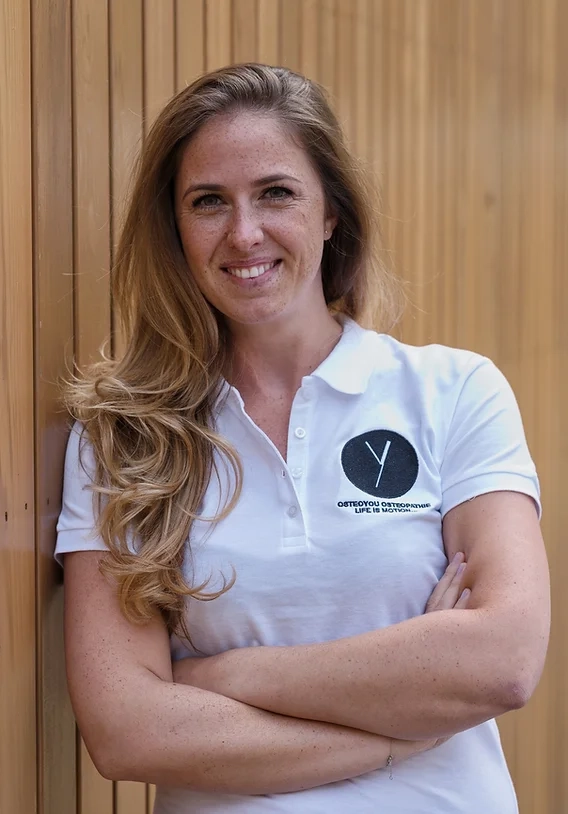
Our guest today is Sary. She is born and raised in Belgium and has a masters degree in osteopathy. Nowadays she lives in and works in the Netherlands and is co-owner of an osteopathy clinic that has several locations. She also teaches at the International Academy of Ostepathy, and through the years has specialised in pelvic problems. A big part of the patients she sees, consult her for tailbone pain. Sary is my personal go-to when my therapy isn’t effective or doesn’t help sufficiently and there doesn’t seem to be a problem that needs medical attention.

As an osteopath she approaches health problems from a wide perspective. Next to the mechanical aspect like the joints and muscles, she also examines and treats the neurological, vascular, visceral and fascia components of problems. In this episode she will explain how she works and what components she sees that are connected to tailbone problems.

As you will hear, Sary is very knowledgable in the theoretical and the practical part of treating tailbone pain and is another true expert on the topic.

You can find the podcast in the menu under Podcast as well as the links to the platforms where it is posted.


Resources

During this episode, Sary gave us two exercises regarding tailbone pain.

1. Squat-sitting

First and foremost, her favorite exercise: squat-sitting. The deep squat pose is sitting with your buttocks on your calfs/heels, the hips open and the feet as flat as possible on the floor. It is a great posture and stretch for the lower back, the back of the pelvis, the pelvic floor and the back fascia. It is also a very natural way of sitting that still normal in many Asian and African countries, or wherever people live more traditionally. We in the industrialised countries are often so used to sitting in chairs that we are not capable of getting into this pose anymore, although as kids we all were capable of doing so.

As the pictures here show; my daugther has no problems with it, where I need to have some support to prevent falling over:
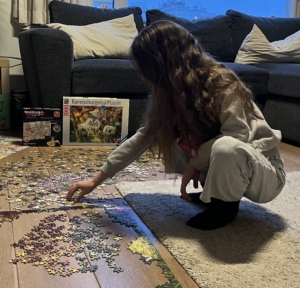
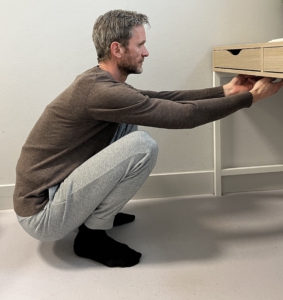
These are the instructions:

  • Sit with your buttocks on the back of your lower legs
  • Put the feet as flat as possible on the surface below
  • Make sure that the hips are open, so the knees are spread and not close to each other
  • If you are not comfortable or stable straight away, make sure you hold on to something so you don’t fall backwards, which especially with tailbone pain is something you want to prevent
  • Don’t torture yourself! Stretch is normal in the beginning, but respect any pain and adjust to that by more support, releasing the stretch on these structures and limiting the time in the pose.

It is a great stretch for often stiffened up and tight areas in and around the pelvis.

It is not too suitable for people that have prolapses (often accompanied by a heavy feeling in the pelvic floor) or the first 2-6 months after delivery. When you feel it is too strainious on your pelvic floor and you have a hard time contain your urine for example, this exercise is probably too early for you; your pelvic floor must be able to hold it. Also take care when you have any knee, hip, pelvic, lower back or other problem or restriction. Be mindful of that what your body is capable of and what not and follow its feedback.

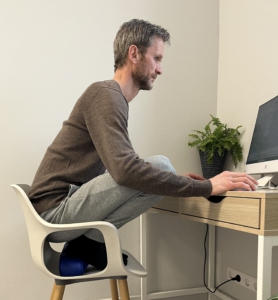
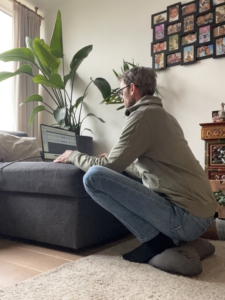
Built it up slowly to get used to the pose and the ligaments, fascia, muscles and all other structures can adapt to a less shortened position again. While training it, start somewhat more on the front of the feet if the stretch is too much for your fascia under the foot and slowly work to more flat contact with the floor. Because it can be quite straining, try the pose first for maybe just seconds at a time and then slowly built up to a level where it finally actually becomes pleasant and relaxed. When you are a bit used to it and more stable in it, you can easily integrate this posture into your daily life by performing activities in squat-sit.

I actually edited some of this episode in this pose and as you can see, with something under my heels until my body is flexible enough to do without.

2. Knees wide

Sary also advised not to cross the legs or squeeze the knees while sitting. Optimal for the pelvis and structural tension is that the hips are open and the knees a bit wider apart. So sit a bit more ‘unlady-like’ to help your pelvis. While lying in bed, you can put a pillow between the knees to reduce pelvic ension if you have pelvic issues.

To open up the pelvis and hips, Sary also shared an exercise. For this you are on your back, with the knees bend and the soles of your feet together so your knees are spread to the sides. This pose is in yoga also known as the reclined butterfly pose. Put a pillow or towels underneath the knees to support the legs a bit, but make sure you feel the stretch in the muscles on the inner side of the thighs, the adductors, that can be tight if you squeeze or cross your legs often.


Therapy by Sary

Sary works at the OsteoYou and at their clinics in Amsterdam-Zuid and Hendrik-Ido-Ambacht. If you are interested in consulting Sary, you can find here here.


Get in touch

In you have any questions about anything in and outside of this episode, comments or requests, let me know! You can email me through the contact field below or directly at roel@roelwilbers.nl.

Transcript

Roel Wilbers

0:04 Welcome to The Tailbone Podcast.

0:06 My name is Roel, and as your host, I bring you only experts, list from most doctors and therapists, unknown problem.

0:12 Let's dive in with today's episode.

0:16 Welcome to a new episode of My Tailbone Podcast Expert Talks.

0:20 And today, my first guest from Belgium, Sary van der Hasselt.

0:24 Sary is an osteopath, and I know her through an osteopath friend of mine, and she's currently probably my first go-to in case I cannot solve the problem.

0:32 And although we both work in a therapeutic field, our different educations make that we really see and approach physical health problems differently.

0:40 And what she does is for me very complimentary to what I do.

0:43 And we will dive deeper into that this episode.

0:46 As a short introduction of my guest today, Sary was born and raised in Belgium, and she felt from early on that she wanted to be in healthcare.

0:53 After exploring animal healthcare, she found out she really wanted to work with people.

0:57 She was drawn to osteopathy because it dives deeply into the interconnectedness and collaboration of different bodily systems.

1:04 She got her bachelor degree for osteopathy a little over 10 years ago, being in Belgium but studying at the University of Wales, and a year later also became a Master of Science in Osteopathy in Austria.

1:15 From there she did several trainings, like in London at the University of Oxford, and became specialized in the pelvic area, for the pelvic floor, but also problems in urogynecology and pre-

1:26 and post-natal problems.

1:28 She works in the practice for osteopathy Osteo-U, where she's the co-owner and this has three locations in the Netherlands.

1:35 Next to that she teaches at the International Academy of Osteopathy, and she's making a course for osteopaths about treating pelvic issues, where there will be a part just about tailbone pain.

1:45 And this is a great addition to the course I am making about tailbone pain for therapists.

1:50 So if you're an osteopath and interested, I will share the link on the web page connected to this episode by the time the course info is available.

1:56 You can find the access to that page in the show notes.

2:00 So I aimed to make this an international podcast, and next to her great expertise, where I invited her for, of course, Sary adds to the international flavor here,

2:09 because so far we've got born in Belgium, did a study at a university in Wales, studied in Austria, in England, and she currently lives and works in the Netherlands.

2:19 So I know of Sary's experience for some years now, and after a few years of referring people to her every now and then, we finally met a few months ago,

2:27 and I already mentioned this in my podcast with Sabine in episode 5, because this literally blew my mind.

2:34 It became a small masterclass for me, and it was actually the first time in years that I talked to someone about this subject that is working in line with my profession and heard so many new things about how to treat and approach tailbone pain.

2:47 It left me inspired and also even a little bit confused about where, even as an expert that sees a lot of people with tailbone problems, and I do that half of my working time,

2:55 and I've read so much about it, how limited my knowledge still is, and there still is a bigger perspective.

3:01 After reminding myself I still have a pretty good success rate of treatment and can help a lot of people where other therapists are not able to, it left me mostly inspired to keep on learning and broadening my scope.

3:12 It is always nice and humbling to see how much more is out there.

3:16 And I think as a therapist it is very important to know what you can do, but as important to be aware of what you don't know and where your skill set is limited.

3:24 And it reminds me of that moment I thought I knew most about therapy and physical problems, and it was directly after my education as a physio.

3:31 And through the years and learning about the immense amount of factors involved in pain and functional problems, I became more and more aware of how little I actually knew and how capable I am even with my highly specialized training.

3:43 And that every answer brings at least one new question.

3:47 So this is also the reason why I love to talk to other experts and started this podcast.

3:52 We can all learn from each other and in that way help the patients that consult us even better, especially in a niche field like Tailbone Promise.

3:59 At our talk, I knew I had to have her on my podcast, and I'm super, super happy she wanted to be my guest here.

4:04 So welcome, Sary.

Sary van der Hasselt

4:07 Well, thank you very much and thank you for the nice introduction about me.

4:10 So my name is Sary.

4:12 I'm an osteopath for 11 years right now.

4:15 I'm originally from Belgium and after my study in Ghent at the International Academy of Osteopathy, I moved to the Netherlands for a pregnancy leave actually back in the days.

4:25 So I dove in directly with a lot of patients, a lot of cases, but I was always even during my study intrigued about the pelvic girdle, the pelvis,

4:36 the pelvic floor, etc.

4:38 So that took me even further along across other borders towards the UK, towards London to be more specific, to get to know even more about the passion that I had.

4:49 Just like Roel said, you think that you know everything once you come out of a study and then you end up knowing maybe 1000 of what it actually is.

5:00 So then you get to see that your knowledge is very limited and knowing even more, that limits even more the thought of, I know everything.

5:10 But yeah, so I'm a very ambitious and a very driven osteopath, because I always want to know more and want to study even more, especially on the human physiology and biomechanics,

5:22 specifically towards the pelvic situations.

5:26 So we're including the urogenicological, so the genital situation.

5:31 So also about testosterone, estrogen, progesterone, etc.

5:35 But also just biomechanics in the pelvic region, and that includes the coccyx or the tailbone.

5:41 So that's also how the patients reach me, because indeed I'm specialized in the female, but also male body, but specifically in the pelvic area.

5:51 And I actually really adore my job.

5:53 I love it.

5:55 I always think or I rethink my life choices in the sense like shouldn't have I done any more like medical studies like a gynecologist or a proctologist,

6:05 as we would say.

6:06 But then on the other side, I really love osteopathy and I really love the vision of an osteopath.

6:11 So yeah, every day I go to work with a lot of, yes, let's do this idea in my head.

6:16 And besides the job of being an osteopath, I'm also a mom.

6:20 So that's my, I would call my second or third job.

6:23 And I also teach in the, as Roel said, at the International Academy of Osteopathy.

6:27 So I teach at the Portain course, a lot of the viscera.

6:30 I'm a part of the visceral team.

6:32 And besides that, I also have some extracurricular courses specifically on the urogenital and the pelvic dysfunctions.

Roel Wilbers

6:40 Hmm, yeah.

6:41 And that she's so passionate about her job and me as well.

6:45 We are here on a Saturday afternoon, actually.

6:47 So we are and then even talking about our passion.

6:52 So so you're an osteopath.

6:54 And before I would like to ask you to explain that to the listeners, because maybe not everybody knows what an osteopath is.

7:01 I would like to get out of the way.

7:03 I think that is kind of going on in the Netherlands about osteopathy and often is perceived as alternative and with less scientifically proven form of therapy.

7:11 And this is mainly because the health insurance companies in the Netherlands file it under alternative, just like the chiropractor and acupuncturist.

7:18 And in itself, all these health care professions, like osteopath, chiropractor and acupuncturist, are professionals that are not doing airy-fairy stuff, are not less educated, do not provide less effective therapy or have a lesser theoretical framework than compared,

7:33 for instance, to the physiotherapy.

7:34 And often they are an alternative or complementary part of the insurance because they don't want to be in regular care for the insurance company because there's a lot of restrictions and limits,

7:43 the freedom for their fare, for instance.

7:45 So I don't know how this is abroad, but at least here for the Dutch listeners, they're very, very knowledgeable, skillful and very, very well trained.

7:52 And a lot of the people in our country don't know that.

7:54 I just want to clarify this for the listeners.

7:57 In our country, osteopathy is a relatively young profession.

8:00 I looked it up and the first osteopath came around 1985 to the Netherlands and physiotherapy was established already since the 1940s.

8:08 So the osteopath came a little bit later.

8:10 So with his long introduction, sorry, Sary, now I will go to the rest of the podcast.

8:13 I'm going to listen more to you than I will talk.

8:16 What is an osteopath and what is osteopathy?

Sary van der Hasselt

8:18 So osteopathy is a form of mineral therapy that considers the body as a whole.

8:25 So we have a very holistic approach and we look at every aspect of the human body or the human physique, naming the nervous system, the vascular system,

8:33 the biomechanics or the parietal system or the musculoskeletal system, but also the visceral system.

8:39 And we actually combine all those pillars as we call it in the osteopathy, so like the osteopathic pillars, and we combine those pillars and we look at the combination of all of those,

8:49 like how is the nervous system evolved in this kind of complaint?

8:52 How is the vascular system evolved in this complaint?

8:55 A good example for this is one of the most seen complaints in an osteopathic practice would be low back pain.

9:01 And we ask ourselves the question, why is the structure painful?

9:04 Why is this patient experiencing such pain?

9:07 Then we have an intake, a very broad intake, we have a broad assessment, and we look at all of the influences going towards that structure that is right now in pain.

9:18 So meaning the fascia, the visceral, so the organs is the viscera, by the way, but also the muscles, how is the posture of that patient?

9:27 How is the blood supply towards that muscle or towards that tissue?

9:30 How is the nervous supply towards that tissue in the sense, is it hypertonic?

9:34 Is it hypotonic?

9:35 Is there asymmetry, et cetera, et cetera?

9:38 So we combine everything that makes a human body and we look at all of the aspects and then we see why is this patient having this complaint?

9:47 So that's actually what osteopathy does.

Roel Wilbers

9:50 And this is about the well-treatedness, a lot broader than, for instance, what we have in physiotherapy.

9:55 I mean, we look at the muscles and the bones and the joints and the nervous system we know a little bit about, the vascular system, nothing, the intestines,

10:02 also nothing.

10:04 And this is all what an osteopath brings to the table.

Sary van der Hasselt

10:06 Yeah, exactly.

10:08 So that's also why quite a lot of physiotherapists, well, I say quite a lot, I don't know the exact percentage, but a lot of physiotherapists are also intrigued about what an osteopath does,

10:17 because you have quite some knowledge as a physiotherapist or as a manual therapist, because we also see quite some manual therapists or, for example, also pelvic physios that start the osteopathy study,

10:28 because they're really intrigued about, okay, we know a lot about the muscle system, we know a lot about the bones and the joints, et cetera.

10:35 But the viscera and the vascular system and the nervous system, what's up there?

10:39 Why is it that if you treat someone's, I would say diaphragm, stomach, esophagus, et cetera, that their upper back pain would get less or that their terrestrial mobility will enhance?

10:51 Why is that?

10:52 So there's a lot of people being triggered about that, because it's a lot more holistic, and we base actually all of the osteopathy treatments on the anatomy,

11:01 on the myomechanics, but also on the physiology.

11:04 Why do we do this technique?

11:06 What's the reason behind it?

11:07 That's also what I think that makes osteopathy pretty strong, because it's always based on what we already know, what also the medical field already knows.

11:17 So indeed, it's not a fairy dust or anything like that.

11:22 Yeah.

Roel Wilbers

11:22 It's often like because it's like an alternative care for health insurances, some people don't really understand maybe from there, what an osteopath does, but it's a really,

11:31 really broad approach on problems.

11:33 And I always was intrigued by it.

11:35 And it's a study that you can do also after physiotherapy.

11:38 And there's quite some osteopaths that were physiotherapists before and actually went into osteopathy afterwards, at least here in the Netherlands.

11:44 Yeah.

11:45 And in every profession, only a small percentage of people seem to have an expertise or at least knowledge about the tailbone.

11:52 Do you recognize this also within the osteopathy?

11:55 What did you learn in your studies about the tailbone and its treatments?

Sary van der Hasselt

11:59 Well, good question.

12:01 So during, I would say, the basic education of osteopathy, that was already a couple of years ago for me, but not that long ago.

12:09 So during the basic education, we see the basic anatomy, we see the biomechanics for the coxis, but no specific treatments, I would say.

12:18 So we assess it, we check the movement, we check if it's, I would say, blocked, if it's hypermobile, if it's hypomobile, but that would be it, I would say,

12:27 in the basic education.

12:28 But in the, I think it was almost the final course weekend that we had over education.

12:35 We also have a course, it's called Internal Techniques, so it's gynecology, as we call it in general, but it's not really a gynecological situation.

12:43 But we have all of the internal techniques for the pelvic floor and the pelvic organs.

12:47 And at that point, we got a glimpse of the real coxis assessments and treatments.

12:53 So that means internal and external approach.

12:56 And it was actually a sort of an epiphany that I had at that point because I was also a coxis patient myself.

13:02 But I thought like, oh, it's actually pretty normal that sitting hurts, that standing up might hurt, I cannot really sit for a long time.

13:09 But during that course, the lady was teaching the course, a very good teacher also.

13:13 She said, oh, is there some people here experience pain?

13:17 And I was like, yeah, well, actually, I'm that person.

13:20 So I was really intrigued that actually there is some sort of treatment and not the normal classic osteopathy treatments that we don't see in the normal courses,

13:29 and that's specific for the tailbone and internal and external.

13:33 But that was only a one day course, but it intrigued me so much that I started looking at even more once I graduated.

13:41 So I did quite some extracurricular courses afterwards, and we do have some.

13:45 The only thing that I'm seeing right now is that in the Benelux, there's a lot more courses coming.

13:51 But I would say like 10 years ago, we only had really good courses, I would say in France and in the UK, so in London.

13:58 So I thought, okay, let's go, let's go to London.

14:01 So I did, I would say, almost every extracurricular course that I had, I did in London with people that are very, very much specialized in this area,

14:09 but also in the urogenital area, in the coccyx area, in the pelvic girdle.

14:14 So yeah, that's how I discovered that there was more.

14:16 Yeah, let me see.

Roel Wilbers

14:18 I think you touched on also a nice point that some people think it's normal to sit with pain and to have some pain lowering, sitting and stuff around the coccyx,

14:26 which actually shouldn't be.

14:28 And you even experienced that as a therapist in training back then, I guess, but still.

14:33 You mentioned that you learned in your basic education, the assessment of the coccyx, like how it's moving and what techniques were this?

14:40 What is internal techniques or from external?

Sary van der Hasselt

14:44 So we start with the external techniques.

14:46 I would say if you get the module that contains sacrum, but also containing cranium, so in the sense of all of the dura and the meninges, you also see the coccyx.

14:57 And the assessment, so I would say the basic assessment would be during sitting, you would sit on the treatment couch, you would place the hand underneath the coccyx,

15:07 and the fingers would be side to side, so lateral, lateral from the coccyx itself.

15:11 And you would ask the patient for a inhalation and an exhalation to see what the pelvic floor is doing and what the coccyx is doing, but also lateral movements in the sense of the patient will move with the body,

15:23 so the buttocks will stay seated on the couch, also the hand will be in the same place, and you would move, we would call it side bending,

15:30 so you would move to the right side and then to the left side.

15:32 And we would see what the coccyx does, what kind of movement it does, because the spine moves, the sacrum moves, so the coccyx will move also, and we see if the coccyx has a normal biomechanical pattern,

15:43 if the patient does this kind of movement.

15:44 Also, flexion and extension of the spine and see what the coccyx does.

15:48 So that's the basic assessment.

15:50 What we can also do is try to, I would say, locate the most distal point of the coccyx itself, how the sensitivity will be, and also once again inhalation,

16:01 exhalation, and see how the coccyx moves itself.

16:04 So we need to have an expansion.

16:06 If not, we know, or it's a pelvic flirting, or it's a blocked coccyx, or it's a hypomobile coccyx.

Roel Wilbers

16:14 That's a lot more than we physios already do, because normally if you go to a regular physiotherapist, here in Holland at least, and we're pretty well trained in the world,

16:21 99% of therapists will say, I cannot do anything with it, right?

16:25 And they will look at the pelvic joints and the lower back and those kinds of things and start treating there.

16:29 But the average, let's say average or basic trained osteopath already has some knowledge about examining at least the coccyx.

16:35 But as I understand you correctly, there's not a lot of treatment techniques that are actually available.

Sary van der Hasselt

16:40 Yeah, exactly.

16:41 Well, I would say very basic and you're not really specialized in that area.

16:46 You can do something with it for sure.

16:48 It's not that every osteopath will be like, oh God, I have no clue what's going on here.

16:53 So yeah, we have the basic knowledge, but it does need some more, I do have to say.

16:58 So you can assess them pretty good.

17:00 But indeed, and the techniques, it's a bit more specific.

17:04 You have lateral-lateral techniques, you have what we call de-coaptation, depending on what the position of the coccyx would be.

17:11 We have a local mobilization of the coccyx, that could be externally, that could be internally, but it's rarely that it's only a coccyx issue.

17:20 We always have a look at the whole system, we have a look at the tensegrity system, what's pulling, what's pushing, why is the coccyx acting like that?

17:29 Why is it not moving or why is it moving too much?

17:32 In a sense of, is there a hypomobility or is there a hypermobility?

17:37 Most of the time, if there's a hypermobility, because that's the most seen option statistically with people with coccydynia.

17:44 But with a hypermobility, is there a case of hypomobility somewhere else that is compensating to that kind of movement?

17:51 So we want to know what's going on, what's the case, and then we adjust our treatment.

17:56 Because it could be that the coccydynia, so that the tailbone pain is coming from a sacral dysfunction or an asymmetry in the pelvic floor.

18:05 And that's why the coccyx is acting the way it is.

18:08 So it always depends on what's going on, if we need to treat the coccyx itself very locally or not.

18:15 Because in some people, I rarely touch the coccyx, and they have a lot of improvement from coccyx pain.

18:20 But every case is completely different on that part.

Roel Wilbers

18:24 And this also again addresses how osteopaths approach problems, right?

18:28 To keep looking at the wider spectrum of things.

18:31 So you use the terms hyper and hypo mobile.

18:34 So that means for the listeners too much or not enough movement, right?

18:38 So hypo is a restriction of movement and hypermobility is too much movement.

18:43 And what is the thing you see most?

Sary van der Hasselt

18:46 Ooh, I would say it's about 50-50 for the moment.

18:51 But also the causes of the tailbone pain would be 50-50 spontaneous.

18:58 Or trauma-related.

18:59 So yeah, I would say 50-50.

Roel Wilbers

19:02 Okay, so sometimes you see that a tailbone is too rigid, too hypo-mobile, not enough mobility, and sometimes there's an excessive mobility, too much.

19:11 But you also addressed, and this is right in the line of where I'm doing research on, that if there's too much movement, sometimes it can be that there's a restriction of movement somewhere else.

19:22 So in my theory, at least, and I don't know if you agree on that, is that if there's an excessive movement, often this is a compensation for a lack of movement somewhere else.

19:32 So for instance, if I have a knee which is not moving correctly, and I'm limping, then I have to have more movement in my hip, or maybe in my pelvis or lower back to compensate for my need to keep on walking.

19:43 Is that also when you see an excessive movement, that there's often a restriction in movement somewhere close by?

Sary van der Hasselt

19:49 Yeah, exactly, yeah, exactly.

19:51 That's why if we assess the coccyx, we want to know what the whole system is doing.

19:55 So everything that is attached to it has an influence on the movement.

20:00 We want to know what's going on there.

20:01 So I want to know the movement of the sacrum.

20:03 Even though it is a very small movement, it's only 4% or something, the mobility of the SI joint.

20:09 It is very small, but every small movement will define also the bigger movements.

20:16 So the sacrum is of importance.

20:17 Is there any dysfunction there?

20:19 Also the innominate or the ilium, what they call it, but also the hip joint, the lower back.

20:24 So it's actually the whole pelvic girdle that's very important, but also the spine mobility.

20:29 How is this person moving?

20:30 How is the whole spine?

20:31 How is the traction from the rest of the spine towards the coccyx?

20:35 So indeed, yeah, I want to see what the rest is doing to see why is this coccyx reacting that way.

Roel Wilbers

20:42 And for the listeners also, this is already a really, really nice example of how different therapists approach a problem.

20:49 If you have a specialist or specialized on coccyx pain, they will do different things than people that have no expertise on it.

20:56 But also the training and how you see the rest of the system is very, very important.

21:01 So if you go to one therapist, it doesn't mean that this therapy doesn't work.

21:05 There's multiple ways of approaching it.

21:07 And you heard the pelvic physiotherapist in these episodes that go a lot from the pelvic floor muscles, right?

21:13 I come at it a lot of times more mechanical.

21:15 And Sary adds to the table also the viscera and the fascia, the tension and how everything moves.

21:21 And even within professions, I mean, she mentioned that the pelvic joint is just moving like four degrees or something.

21:26 There's a lot of discussion also there, like 50% of all physiomanual therapists say it's not even moving.

21:31 And the other half say it is moving and even there's no consensus.

21:35 So it seems we all learn the same, but it's really not the case.

21:39 So we have a basic training, which is the same.

21:41 And then there's so much individual knowledge, expertise, experience, and so on and so on.

21:47 Do you recognize Sary?

21:48 Is that correct what I meant?

Sary van der Hasselt

21:49 Yeah, exactly.

21:50 Yeah, exactly.

21:51 Totally.

21:52 Good.

Roel Wilbers

21:52 Back to the coccyx.

21:53 I once had an interview by a newspaper that wanted to write an article about coccyx pain, and they asked me this question.

21:59 I was treating tailbone pain for some time.

22:01 Why do we have a tailbone?

22:03 I was kind of, I never thought of that.

22:06 So maybe the osteopaths have the answer, but I thought that was such an interesting question, which I never thought about stupidly enough.

Sary van der Hasselt

22:13 It is indeed a really intriguing question and a good question, because we always ask that question also in the osteopathies study.

22:20 Why is the structure formed in a specific way?

22:24 Why do we have, I would say, a rib that is formed in a specific way?

22:28 Why do we have a stomach that has this kind of form?

22:30 Why do we have a ligament that is there?

22:33 It always still has a certain function, even though it is coming from the animal kingdom that we once were.

22:42 It is, of course, a remnant of a tail, so that's why it is a tailbone, and it was a balancing tool, so a balancing structure.

22:51 Actually, right now, the coccyx still has a role in balancing function in our pelvic floor, but it's also a structure that has a lot of attachments.

23:01 For example, ligamentous attachments, the filum terminale, as we said, the corda equina, so it's actually more of the maningus structure, also nervous structures going towards there,

23:13 but also muscular structure, think of the glute max, our biggest muscle in our lower limb, but also the pelvic floor muscle, the levator any muscle.

23:23 So it has a lot of attachment points.

23:26 That's why I think this structure, even though it's a remnant, we would say it has still quite a lot of function in our body.

Roel Wilbers

23:34 And like the filament terminale and the corda, that is more of the central nervous system, the end of the spine for the listeners that have no magical education.

23:44 If we come from the theory that it was like a tail before, and this is like a little last part, often in medicine, sometimes you see it's like,

23:51 oh, it doesn't have a function anymore.

23:52 We just take it out.

23:54 Like we all with the appendix and those kind of things or the tonsils, right?

23:57 So although we cannot really explain it, it does have a function.

24:01 And I think also a very nice thing that you say, form and function are very, very interconnected.

24:06 And what I read in several articles that the tailbone also has a function in sitting, that is kind of like the tripod.

24:12 You sit on both sitting bones and the tailbone.

24:14 But personally, I doubt that, because if you look at the structure of the tailbone, it is not really made to bear any weight because it's pretty pointy.

24:22 It's not very stable, like the sitting bones.

24:25 So I don't know how you see that, but I'm down to try for Terry.

Sary van der Hasselt

24:29 I think it's not to compare with the sitting bones or the tuberosities.

24:34 We cannot really compare it with that.

24:36 But also the thing is, we were not really made to sit on chairs the whole time.

24:42 We were made, you can sit, but the sitting would be like the squatting position.

24:48 Then also the tailbone would have a stabilizing function also in the pelvic floor muscles.

24:54 And it would contain that the pelvic floor would not keep on stretching.

24:58 So I think it does have a stabilizing function.

25:01 But if we look at how we are living right now, I would say, okay, tailbone, not the best function, because we're sitting on it the whole time,

25:09 because we're contacting it with the seating surface.

25:12 So I still think that it has a balancing function, because there's a lot of attachment going towards it.

25:18 And if you take away the attachments, where's the anchor point of all of those structures?

25:23 So I totally get your argument, too.

Roel Wilbers

25:27 And the tripod is fully for sitting, right?

25:29 And I think it's very interesting, like if we go back and we still see this with ancient cultures, right?

25:33 They sit in this squatting position, like with their feet flat and all the way down.

25:37 I never thought of that, but the tailbone definitely has a function there as well.

25:41 I think up to a century ago, we didn't have any sitting work almost at all, right?

25:45 We didn't have any computers and even cashiers in supermarkets and stuff, they were all standing.

25:50 So it's quite of a new thing.

25:51 And I think definitely we're not developed or made for sitting on a chair, which unfortunately we do nowadays.

Sary van der Hasselt

25:58 Yeah, true.

25:58 The funny thing is that I had a, I would say a conversation with a colleague and he did some, I will call it internship or some voluntary work in Africa with some tribes.

26:09 And I asked him, like, how do those people sit?

26:12 What do they do?

26:13 And also ladies who deliver babies and how do they carry their babies?

26:17 And what kind of complaints do those people have?

26:19 And he said, like, low back pain does not occur there.

26:22 It's just not happening.

26:23 But if they want to sit or they want to rest, they're going to squat.

26:27 They're going to indeed like flat feet on the floor and they're going to squat really deep down.

26:31 And that's their resting position.

26:33 But that position is amazing for a body.

26:36 Our body loves it doing this.

26:38 And we are made to sit in that position.

26:40 Also, if you look at where we came from monkeys, they sit in like a squatting position.

26:45 So we're not evolved that much in the sense like that we can't do it anymore.

26:51 It is the best thing that we can do.

Roel Wilbers

26:53 I cannot do it without falling over.

Sary van der Hasselt

26:55 Well, that's the thing, because we don't do it anymore.

26:57 We're not trained to do it anymore.

26:59 So our muscles and our joints are not used to that movement anymore.

27:02 But it is amazing to do.

27:04 And if you tell people to do it on a daily basis, it's one of my favorite things to tell people is to squat more and to be more in a natural,

27:14 physiological, biomechanical position for our pelvis.

27:18 And our pelvis will adore it.

Roel Wilbers

27:20 Hmm.

27:21 What I know of like the ideal defecation position, if you have the number two, the knee is up, right?

27:27 It's kind of like this deep squatting.

27:28 And this is what we hardly ever do anymore.

27:31 And even with labor, lying on your back was, I think I read it was by some kind of French emperor who did that because he could see his sons being born,

27:40 that the lady was put on the back.

27:42 But that's also not the most natural position for a pelvic floor, right?

Sary van der Hasselt

27:45 Actually, I think they call it the prone, so the dorsal position, so being on your back with your legs up.

27:51 It is also for a medical reason that they introduced it.

27:54 So if you need some sort of intervention that they can reach right away.

28:00 So it is very much a medical standpoint that they developed that laboring position.

28:06 But it's for sure not the best laboring position.

28:09 They do adjust it with a lot of, I would say, the angle that you lie in as a laboring lady, but also how high the knees are up,

28:18 how they are assisting you during the labor.

28:21 So they did a good job, and it's not flat on the back anymore.

28:24 So it got better, though.

Roel Wilbers

28:27 I'm not too updated there.

28:28 So you've been there not too long ago.

28:32 So it's like, yeah.

Sary van der Hasselt

28:33 No, exactly.

Roel Wilbers

28:35 Yeah.

28:35 So inspiring.

28:37 I'm definitely going to try the squatting pose.

28:38 I'm going to exercise with it a little bit more the next few days.

28:42 So for the listeners, just if you don't understand fully, it's the feet flat and then kind of all the way down, sitting with your buttocks on your Achilles tendons,

28:50 almost on your knees.

Sary van der Hasselt

28:51 Also, knees quite wide.

28:53 The knees are not close to each other.

28:55 And at first, if you start practicing it, please hold on to something because at first, the balance would be a bit of a thing.

29:01 Also, flat feet will be a bit of a thing.

29:04 So you have to evolve in that exercise or in that position.

29:07 So grab on to something, the table, the couch or whatever, and start doing it with just like a couple of seconds.

29:14 And then you start building it up towards more time.

29:17 And then after a while, you'll see that it's actually pretty comfortable to sitting.

29:21 Also, depending what's the quality of your knees, what's the quality of your ankle joints, it all depends though.

29:26 But for example, if you have pets, if you have small children, please just do the squatting, play with the children during squatting, or like pet your dog or your cat during squatting.

29:36 It's really easy to integrate in your daily life also.

Roel Wilbers

29:40 Yeah.

29:40 And very good addition there.

29:42 If you fall over, you kind of make sure that we, tailbone therapists, have more work.

29:47 So this is the one thing you land on.

29:50 So be careful there, especially if you're already tailbone problems.

29:53 So you became a specialist on the pelvic area, but also on the tailbone.

29:58 Do you have any idea about what the percentage of people is that you see that have tailbone problems or tailbone-related problems?

Sary van der Hasselt

30:05 I will think that the percentage right now, specifically tailbone, would be around 40.

30:12 Because the practice in general with me is specialized in pelvic dysfunctions.

30:17 I would say you can compare it to a pelvic physio, but then the osteopathy department.

30:22 It's not completely the same as a pelvic physio for sure, but we've worked very complimentary to each other.

30:28 So we see quite a lot of complaints like pelvic girdle pain, pelvic instability, incontinence, pain during sexual interaction or intercourse, scar tissues, endometriosis, pre and postpartum,

30:41 etc.

30:42 But also think of traumatic falls or a pain after a fall of a bike or a car accident or a fall on the sidewalk.

30:53 I saw quite some people who have that kind of trauma and they had some pelvic dysfunction due to that or to the other things that I just said.

31:01 So we see a lot of complaints and most of the time, the coccyx is integrated in all of that story, I would say.

31:08 But specific coccyx, I would say around 40 and then the rest is most integrated in the rest of the story or the other complaints that they have.

Roel Wilbers

31:17 And also for the listeners, we already mentioned in previous episodes that the pelvic physiotherapist is the one that does internal work as well and the pelvic therapist often doesn't.

31:27 But the osteopaths have these skills as well.

31:29 So they're pretty close and complimentary.

31:31 And then the 40% Sary, is that the people that come in because of coccyx pain, actually that's the question they ask you.

31:38 And there seems to be more patients that have a coccyx involvement.

31:41 Is that what you say?

31:42 Or is the coccyx involvement in the patients that you see, although they're even don't come in because of coccyx pain primarily around 40%?

Sary van der Hasselt

31:50 I would say the primary coccyx patients, so indeed they come in and you ask them, where can I help you with?

31:56 They would say, I have coccyx pain.

31:58 I think that's around 40%.

32:00 And then you also have the different, I would say, secondary complaints that come with it, or maybe there's another primary thing, but they're coming for coccyx pain.

32:08 And then you have the secondary coccyx pain patient.

32:11 They would say, I have pelvic floor dysfunctions, I have spasms, I have an incontinence problem, or I had a really big tear due to my delivery.

32:21 And, oh yeah, by the way, I also have coccyx pain.

32:24 Or now that you mention, or I start asking my questions, and then I also ask, like, how is your coccyx?

32:29 How is sitting?

32:29 How is cycling, for example?

32:31 And they're like, oh, it is very sensitive.

32:33 It's not very comfortable for me.

32:35 Or maybe also during defecation, so going to the toilet will be painful or more difficult, etc.

32:41 So, yeah, I would say the primary would be 40.

Roel Wilbers

32:45 And do you always see that if people have a coccyx problem, that they also have coccyx pain, or do you see sometimes there's a dysfunction of the coccyx,

32:54 but there's no local pain?

Sary van der Hasselt

32:56 Yeah, yeah, true, true, true.

32:58 I would say if we have any dysfunction towards the pelvic girdle, so towards the sacrum to be more specific, but also I would say in asymmetry in the pelvic floor,

33:09 the coccyx will be involved because of the attachment that it has, because of the link in the movement and the biomechanics that it has.

33:16 There will be a dysfunction, but it doesn't always relate to pain, as you said, indeed.

Roel Wilbers

33:22 So sometimes you see a coccyx kind of problem without coccyx pain, but it is involved in problems in the area.

33:29 And then it doesn't directly mean that the coccyx is the only reason and you just treat the coccyx and it's gone, right?

33:35 But it's part of the problem.

Sary van der Hasselt

33:37 Yeah, exactly.

33:39 They're coming for a completely different thing.

33:41 But as I assessment, I would say the external and the internal examination, I do have a feel at the coccyx and most of the time like, well,

33:50 there's something there.

33:51 They're like, oh, yeah, yeah, yeah.

Roel Wilbers

33:52 Oh, yeah.

Sary van der Hasselt

33:52 Is that my coccyx?

33:54 Because most of the time, or some people are not always aware that that pain is coming from their coccyx.

34:00 They just said like, oh, it's pain in my buttocks, for example, or it's a pain in my pelvic floor, or it's an anal pain or something that they would describe.

34:07 But they don't always say that it's a coccyx pain.

Roel Wilbers

34:11 And there's also a lot of people that actually come to you because of coccyx pain, right?

34:16 Are you the first one that treats them, or do you often see that they went to this trajectory already of doctors?

Sary van der Hasselt

34:23 I would say most people reach me by the end of their trajectory.

34:27 So I would call it, and also the people or the patients tell me I'm their last resort.

34:33 They tried a lot.

34:35 They tried the classical medical option.

34:38 They saw a lot of physiotherapists, mineral therapists, but also pelvic floor therapist.

34:43 And some of them did already have quite some pain relief or not at all.

34:49 It really depends on the patient.

34:50 But yeah, I'm more by the end of the trajectory for sure.

Roel Wilbers

34:54 Yeah.

34:55 And you think that's where you should be or?

Sary van der Hasselt

34:58 Oh, I don't mind, I have to say, because that means that they already did quite a lot of things in the sense of all of the structural medical imaging is being done.

35:08 Mobilizations were being done, but local mobilizations were being done.

35:12 Some people, but not all of them, saw pelvic floor physio.

35:15 So they know how to sit, they know how to go to the toilet, they know how to breed, they know how to move.

35:20 So well, that lightens my job, I would say.

35:24 So that means that I can do all of the manual stuff, but they know all the tips and tricks and advice.

35:29 But not all of the people had that trajectory and saw that amount of people.

35:33 So it very much depends.

Roel Wilbers

35:36 Yeah.

35:37 The reason of the remark was also because it's kind of frustration of a lot of, I mean, at least me as therapists, that we come after like this whole medical examinations were done,

35:47 which often is not really beneficial to the dysfunction in the system itself, where often the problem lies, right?

35:53 So I wish that we as therapists would be like a little bit earlier on in the trajectory and consulted earlier, because we can help so many people and make sure that they don't have to go through like this whole medical trajectory.

36:06 But that's why I kind of like that one.

Sary van der Hasselt

36:09 True, true, very much, very much.

36:11 I think that it would help quite a lot of patients exactly actually what you're doing, just like helping the awareness and to see there are a lot of options.

36:20 And you can do tons with it.

36:22 And it's not only the classical method that you have to follow.

36:26 So you have options.

36:27 So it's really good that just the awareness is more about options for treatments.

Roel Wilbers

36:32 Now, and I also recognize what you say.

36:35 If they were already at a pelvic physiotherapist, I know the pelvic floor is checked by someone who knows it better than me as a manual therapist, right?

36:43 So it definitely has its advantages.

36:45 You also mentioned imagery, right?

36:47 X-rays and MRI scans and those kinds of things are done.

36:49 How important are those for coccyx pain for you?

Sary van der Hasselt

36:53 Well, especially post-traumatic, so post-fall accidents, anything that had a hit on it, I love that the people had some imaging done to see, is there a fracture?

37:07 Is there a hematoma?

37:09 So is there blood?

37:10 Is there some inflammation or also infection going on?

37:14 Is there swelling also there?

37:16 Is there a dislocation?

37:17 So is it completely inverted, for example?

37:20 With most people, if they had a quite severe fall, you can see that the coccyx is dislocated, so the ligaments were torn and it is completely inverted,

37:29 so it's completely up towards the rectal canal.

37:32 And it is very good to see what the situation is, to be more specific, and also to see if there is a fracture, if we have some bone damage,

37:42 then we know what to treat or what not to treat.

Roel Wilbers

37:46 Do you often see things on imagery which kind of changes your approach, or like fractures or tumors or those kind of things?

37:54 Is it often that you actually see something there and you say, okay, I'm glad I know this now?

Sary van der Hasselt

37:58 I would say the dislocation, because with the dislocation, you tear or a very big elongation of the ligaments, but most of the time a tear or partial tear of the ligaments,

38:08 and you see that the coccyx is inverted, so it collapsed on the inside, but then you know even though you're going to correct it, and you're going to treat the tissues around it,

38:17 maybe there's some post-traumatic inflammation afterwards, so we want to treat all of the tissue, but we know that a part of the stability is gone of the coccyx.

38:26 We have to take into account that being completely pain-free, I cannot reassure you that.

38:33 It is good to get a very realistic image for the patients.

Roel Wilbers

38:39 And do you also sometimes ask for that if the imagery was not done?

Sary van der Hasselt

38:42 Yeah, when it's post-traumatic, I ask them, did you get some imagery done?

38:46 If they're telling me no, it also depends on how long ago was the trauma, was it a fall or the incident?

38:52 Because, for example, if they're telling me it's 20 years ago, yeah, we cannot really see that much on it anymore, maybe if the position of the coccyx is a bit different.

39:01 But yeah, it depends on the timeframe, I do have to say, but I do love imaging.

Roel Wilbers

39:06 Is there a certain limit that you say like, okay, this long ago the trauma was, and then I'm not directly that much interested in imaging, and up till this moment,

39:14 I really want to know?

Sary van der Hasselt

39:16 When it is very close by that it happened, I would say two weeks a month or something like that.

39:23 I do prefer the images.

39:25 I would say if it's more than a year and a half ago, I don't know if it has more value to the treatments.

Roel Wilbers

39:32 But less than a year, you still want to see them.

Sary van der Hasselt

39:35 Yeah, but also depending on the complaints of the patient, if they're telling me it is a sharp pain, it is constant, it is still progressive comparing to where I came from,

39:44 I want to know what's going on on the inside.

Roel Wilbers

39:48 So what are the main problems that patients with tailbone problems present themselves to you with?

39:54 What are the symptoms?

39:55 What do they say to you at the intake?

Sary van der Hasselt

39:57 Well, it depends on a primary or a secondary coccidinous or tailbone pain.

40:03 If we look at the primary tailbone pain, it will be pain during sitting, pain during cycling.

40:09 Most of the time, it is a nagging pain constantly.

40:12 Once they try to stand up or they want to stand up, it is a sharp shooting pain coming up.

40:18 And once they start moving, it takes a little while for the pain to disappear.

40:22 That's also a cue for me.

40:24 If they stand up, it is more pain and then it is a lasting nagging pain for a couple of minutes or maybe even half an hour with some people.

40:34 I do know this is a coccyx dysfunction.

40:37 But in some people, they tell me if I'm sitting, it is painful, it sounds like a coccyx dysfunction.

40:43 But once I stand up and the pressure is off the coccyx, the pain is completely gone.

40:48 So then I know, hmm, maybe there's something else being triggered or triggering that coccyx itself.

40:53 So I would say the pain during sitting for sure, the stabbing pain or the sharper pain during standing up, it keeps snagging on for a couple of minutes after they stand up.

41:02 But also cycling will be hard to do.

41:05 Maybe during defecation would be painful, or they would feel some kind of a stuck feeling when the stool needs to pass, because the coccyx could, I would say,

41:14 poke into the ampulla recti.

41:16 So that's the part where the stool is being contained, and then you have to push it out, I would say.

41:22 So we can push against the exit of the colon.

Roel Wilbers

41:26 The anus is just in front of the coccyx, so if the stool passes, there's going to be pressure on the coccyx, or if the coccyx is pressuring because of a disposition to the front,

41:36 that can interfere or interconnect with each other.

41:38 Yeah, so please continue.

Sary van der Hasselt

41:40 Exactly.

41:41 But also, when they had a fall and they have a fall exactly on it, so it would be like a constant pain, I would also ask them if you're indeed lowering down,

41:50 if you're pulling something up, but also for the ladies, for example, pregnancy-related, delivery-related, how did that go?

41:58 Did you have any complaints there?

42:00 Because some ladies, they have during their pregnancy, because of the relaxant, the hormone that makes sure that everything is able to stretch out for the pregnancy, for the growing uterus,

42:10 the pelvic girdle is also settling because of the relaxant, that also the coccyx is being pulled, so they could also have some tailbone pain.

42:18 Or during a delivery process, that they had a snap of the coccyx, or that the coccyx was inverted and the baby got a bit stuck in there,

42:28 so it pushed because normally during a labor process, the coccyx will go to the back or it will extend more to make space for the baby to come through because the pelvic floor is elongated three times the normal length during a labor process.

42:43 So it will pull the coccyx quite strongly, but also it will open up the whole pelvic floor.

42:49 So, yeah.

Roel Wilbers

42:50 And what you said like the primary coccydynia, so that's people that actually come in with tailbone pain and not the secondary that is more like they come in with a different question and there seems to be a tailbone dysfunction involved,

43:01 right?

Sary van der Hasselt

43:02 Yeah, exactly.

43:03 So they will come in, I would see the most patients would be a very tight and stiff pelvic girdle.

43:09 For example, people also with hip complaints or hip issues, but also people with a lot of visceral, so intestine issue or urogynecological complaints, and you would see that the pelvic floor is reacting on those urogenital or visceral complaints,

43:27 I would say like the gastrointestinal tract, that the pelvic floor is reacting, for example, with spasm, with a hypertonic tone, and then it will pull on the coccyx and they will have then a secondary coccyx pain.

Roel Wilbers

43:41 Yeah, yeah.

43:42 So what you listeners already hear is that there's so much factors, but also so much knowledge out there, which is quite reassuring, which can influence the coccyx and the coccyx function and lead to pain or treating that can solve the pain.

43:58 So often, and I know how you experience this in the practice, often what I experience and what I hear from colleagues is that patients are not partly or maybe misinformed by doctors or therapists about their tailbone pain.

44:12 Like what I hear a lot is like, these things last a long time, there's nothing we can do about it.

44:17 Do you recognize that when people come and visit you for the first time, or do you feel that they have quite some knowledge and good information already?

Sary van der Hasselt

44:25 I do feel that the misinformation is actually not too bad in my case or in my practice.

Roel Wilbers

44:31 Before they visit you?

Sary van der Hasselt

44:32 Yeah, I would say the first time that they visit me, they're actually already quite well-informed because they saw already quite some therapist and also because of I would say chat CTP and artificial intelligence and stuff like that.

44:45 So they already looked up quite a lot.

44:48 So it is okay.

44:50 I do have to say, yeah.

Roel Wilbers

44:51 Also, that's because you're also at the end of the cycle often, right?

Sary van der Hasselt

44:54 Exactly.

44:55 Yeah, exactly.

44:56 Yeah.

44:57 I do have to say that they knew a lot about the, I would say, the position of the coxas.

45:02 Maybe it's a bit crooked.

45:03 It's pointing to one side, to the left side, to the right side.

45:06 It is inverted.

45:08 Maybe how the mobility is, because the other therapists already informed the patient about it.

45:12 But my part or my job in this would be, I inform them about the holistic view about the tailbone.

45:20 Even though they had their coxas adjusted or manipulated or whatever, that the pain is still present and that we will be looking at the whole biomechanics or the whole influence coming from the other system,

45:31 meaning the pelvic girdle, the spine, the hip joints, the lower back, the dura, so the whole pull coming from up.

45:39 And we also want to know if there is a pull, is there a compression, going towards what is actually a pretty tiny structure in our body, but it can create quite a lot of pain,

45:49 like why is that pain still there?

Roel Wilbers

45:53 To give a little bit of an idea for the listeners, because you treat the joints, you look at the muscles, you look at the nervous system, you look at the blood vessels,

46:03 you look at the internal intestines, you look at the fascia, the connective tissue and the tuning of the nervous system, right?

Sary van der Hasselt

46:10 So this is all interconnected.

46:13 And that's the fun part or the really nice part on our body being a body.

46:18 Everything reacts on each other.

46:20 So that's what makes us talking, moving, sleeping, doing everything that we do is because our physiology, our anatomy and our nervous system, for example,

46:32 it's just working all together.

46:34 And that will make sure that we can do everything that we'd like to do or that we are doing at the time.

46:39 But also then during treatment, we take into account all of those factors.

46:44 So what is every factor in our body doing?

46:47 And how is it for your pain complain?

46:50 How is it affected?

Roel Wilbers

46:53 And I think most of the listeners will recognize this in the medical field that there's so much specialization.

47:00 The urologist doesn't know what the cardiologists do and the rheumatologist, and there's so many specializations that this is kind of rare what the osteopaths have and do in the medical field,

47:11 in the biomedical field, that they kind of keep the overview.

47:15 The osteopathy kind of combines a lot of things, which in medical care we see often is divided into several specializations, right?

47:22 I think it's rare.

Sary van der Hasselt

47:24 And it is also what makes a specialist very strong in their field.

47:28 In a sense, they know everything or almost everything about one part of the body, and I love it about it.

47:36 But we're still one body that's connected to each other and that's communicating with each other.

47:41 So I always stay in to count the advice that they had from the medical field, and I always put it, I would say, in my box that's the patient.

47:51 But it's always a possibility that the complaints comparing to where they start and once they came into the practice, that it changed or the structure changed at that point,

48:02 or when they had it medically checked in the sense of also X-ray or something.

48:06 Maybe it's a different case right now, comparing to where they came from.

48:10 Is there still maybe an inflammation going on?

48:13 Is there some fibrotic tissue going on?

48:16 I want to make sure that everything medically is completely covered, and then we come in and then we take the whole thing.

Roel Wilbers

48:25 And what you do then in the end with treatment is, like you introduced yourself already, it's kind of like a form of manual therapy, right?

48:33 You work manual hands, you work with your hands, right?

48:36 So this is the therapy you do with tailbone problems, and probably most problems you see.

Sary van der Hasselt

48:41 Yeah, exactly.

48:42 It is a manual therapy, so I need to work with my hands.

48:46 I do have to say that I love also having a good physiotherapist or good breathing coach or good, I would say lifestyle coach, but someone who also has a look at how do you move?

48:58 How many hours do you sit?

49:00 Or how do you eat?

49:01 What do you do?

49:02 Because everything that we do, how we function, how our nervous system is balanced, how our stress hormones are balanced, or how much stress hormones we produce, it all has an impact on the complaint of the patients.

49:16 So I'm not the golden therapist on that point.

49:19 I'm not the one that will take all of your complaints away, for sure not.

49:23 We have to look at the whole thing.

49:25 Why is that complaint?

49:26 Even though we're mobilizing it, we're making sure that the blood supply is as optimal as it can be.

49:32 Also towards the nervous system, how is your parasympathetic or your rest and digest system?

49:37 How is your sympathetic or your fight or flight system?

49:40 How is it balanced?

49:41 What is active right now?

49:42 Can you make, I wouldn't say the switch, but can you balance in those two?

49:47 So that's a lot about how you're living your life and how you're reacting to certain situations, for example.

49:54 And we want to take all of that into account.

Roel Wilbers

49:58 And how you treat it then, it's with the manual techniques, with your hands, but also true advice and explain people about it.

Sary van der Hasselt

50:04 I would say the first step of treatment is making people aware of the problem.

50:09 I would say their complain, like we discuss where does it come from?

50:14 What's the cause of it?

50:15 How are you still maintaining the problem?

50:18 For example, how are you sitting?

50:20 How are you working?

50:21 How are you breathing?

50:22 What are you eating?

50:23 And that on the side of the mineral therapist.

50:26 So for sure the treatments, once you come in with me, we talk at first for sure the intake, etc.

50:32 But then I do the mineral treatment.

50:34 So we look at the whole body, we look at every structure, I do the treatment and the treatment actually, the basic or the bottom line of the treatment,

50:42 is we signalize the autonomic nervous system.

50:46 So that will react to, I would say the manipulation, the mobilizations, the hemodynamic techniques, etc.

50:54 So that the blood supply will be enhanced, the sensitivity will change, the tone of the muscle or the connective tissue will change, etc.

51:02 So that's actually the point of the treatment.

Roel Wilbers

51:06 And for the listeners, the autonomic nervous system is, you have two kinds of nervous system.

51:10 One part you can voluntary influence, like bringing your hand to your nose or wherever, and start walking.

51:16 And the other one, the autonomic one, is more the one that is going on the automatic, like a thermostat, which arranges like your pH level in your blood,

51:24 your blood pressure and those kinds of things, which you do more automatically, right?

51:28 And you're tapping more into that one, right, Sary?

51:31 Is that correctly what I'm...

Sary van der Hasselt

51:32 Exactly, exactly.

51:33 So we're gonna play or we're gonna interfere on the autonomic nervous system.

51:39 So that's indeed the part of our nervous system.

51:41 We have the somatic and the autonomic nervous system, and it is the autonomic, so we do not control it.

51:48 So it does its own thing.

51:50 For example, also your heartbeat is an autonomic thing.

51:53 Your intestines moving is an autonomic thing.

51:56 And we're going to play on that part of the autonomic balancing.

51:59 So we have an, I would say, to activate and to inhibit a bit.

52:04 And we're going to play on that balance of the inhibition and activation.

52:09 So we have a, I would say, an optimal situation going on on the inside.

52:13 And then the thing is that your nervous system will co-exist with your physiology on the inside.

52:20 So they're going to signalize each other also.

Roel Wilbers

52:24 And what I like a lot about the techniques that you use, they're very mild.

52:27 They don't have very forceful techniques with elbows and very painful techniques.

52:33 There's also a thought behind that, right?

Sary van der Hasselt

52:35 Exactly.

52:36 So the funny thing is that quite a lot of people tell me, but I don't feel it very strongly or it doesn't hurt me.

52:44 Is this normal?

52:45 Or some people, is it in a positive way in the sense like, oh, it's amazing, it's not hurting me.

52:51 This is so good and I'm being relaxed and it feels actually pretty pleasant to have the treatment.

52:56 But other people like, why is it not strong enough?

52:59 Because they've been treated so hard handed the whole time that they even question, is it even doing anything, this treatment?

53:07 But as I said that what you do during treatment, and that's also what the physiotherapist is doing, that's also what the mineral therapist does.

53:14 So every mineral therapist will play on that autonomic nervous system.

53:19 And we do not want to over trigger the sympathetic nervous system, and that's what you'll do if you do it quite hard handed.

53:27 You will over stimulate and trigger the sympathetic nervous system.

53:31 And then you will have a vasoconstricted blood vessel, so it will close a bit more, the sensitivity will be higher, the tone of the muscle will be higher.

53:41 So that's what a lot of people say, like if they had like a really hard massage, they would say afterwards, oh, it felt so stiff and everything felt sore and painful,

53:50 et cetera.

53:52 We do not want to do that because as an osteopathic standpoint, also with the blood vessels, also with the nervous system, also with the viscera, we want to balance everything out.

54:02 We do not want to over trigger stuff.

54:04 That's why the treatment in general is actually quite soft.

54:08 I wouldn't say like in a rubbing sense of way or stroking way, not at all.

54:13 It does have an effect or it's efficient in that way, but it's for sure not with elbows and a lot of thumb work and stuff like that.

Roel Wilbers

54:22 And also if you look at the healing, it's in the parasympathetic part of the nervous system, right?

54:27 It's in the relaxation that actually the healing finds place and not in the activity.

54:31 So, I mean, if you kind of divide the autonomic nervous system into the activation part and the relaxing part, mostly the healing, the rest of the digest state or function of your nervous system,

54:40 this is where your healing actually finds place, right?

Sary van der Hasselt

54:43 Yeah, exactly.

54:44 Yeah, exactly.

54:45 And we want to get those people into the parasympathetic state, to get in a sort of recovery state, in a healing state.

54:53 But also, which is a very important part of that, is how you, as a therapist, hold yourself against the patient.

55:00 Don't be a very cocky therapist, that the people will feel intimidated.

55:05 Also, that there's a lot of noise, very loud music, a lot of lighting in the room.

55:10 So, we want to relax our patients to have the most optimal effect of the treatments.

Roel Wilbers

55:15 You see often like these two kinds of therapists or like that's one form of deviating them.

55:19 But the really rough treatments, like with the massage as well, you have these really strong treatments and it's more soft and subtle ones.

55:25 And I mean, they both have their advantage and disadvantage, but from a standpoint of healing, it fully makes sense to have softer approach.

55:33 This is also what I do and what I use.

55:35 And I think I mentioned this before in a previous podcast.

55:38 I had this one person came in for the second time after I treated the tailbone for the first time.

55:42 And I asked her, how are you doing?

55:43 And she said, well, actually 80% of the pain is gone, but, Roel, let's be fair, you didn't really do anything special last time, right?

55:54 Because it was so subtle, she expected like this, like, I asked her, what do you want?

55:58 Do you want intense or do you want recovery?

56:00 So yeah, and especially in a pelvic area where you specialized in, it's so sensitive.

Sary van der Hasselt

56:05 Exactly.

56:06 There are a lot of nerves.

56:07 There are a lot of blood vessels.

56:09 It is a very important part of our body because it is a reproductive area.

56:14 And that's our, it's maybe a bit blunt to say, but that's our main goal in life is to reproduce.

56:20 So it is a very sensitive area.

56:22 So that's why to be hard handed there is actually a pretty big no go in my point of view.

Roel Wilbers

56:28 And for the male listeners, just to let you experience how painful it is.

56:33 If we're looking at a football match, and there's this guy getting the ball into the area between the legs, we all, Ouch, we on the couch, there's nothing going on with us.

56:44 And we kind of like feel the pain, right?

56:46 So it is very, very sensitive indeed.

56:48 But of course we all know.

56:50 So, and there a lot of hard inputs probably is maybe not the best idea now.

56:55 So you do the explanations and you do the manual techniques.

56:58 Is there something that you see that works especially well, a specific form of therapy?

57:04 Do you work more on red joints or more on the pelvic floor or on the viscera or the fascia?

57:08 Is there something that you see that you recognize, say, okay, this is kind of like a go-to a lot.

57:13 You mentioned every patient is different, but something that works pretty well on tailbone problems for you.

Sary van der Hasselt

57:18 Ooh, good question.

57:21 I can't really say that there's like one technique that's like the golden egg.

57:26 Oh, hmm.

Roel Wilbers

57:28 But is there a tendency that you say like, I'd rather go to mobilizations of the joint, what I do, or relax the pelvic floor?

Sary van der Hasselt

57:35 I would say I am always fond of first the soft tissue, then the bony structures and the joint structure.

57:43 Because also the soft tissues, that would be like the viscera, the ligaments, the fascia, the connective tissue on the inside.

57:51 They're more primary regarding to the bony structures and the joints.

57:56 If we look at the embryology, we have three layers how we develop, and the inner layer, so the endoderm, will grow out faster, I would say, comparing to the ectoderm,

58:08 so the outer layer.

58:10 So our bony system is actually a bit of the soldier of our visceral system, our soft tissue.

58:19 So that's why we love treating the softer tissues first, and then see how the bony structures are reacting to it, or the musculoskeletal system is reacting to this approach.

58:30 But it does go both ways, so it's not the only solution.

58:34 It does go both ways, though.

58:35 But I do prefer assessing or treating the pelvic floor, and then rethinking why is this pelvic floor acting this way.

58:44 And then we go back to the anatomy of the pelvic floor, because the pelvic floor is very much interrelated to the viscera, the ligaments, and the fascia in the pelvic itself.

58:56 But why is that?

58:57 The pelvic organs, as we know in the bladder, the uterus in females, and the ovaries and the tubes, and the rectum.

59:05 And with males, we do not have the uterus and the ovaries, of course.

59:08 We have the bladder, the prostate that's underneath the bladder and the rectum.

59:13 And those organs, they all must have a certain position but also a certain movement.

59:19 And the structures that we need for the position and the movement, we need the fascia and we need the ligaments.

59:25 So they have a dynamic but also a stabilizing function.

59:29 And we need those to keep the organs where they should be, so we don't have a prolapse or we don't have any weird positioning going on.

59:37 But we also need them for the continence issue, so we don't lose any urine, for example, or we don't lose any feces.

59:44 So we have the fascia that will contain the position, but also the mobility.

59:50 Why do we need the mobility?

59:52 We need to pee, we need to fill up our bladder.

59:55 Ladies, not all of them, want to get pregnant, so we need movement of the uterus, but also cycle wise, there's always movement of the uterus and also the ovaries.

1:00:05 But especially also the rectum needs to move.

1:00:07 We need to have feces in there, so it will push against the organ that's more up front compared to the rectum.

1:00:13 So they need to make space for each other, so they need the movement.

1:00:17 So we have a perfect balance of the stabilizing functions and the dynamic functions, so the mobility of the organs.

1:00:24 And the nice thing to know is that the fascia, so that's the connective tissue sheet, I would call it, that is covering all of the pelvic organs.

1:00:35 And some parts of the fascia, they have more collagen in there, and they will become the ligaments.

1:00:41 And the ligaments are a lot stronger than the fascia itself.

1:00:44 For example, I would say in ladies, we have the pubocervical ligaments that will attach the cervix, so that's the beginning of the uterus to the pubic bone.

1:00:55 Or we also have a really strong one, the cardinal ligaments, that's from the side of the uterus, the lower side of the cervix also going towards the pelvic wall.

1:01:06 But all of those structures, the endopelvic fascia, and then containing those ligaments, so that contain more collagen, they will attach to a certain point that is called the arcus tendinem levator anii.

1:01:19 That connective tissue, I would say, line, that is also the anchor point of our biggest pelvic floor muscle, naming the levator anii muscle.

1:01:30 It also is an anchor point for obteratoris internus, and the obteratoris internus is a muscle that will make sure that we have hip movement, but the levator anii muscle is the biggest pelvic floor muscle.

1:01:43 So there's a very big correlation between the movement and the stability and what the pelvic organs are doing, and that with the pelvic floor muscle, because you have the same attachment point.

1:01:56 I always want to check and I want to know what the visceral system is doing, and what the ligamentous system is doing, and what the pelvic floor is doing,

1:02:05 and then I know what the coccyx is doing.

Roel Wilbers

1:02:08 Levator anii, just for the listeners.

Sary van der Hasselt

1:02:10 The levator anii is actually a muscle that has some sort of a hammock function.

1:02:16 So it goes from the pubic bone towards the coccyx bone.

1:02:20 So it creates also some slings.

1:02:22 So we create some fibers going around the urethra.

1:02:26 So that's the opening from the bladder going outwards, so that you pee through.

1:02:31 That also creates a sling around the vaginal opening for ladies.

1:02:35 And it also creates a sling around the anus.

1:02:38 And imagine if the hammock will be pulled up from the front to the back, it will close all of those sling systems.

1:02:47 So that will make sure that if we stand up, that all of those slings and all of those pelvic openings are closed up.

1:02:54 And how do we open those slings up?

1:02:56 Once we start lowering our pelvis, if we start opening the pelvis, meaning put the knees higher up than the hips, and then those slings will open up,

1:03:06 and then you can go to the toilet or you can birth a child, I would say.

Roel Wilbers

1:03:11 And then we come back to the squat pose, which we already talked about.

Sary van der Hasselt

1:03:14 Exactly.

1:03:15 And that's why I'm such a big fan of that deep squatting.

1:03:18 It's like my go-to thing to do.

Roel Wilbers

1:03:21 Yeah.

1:03:22 Nice.

1:03:22 Thank you.

1:03:23 Again, a lot of interesting information.

1:03:25 And the funny thing is this is where we manual therapists are trained differently.

1:03:28 We always say the muscles follow the joints.

1:03:33 It's kind of like the way we approach problems.

1:03:35 So first to the joints and then the muscles will follow.

1:03:38 So we primarily go for the bony parts.

1:03:41 What you just said, like you like to have first the soft tissue and then go to the bony parts and both work, of course, but coming from a different way or theoretical system there.

1:03:51 Just to set it correctly, I mostly start with the bony part when I treat a tailbone, but you don't really see that one system has the biggest influence or the biggest cause for the tailbone problems.

1:04:03 It can be the intestines, it can be the fascia, it can be the pelvic floor, it can be the bony part.

1:04:07 So you don't really see a dominant one, I guess.

1:04:10 Do I understand correctly?

Sary van der Hasselt

1:04:12 Yeah, exactly.

1:04:13 That's why we assess the whole picture and the whole body, because it could come from a lot of influences.

1:04:20 So I wouldn't really say like, oh, this is the biggest primary cause.

1:04:24 I wouldn't really say that, no, because it can be a bony issue, it can be a muscle issue, it can be a ligamentous issue that the muscles also involve.

1:04:32 It can be a visceral issue.

1:04:33 It could be a lot of things.

1:04:36 Yeah.

Roel Wilbers

1:04:37 And this is great to have you as my backup when I cannot solve the whole picture.

1:04:41 Because I start somewhere and they all interconnected.

1:04:44 So it could be that the intestines follow again.

1:04:47 When the bony parts are good, or the other way around.

Sary van der Hasselt

1:04:50 It can go both ways.

1:04:52 That's a nice thing.

1:04:53 And that's why some people have a lot of benefit on just mobilizing the bony parts.

1:04:59 And some have amazing results with the visceral system.

1:05:03 Some have amazing results with breathing exercises.

1:05:06 So it all depends on your case as a patient.

Roel Wilbers

1:05:09 And also what you said before, all physiotherapists and maniotherapists are treating the autonomous nervous system, whether we know it or not.

1:05:16 So we're not trained in that often, but we're definitely doing something to change the balance there, right?

Sary van der Hasselt

1:05:22 Of course, yeah.

Roel Wilbers

1:05:24 When you look at your therapy, when you kind of would take on the one side mobilization, so loosening things up, giving freedom to something and stabilization, like to control it better.

1:05:33 Do you feel that your therapy for tailbone pain is more in one of those two categories?

Sary van der Hasselt

1:05:39 I would say I try for balance in between those two.

1:05:45 Everything that is too much is not good.

1:05:47 So we don't want too much stability or too tight, I would call it then.

1:05:52 And we do not want too much elasticity or mobility, because then we get into the hypermobile situation, so too much movement.

1:06:00 In both cases, not perfect.

1:06:03 We want to balance in between those two.

1:06:05 So that's why with the manual treatment that I do, first I want to assess, is it too mobile or is it not mobile enough?

1:06:13 If it's too mobile, I'm not going to extra mobilize that tissue, because that's not the way to go.

1:06:19 I'm going to see, okay, why is it too mobile?

1:06:21 Is there another hypomobile situation going on or structure?

1:06:26 And if it is a less mobile structure, I'm going to mobilize, manipulate whatever that is needed.

1:06:34 But for sure, because most of the time with people, even with a too mobile or less mobile structure, we want to make sure that they also reintegrate that new way of moving and how do I make a normal movement with my

1:06:52 pelvis in this case.

1:06:54 Because with a lot of patients, they have been in this situation for a really long time already.

1:07:00 So they don't know what's normal anymore.

1:07:02 They don't know what normal movement in the pelvic floor is in the sense of breathing and movement going up towards the pelvic floor.

1:07:10 But also, how do I sit normal?

1:07:12 How do I get up normal?

1:07:14 How do I pick something up?

1:07:15 Also stuff like that.

1:07:16 So I really like the mannual therapy in combination with exercises, but also advice at home.

1:07:23 So I love working also with a good physiotherapist that the strength is good enough, but also that the mobility is good enough.

1:07:31 So like best of both worlds.

Roel Wilbers

1:07:34 And the mobility you mainly do with your manual techniques, I guess.

Sary van der Hasselt

1:07:37 Yeah, exactly.

1:07:38 Manual techniques, but also exercises at home.

Roel Wilbers

1:07:41 Also from the mobility, yeah.

1:07:43 Are there specific exercises for the stability that you advise people with tailbone pain?

Sary van der Hasselt

1:07:48 Oh, yeah.

1:07:49 Glute max is really good to do, but also just in general, core stability, leg strength is really good.

1:07:56 And I want to make sure that also your pelvic floor is not in a dysfunction in the sense like maybe there's an asymmetry.

1:08:03 So, we have two sides in the pelvic floor.

1:08:05 Maybe the right side is tighter compared to the other side.

1:08:09 So, we could have some asymmetry or just the pelvic floor is not strong enough.

1:08:14 It is too weak.

1:08:15 So, we want to reinforce the stability of the coccyx and how do we get that?

1:08:20 For example, if the ligaments were torn, we cannot remake those ligaments.

1:08:25 So, we will make sure that you do the same with ankles and knees and stuff.

1:08:29 If the ligaments are torn, we're going to make sure that the tendons and the muscle tissue will take over the stabilizing function of the ligaments.

1:08:38 So, we're going to make sure that all of the muscles that attach to the coccyx are as strong as it can be.

1:08:43 So, we're talking about the glute max, we're talking about the coccygeal muscle that's also part of the pelvic floor, but more the back part of the pelvic floor,

1:08:51 and also the big pelvic floor muscle, the levator anii.

1:08:54 So, yeah, I would do a combination of those.

Roel Wilbers

1:08:57 And then strengthening or coordination exercises are both for them.

Sary van der Hasselt

1:09:02 I would say both of them, because the coordination and the first part of strengthening is signalizing your brain again, like this is activation, this is what we have to do,

1:09:13 and this is a normal pattern also in movement.

1:09:16 So, we first need to signalize the brain and the nervous system in a normal way, so that the body knows what a normal biomechanic is, and then we need to build that muscle strength to keep it stable.

Roel Wilbers

1:09:30 And specifically for the pelvic floor.

1:09:32 What I think I see and what I think I hear from pelvic physiotherapists is that the pelvic floor mostly is hypertonic, so too tense, too tight.

1:09:41 A lot.

1:09:42 Not really weak.

1:09:44 And just to also prevent listeners to say, okay, I must drain my pelvic floor, I'm going to contract it a lot.

Sary van der Hasselt

1:09:50 Yeah, completely true.

1:09:51 So a lot of people think that if they have some pelvic floor dysfunction, that it is a weak pelvic floor.

1:09:59 For example, also people who have urinary incontinence, what quite a lot of ladies have, they think that it is a very weak pelvic floor.

1:10:07 But there is a difference between the tone of the muscle and also the contraction and the power that the muscle can give.

1:10:16 So with a lot of people, they have quite a high tone of the muscle itself.

1:10:20 So it feels very, very tight.

1:10:22 So they think, oh, it is so strong.

1:10:24 But no, they have a high tone.

1:10:26 But the power, so the contraction force that they have is actually low.

1:10:31 Because the base tone is that high, they cannot give that extra force.

1:10:36 And in that case, if the tone is pretty high and it's hypertonic, as we call it, or there's a spasm going on or whatever, it will pull the tailbone in the pelvic cavity.

1:10:46 Because we have the attachment from the pubic bone to the tailbone itself.

1:10:50 And if you imagine if they would contract, the tailbone is actually way looser than the pubic bone is.

1:10:57 So it will pull the tailbone inwards.

1:11:00 I always tell patients it's like pulling your tail in what they're doing.

Roel Wilbers

1:11:05 Yeah, very clear.

1:11:06 And now we're in this nice section of what you're explaining about exercises.

1:11:11 I almost always ask my guests that are therapists, do you have a certain exercise which you can recommend people with tailbone problems?

1:11:17 And of course, not every tailbone problem is the same.

1:11:19 But is there something you can recommend or advise people to do to help them with their tailbone problems?

1:11:25 Is there an exercise you use a lot?

Sary van der Hasselt

1:11:27 As you probably hear me coming, the deep squatting.

1:11:31 I am the biggest fan of the deep squatting position because of the stretch that you get on the back.

1:11:38 So the back fascia, you get a big, big, big stretch.

1:11:41 So it's amazing also for lower backs, lower back pain.

1:11:45 But also because it stretches the back fascia, it will pull on the sacrum, it will pull on the pelvis.

1:11:51 So it will also open up the pelvis a bit more.

1:11:55 It's going to open up your hip joints.

1:11:57 It's going to open up the pelvic floor because most of the people have a tighter pelvic floor and they're just not aware also of the pelvic floor itself.

1:12:05 Do mind with the deep squatting position with people having prolapses, so a heavy feeling in the pelvic floor.

1:12:13 Or also if you just delivered, not the best exercise to do for sure.

1:12:17 It's not the golden standard for everyone.

1:12:20 But I would say deep squatting, big, big fan.

1:12:23 But actually also what I tell almost every person is how do you position your legs when you're sitting, when you're standing and when you're lying down?

1:12:32 Are they close to each other or are they wider?

1:12:36 So more apart from each other?

1:12:38 Because normally if we look at the angle that our hip joint is at, we prefer our legs to be more open, to be a bit more outwards from each other.

1:12:48 We do not want cross legs.

1:12:50 We do not want squeeze legs.

1:12:52 I always say it is very un-lady-like what I'm going to tell you.

1:12:55 But we do not want those lady legs to be very close to each other and to be like glued to each other.

1:13:01 We want to open them up.

1:13:03 We want to be spacious in our legs.

1:13:05 So also people sitting at a desk, open up your legs.

1:13:08 Even it is very un-lady-like, we do not care.

1:13:12 We want to improve your pelvis.

1:13:14 We want to improve your coccyx.

1:13:15 So open up those legs.

1:13:17 Also, when you're lying on the couch or you're lying in bed, put a pillow underneath your legs, open up your legs and lie like a frog, I would say.

1:13:26 The feet touching each other, the knees are a bit bended and open up those knees completely.

1:13:31 But put a pillow or a towel or anything like that underneath your knees just to stabilize and to support your knees a little bit, because otherwise for some people,

1:13:40 it could be a bit uncomfortable to open up your legs completely.

1:13:43 Because a lot of also the adductors, so that's the inside of your upper leg, if they're too tight, and that's with quite a lot of patients because they're used to close their legs,

1:13:52 all the time, it's going to pull towards the pubic bone, because it attaches to the pubic bone, and who also attaches to the pubic bone is the pelvic floor muscle.

Roel Wilbers

1:14:02 Which pulls directly on the...

Sary van der Hasselt

1:14:03 Exactly.

1:14:04 Yeah, exactly.

Roel Wilbers

1:14:06 So actually, we got two exercises, which is great, double, I would say the money, but there's no money even, so it's like for free even.

1:14:13 So on your back, feet flat, connected to each other, knees out, so it's comfortable under the knees.

1:14:20 And then the deep squatting, and just for the fitness addicts out there, deep squatting doesn't mean that you do a lot of strength in it, it's the stretching part.

1:14:28 And not directly after delivery, is there a certain amount of time which you should wait with that?

Sary van der Hasselt

1:14:34 I would say for sure, eight weeks, maybe even up to six months, depending on the case, how long the delivery was, what kind of delivery did they have?

1:14:46 Was it a C-section, a vaginal birth?

1:14:48 Did they have a tear, a cut, an episotomy, a cut then?

1:14:52 It all depends on the case, but if you're squatting and you feel like the pressure is way too much for you on your pelvic floor, and you feel like you're going to pee yourself,

1:15:02 it has like a very, we call it, the feeling that there's a ball in between your legs, stop doing it, then this is too much for you.

1:15:10 Your pelvic floor cannot hold it.

Roel Wilbers

1:15:12 Yeah, for sure.

1:15:13 So always listen to your body.

Sary van der Hasselt

1:15:15 Exactly.

1:15:16 Yes.

Roel Wilbers

1:15:17 And then how do you build this deep squatting up?

1:15:19 Is it just like you hold yourself on like a table or a chair or whatever, and first you try to get the feet flat, or you first go to start with being a little bit more on the fourth front of the feet?

1:15:29 If you cannot make it, how do you advise this?

Sary van der Hasselt

1:15:31 I would say first the front part of the feet, because it also has to do with the fascia underneath your feet.

1:15:37 A lot of people have a tighter fascia there.

1:15:40 So first of all, we want to start on the front of the feet and then indeed go down with your buttocks.

1:15:45 With your pelvis and try to make sure that you open up your legs wide enough that also your hips have the space to open up.

1:15:54 But also, like you said, try to grab on to something that you don't fall over, that you don't lose your balance or it feels uncomfortable for you.

1:16:03 So see how low you can go.

1:16:05 The best option would be that you're completely sitting comfortable.

1:16:09 You don't need anything at all, but you do have to build it up.

1:16:12 So try to hold on to stuff.

1:16:14 Also, time-wise, start very small and start building up, I would say, seconds, minutes, depending on your case.

1:16:21 Also, if you're struggling with low back structural problems, do mind, is this possible for me?

1:16:28 But also, hip prosthesis, so anything structural, do keep in mind, is this good for me, yes or no?

Roel Wilbers

1:16:37 Sure, yeah.

1:16:38 There's a web page connected to this episode, and there, the information, what Sary just gave us, nicely structured, and I will try to put a picture next to it.

1:16:47 Not of myself, unfortunately, because I cannot go fully, but I think I can try to get my daughter in there.

1:16:53 Yeah, thank you, very, very useful.

1:16:55 So I want to go back to the osteopathy.

1:16:58 I can imagine that doing scientific research on osteopathy is pretty hard, as I just heard your story, because you come from so many angles.

1:17:06 Do you know if there's osteopathic studies about the effect of osteopathy on tailbone pain?

Sary van der Hasselt

1:17:12 Well, the nice thing to know is that one of the students of the last year of osteopathy, she's starting up her thesis and she's also pelvic floor physio,

1:17:20 and she's very intrigued about the tailbone pain, and she's going to do her thesis about it.

Roel Wilbers

1:17:25 Nice.

Sary van der Hasselt

1:17:26 There are some researches about it, but they're still pretty small, and the problem with that is especially budget and time.

1:17:35 Unfortunately, we're not researchers.

1:17:37 They do want to try, especially in the International Academy of Osteopathy, we have a research team.

1:17:43 They want to enhance the quality of the theses, they want to enhance the quality and also the amount of research about osteopathy.

1:17:51 So it's getting places, but it's still quite small, especially because of the budget and the time.

1:17:57 Because as you know, as no other, a really good research takes a lot of money and a lot of time.

1:18:03 And that's the problem.

Roel Wilbers

1:18:06 And this is not different from any other form of therapy, right?

1:18:10 What I hear, I found personally two studies of osteopaths with pretty good results, but it's mostly small and...

Sary van der Hasselt

1:18:16 Yeah, exactly.

1:18:17 So we do have some theses and researchers about it, but it's always pretty small.

1:18:22 So that's the only downside, I would say.

Roel Wilbers

1:18:24 Yeah.

1:18:25 And how are the results?

Sary van der Hasselt

1:18:27 Very good.

1:18:28 Yeah, positive effect.

Roel Wilbers

1:18:29 Yeah.

Sary van der Hasselt

1:18:30 So it's not only one technique that they're checking.

1:18:33 They do a standardized mineral osteopathic techniques.

1:18:37 So I would say on 50 people, they're going to repeat four different techniques or a combination of four or five techniques, and they're going to do those on those 50 people and see what that standardized protocol I would say does on those people.

1:18:53 But it's never only one technique because that's not really how an osteopath works.

1:18:57 So we want to really work on the holistic skill of an osteopath and put that into research.

Roel Wilbers

1:19:04 Which is kind of interfering with how science likes to see it, right?

1:19:08 They want to do exactly one technique, which is, with medicine, it's easy or like it's doable, right?

1:19:14 But with our profession, that is harder.

Sary van der Hasselt

1:19:16 So exactly, exactly.

1:19:18 Because we work more on a personal level, actually, at the standpoint that you see, what does this person needs?

1:19:25 And we're going to work on the body of this person and not have a protocol that one same thing works for 150 people.

1:19:33 And I think that's also where the difference lies.

Roel Wilbers

1:19:35 Yeah.

1:19:36 And this is a problem also with scientific research, like there's so much more.

1:19:40 And I think if there's any episode of this podcast so far, that kind of emphasizes how broad the problem can be, or at least the influence on a problem,

1:19:49 it's this episode.

1:19:51 So it's very good to keep the whole person into consideration.

1:19:55 And then it's hard to really research that.

1:19:57 And then also with the limitations, osteopaths, just as physiotherapists, are not working in hospitals and institutions here in Western Europe, right?

1:20:04 So we don't have a big institution backing us up with money and scientific skills, which we're also mostly not trained in.

1:20:12 So and your personal experience of the effects, you treat like a lot of people with tailbone pain, primary and secondary, like you mentioned.

1:20:19 How good are the effects?

1:20:20 Do you have any ballpark figure of the amount of people that you see that are problem free afterwards?

1:20:26 Or how is that?

Sary van der Hasselt

1:20:27 First of all, I would say that it depends on the time that you complain, because the pain was already there.

1:20:35 So if it's been there for years and years, I would say up to 15 years or 20 years or something, the chance of it being completely gone is smaller.

1:20:46 If it is pretty acute, if time-wise it's been there a couple of weeks, couple of months, maybe up to a year or something, the chances of getting rid of it to treatments are a bit bigger,

1:20:58 a bit larger.

1:20:59 But even though with people who has been experienced it for years, we still have improvement.

1:21:05 And I would say that people will notice a difference in pain intensity, a difference in how do I stand up, how do I sit, how long does it take till the complaint occurs?

1:21:18 And that's already a big win for them.

1:21:20 For example, some people barely could sit for five minutes and now they can sit for two and a half hours and they're like, it starts nagging a bit and I know that it will be a bit annoying tomorrow,

1:21:32 but this is more than okay.

1:21:33 So we want to achieve a very livable point.

1:21:38 And maybe or with a lot of people, it might be still sensitive, but they cannot really call it pain anymore.

1:21:44 So that's like my drive, I would say.

Roel Wilbers

1:21:48 And I think what you say is the same for back problems, neck problems and any form of problems.

1:21:52 If it's there for 20 years, it's less easy to solve and that is there for two weeks.

1:21:56 How much percent of the people-ish reach that level which you just said, that it's not really pain anymore, it's very livable or the problem is gone?

Sary van der Hasselt

1:22:05 That is quite high though.

1:22:06 I would even say like 80-85 percent.

Roel Wilbers

1:22:09 For the tailbone, usually.

Sary van der Hasselt

1:22:10 Yeah.

1:22:11 And some people, I do see that there are other influences boycotting their tailbone issue.

1:22:19 So with the treatments, they have actually a lot of days with no pain at all and then it starts building up again.

1:22:25 And then we know, okay, there is something in your daily activity in how you live that is evoking and bringing that tailbone pain back.

1:22:34 So that are like the other 20 percent, I would say, that it's not completely gone because there's a lot more going on.

1:22:41 Or maybe also people with bone deformations at the coccyx itself or at the sacrum, that it is always still quite painful to sit on.

1:22:49 Or if they had a really big inflammation and a lot of scar tissue, for example, that it's still painful because anatomically, structurally, it's just not the same anymore.

1:22:58 So I cannot redo that tissue.

1:23:01 That's the thing.

Roel Wilbers

1:23:02 Yeah.

1:23:03 And then do you also often see that people come back with a problem after a certain amount of time?

1:23:08 Or are the most effects that you experience durable, that you see people don't come back with the same problems or there's a lot of reoccurrence?

1:23:14 How is that for tailbone people?

Sary van der Hasselt

1:23:16 I would say from that 80%, 50% of them, they come back with slightly more discomfort.

1:23:23 But for example, when they had an international flight, they sat down for a long time, or they had a really long bus ride, or they fell from their bike.

1:23:34 Something happens that if they feel the pain again.

1:23:37 And the other part, they know that how they're breathing, how they're moving, what they're doing on a daily basis, that is just very negative for the pelvic floor.

1:23:45 And they know they have to come back every once in a while, because it's going to build up to a certain point.

1:23:50 So it very much depends.

1:23:52 And some people I never see again.

Roel Wilbers

1:23:55 Also, the recurrence that I recognize that, like a lot of people say, okay, I went out a slide and injured my tailbone again.

1:24:01 Which could have injured it the first time.

1:24:05 Right?

1:24:05 It could have been the first time incident as well.

1:24:07 And the same with an ankle.

1:24:08 If you once sprained it, and then you go into a football match, and you're like tackled again, you can sprain your ankle again, which doesn't mean that the problem wasn't healed before,

1:24:16 but it can also, yeah, for sure.

1:24:19 So with the therapy you use, are there any inclusion or exclusion criteria for your treatments?

1:24:24 Because when we compare the therapy, for instance, what I do with the medical interventions, like medical procedures are, for instance, not possible with like pregnancies, like medication,

1:24:36 injections, operations, even imagery is not possible, right?

1:24:39 Is there any sort of patients that cannot visit the osteopath?

1:24:42 Or you say like, it's very accessible for almost everybody?

Sary van der Hasselt

1:24:45 Yeah, no, we have the counterindications as we would call it.

1:24:50 When are we not going to treat this patient?

1:24:53 When it's infected, inflamed, but acutely infected and inflamed, it's swollen, it's very painful, it is reddish, it is a constant pain, it is progressive pain, so it's getting more in time.

1:25:05 So that shows that there's something structurally medical, I always call it, going on, but also a constant pain, very sharp, very present, that it's almost unbearable, but also open wounds,

1:25:19 very acute after trauma.

1:25:21 I do not treat those patients, because I cannot assure that structurally, it is okay on the inside, and I can do my thing on the biomechanics and stuff.

1:25:33 But if the structure is damaged, I'm not going to do it.

Roel Wilbers

1:25:37 So that's a general kind of what we call red flags, right?

1:25:40 Exactly.

Sary van der Hasselt

1:25:41 If we have any red flags, it is a no-go.

1:25:44 I do discuss it with the patients, and I also discuss the options.

1:25:49 Maybe you could come back in a couple of weeks, couple of months, depends on what the patient.

1:25:53 But first of all, we want to make sure that the internal structure is completely intact, and we're not doing anything wrong.

Roel Wilbers

1:26:02 That we do not harm.

1:26:03 Yeah, for sure.

1:26:04 Pregnancy is not a problem, I guess.

Sary van der Hasselt

1:26:06 No, no, actually, a bit of an, I wouldn't say a myth about pregnant ladies.

1:26:12 You cannot treat pregnant ladies because there's not a lot of research about therapy on pregnant ladies, because it is such a delicate and sensitive situation, because there's a lot of things going on in that body,

1:26:24 physiological, biomechanical.

1:26:27 She's just growing a child, so that body has a lot of load on it.

1:26:31 So there's not a lot of research on what are the effects of certain things in pregnant ladies.

1:26:36 It's very sensitive, but I can say for sure that meneral therapy, but do mind the intensity of the meneral therapy is very important on pregnant ladies, and also know what to do and what not to do on pregnant ladies.

1:26:50 But I would say coccyx treatment and pelvic floor treatment and pelvic girdle treatment, it's very beneficial for pregnant ladies, because they need that pelvis to carry the load,

1:27:03 and also the baby needs to lower down into the pelvic cavity, into the birk canal, and the pelvic floor needs to completely stretch out, like I said,

1:27:12 three times the normal length of a pelvic floor muscle.

1:27:15 It is the only muscle in our body that can elongate three times the normal length.

1:27:20 So it is insane that that's even possible, but it has to be possible.

1:27:23 So it has to be elastic, it has to give, but also the tailbone needs to extend to the back.

1:27:30 So we want a good mobility of the pelvic girdle, we want good pelvic floor and good tailbone mobility.

1:27:36 So I'm a big fan of treating the pregnant ladies.

1:27:40 Yeah.

Roel Wilbers

1:27:40 It's not a contraindication, it's maybe even an indication, right?

Sary van der Hasselt

1:27:44 Exactly.

1:27:44 I always get very happy when pregnant ladies come in and they're like, okay, I'm here for my checkup during my pregnancy because I want to optimize my whole body.

1:27:53 I'm like, yes, let's go.

1:27:56 Yeah.

1:27:56 The part of the pregnancy, you have to have the knowledge about what can I do?

1:28:01 What can I do?

1:28:02 What's going on here?

1:28:03 How does she feel?

1:28:04 How is it going?

1:28:05 And also, like I said, the intensity of the treatment is very low because their nervous system is so reactive.

1:28:11 Their physiologic is like a bomb of hormones in there.

1:28:15 So they're super, super sensitive.

1:28:18 So every little thing that you do, their body is going to react like an anatomic bomb.

1:28:22 So we do not want the hard approach at all.

Roel Wilbers

1:28:25 We men know that we have to have to be very sensitive if the woman is pregnant.

1:28:29 Yeah, exactly, exactly.

1:28:31 Just about the hormonal parts.

1:28:33 So there's an additional question.

1:28:34 I had this patient not too long ago.

1:28:36 I didn't understand the problem.

1:28:38 She came in with tailbone problems.

1:28:39 It started after delivery.

1:28:42 She said, I have tailbone problems now for three years.

1:28:44 Three years ago, my first child was born.

1:28:46 Then it stayed.

1:28:48 A year ago, she said, I became pregnant again.

1:28:51 I was pain free for the first three months.

1:28:53 The tailbone pain was fully gone.

1:28:55 After three months, she had a miscarriage, unfortunately, and the pain came back.

1:29:00 Now she came in and said, I'm pregnant again on my second kid.

1:29:04 The first three months, the problem was fully gone.

1:29:06 Now after the fourth month, it came back.

1:29:09 I was pretty puzzled.

1:29:10 The only thing I could actually imagine that there's a hormonal factor going on because there's not a lot of body weight increase and stuff.

1:29:17 This is a very specific case, but also in general, hormones, do they have a big impact on tailbone pain, you think?

1:29:26 Yeah.

Sary van der Hasselt

1:29:27 So actually, different angles here.

1:29:31 So the first trimester in pregnancy, there is the biggest hormonal peak, the biggest expansion that our body will experience.

1:29:40 We have a lot of relaxin in our body and that's a hormone that loosens everything up.

1:29:44 So that's very high in the first trimester.

1:29:47 So probably, that's why her tailbone was better.

1:29:51 But also, the beginning of the first trimester, the uterus is still in the cavity of the pelvis.

1:29:58 So it is expanding the pelvis and then it rises up the pelvic, I would say border, so the upper pelvic inlet.

1:30:07 It arises and then it has a different influence on the pelvis itself.

1:30:11 So I would say that also the pelvic girdle itself has a big influence there, but also the hormones, because the first trimester, it is a lot, it is like a bomb on the inside.

1:30:23 But yeah, hormones in general, not pregnancy related, it does quite a lot also on pain sensitivity, on low-grade inflammation, but on inflammation in general, also muscle tone,

1:30:34 how does your connective tissue feel, how is your pH level in your blood, so how does the tissue in general feel.

1:30:41 So yes, physiologically, so the hormones, they do have an impact on your pain complaint.

Roel Wilbers

1:30:49 Yeah, makes sense.

1:30:50 I started to research this a little bit more now.

1:30:52 I ask all my patients, female patients, if there is any changes of pain during their period.

1:30:57 And it seems like that there's definitely more mention of it where I didn't actually understand before.

Sary van der Hasselt

1:31:04 So what actually happens, what is fun, I would say, well, I call it fun to know, is that if you're not on birth control and you have a normal cycle and you're ovulating and you have your menstruation.

1:31:15 So during ovulation and during menstruation, you have pro-inflammatory, sedokines, prostaglandinous histamine being released.

1:31:24 And those pro-inflammatory factors will make sure that you can ovulate, but also that you can menstruate.

1:31:33 So by bringing in the fluid, it will enhance the pressure that the follicle will break.

1:31:38 So we have an ovulation and the egg will come out.

1:31:41 But during menstruation, that the inner lining of the uterus will come off and that we menstruate.

1:31:48 So we need those pro-inflammatory factors in our body.

1:31:52 But if we had quite a lot of it, and it will also enhance our pain sensation, and that's the thing why we have pain during our menstruation because of the pro-inflammatory factors that are in our body.

1:32:04 So it is pretty logic that you have a bigger pain sensation depending on your cycle.

Roel Wilbers

1:32:10 This is what I love about this podcast, talking to the experts and learning so much myself.

1:32:16 Thank you.

1:32:16 That was very useful for at least me, and I hope for all the listeners as well.

1:32:20 Just a last few questions because you're already very generous with your time.

1:32:24 For the interventions, what can people expect?

1:32:27 Do they see quick noticeable results?

1:32:29 How many sessions do you normally need?

1:32:31 How much time is in between sessions?

1:32:33 Sorry, that's three questions in one.

1:32:35 What is your experience there when people come in with tailbone pain?

Sary van der Hasselt

1:32:38 I would say I aim, always depending on the patient, maybe six to eight visits or sessions.

1:32:46 In the beginning, there will be an interval of two, maximum three weeks, and most of the time, a lot of people notice difference already after the second session or even the first session.

1:32:57 Then depending on how they feel after the second or maybe the third session, what's needed even more?

1:33:04 Do we need to do six sessions or not at all?

1:33:06 Or do we put more time in between?

1:33:09 So at first, it would be a bit more closer towards each other, the sessions, and then we would elongate the time in between the sessions.

1:33:16 For example, if it's going pretty well, I always tell them, okay, we see each other in six weeks and then the time afterwards, it would be we see each other maybe in three months.

1:33:26 If the pain is completely gone, you can always cancel the session.

1:33:29 But then we know if there's a little bit like restriction left, that it cannot build up even further.

1:33:36 So we tackle it at the start of a beginning issue.

1:33:40 And some people, if they come in after three months, they say like, yeah, you know, it's actually quite funny because a couple of weeks ago, I flew to Thailand and I sat in a really bad way.

1:33:49 And now it starts to build up a little bit again.

1:33:51 So I'm really happy that this appointment was set.

1:33:54 And then we continue, I think, for two more times with a longer period of time.

1:33:59 And that's about it, actually.

Roel Wilbers

1:34:01 Nice.

1:34:02 So often, and this is also what I recognize, there's quick results, like changes after the first or second session.

1:34:07 And you don't need like 30 sessions.

1:34:10 It's also pretty compact the amount of therapy you need.

Sary van der Hasselt

1:34:14 I do have to say that with some people, if they have a really big trauma, they had a fracture, coxas, they have bony abnormalities going on, they have car tissue in their pelvic floor,

1:34:25 and they have like a combination of a lot of factors that has a negative influence on the coxas, then we see each other a bit more than four sessions,

1:34:33 I do have to say.

Roel Wilbers

1:34:35 But it's more on an average, right?

1:34:36 Some people might be done after once and some, yeah, for sure.

1:34:42 Is there any form of advice that you give your patients during treatments and trajectory on managing their pain, the problems, the do's, the don'ts?

1:34:51 We already talked a little bit about exercises.

1:34:53 Is there any form of advice that we didn't talk about yet that you often give to people with tailbone pain?

Sary van der Hasselt

1:34:59 Breathing is also, I think, my number one or even my number two is a shared number one spot.

1:35:06 Because every time we inhale, the diaphragm will lower down, the abdominal pressure will enhance, but also the pressure on the pelvic floor, and that will make sure that our tailbone moves,

1:35:16 and we need the movement because everything we do, it is moving.

1:35:20 So breathing is so important.

1:35:23 And if the case is maybe too complex with the breathing situation, I do recommend them to go to a breathing coach, or I know that you also do that kind of work.

1:35:33 So yeah, breathing for sure.

1:35:35 And as I said, the squatting, the seating position, how are you using your legs?

1:35:39 How are you going to the toilet?

1:35:41 Are you squeezing?

1:35:42 Are you like clenching your pelvic floor?

1:35:44 And also just the awareness about everything going on in the pelvic region.

Roel Wilbers

1:35:50 Yeah, so pretty broad approach there.

1:35:52 And as people are looking for specific exercises on my website, I have a special section on exercises where there's also definitely some breath work.

1:36:00 And there's even an audio, a full relaxation aimed on the tailbone.

1:36:03 So yeah, I think we're definitely on the same page there.

1:36:07 What do you do when you don't reach the results that you want?

1:36:10 Do you refer them to someone?

1:36:12 Do you have any plan Bs?

1:36:13 I mean, you're my plan B, normally.

1:36:17 Do you also have a plan B?

Sary van der Hasselt

1:36:18 I would say the fun part, but also the hard part about it, because I'm their last resort.

1:36:24 There's not a lot of plan B and C anymore.

Roel Wilbers

1:36:27 I know that's a problem.

1:36:28 Yeah.

Sary van der Hasselt

1:36:29 And the nice thing about this, because I'm so involved in the pelvic region and I'm so passionate about it, that I'm sure of myself that, okay, I did not miss anything here,

1:36:41 or I missed a structural issue that I cannot fix or I cannot adjust.

1:36:47 So I always talk to my patients about the options.

1:36:51 Okay, why is it not bettering your complaint?

1:36:54 In the sense, okay, what's your daily base activity?

1:36:58 What are you doing that can negatively involve your pelvic floor?

1:37:01 Are there any infections, inflammations going on that you're not aware of?

1:37:05 Did you have a bladder infection or an STD or anything like that?

1:37:09 So I want to discuss with the patient, okay, what's going on?

1:37:11 What are we missing right now?

1:37:13 Or what am I not aware of as your therapist?

1:37:17 And if we tackle the whole thing, and maybe I already had a hunch like there's something structural going on in there, maybe there was a hematoma on the inside,

1:37:25 maybe there's some scar tissue that's evolving the nervous supply or the blood supply or the structural movement, then I always actually go back to the medical part,

1:37:35 I do have to say.

1:37:37 But besides my treatments, I love working with a mineral or a pelvic floor physio to see that also the movement and the use of their pelvic and pelvic floor is as correct as it should be.

1:37:51 So if we tackled all of the therapy situations, and they're telling me, no, I'm doing everything that I can and it's not improvement, I go back to base one and there's a medical part,

1:38:03 maybe they missed something out.

1:38:04 You never know, we're all human on that part.

1:38:07 So let's go back to the start.

Roel Wilbers

1:38:09 Yeah, good.

1:38:10 And again, it is luckily not necessary in a lot of cases, right?

1:38:14 Because most cases are rarely, rarely, rarely.

Sary van der Hasselt

1:38:18 Yeah, yeah, yeah, yeah.

1:38:19 Sometimes it's a endometriosis situation because it's a very complex inflammatory condition.

1:38:27 So it could be that is present and with the manual therapy and with all the changes on inflammatory situation and on nutrition, etc.

1:38:37 That it's not really helping.

1:38:39 Now I'll refer them to a surgeon.

Roel Wilbers

1:38:41 Yeah, yeah, for sure.

1:38:43 I think what you're listening to is here of all the guests so far, the therapist, it's rare.

1:38:48 The most cases are solvable, are treatable through therapy.

1:38:52 But there's of course no 100% score, unfortunately, for anybody.

Sary van der Hasselt

1:38:56 Yeah, okay.

Roel Wilbers

1:38:57 So maybe as the last question, what tip or advice do you have for people with tailbone pain because a lot of people are out there, have tailbone pain,

1:39:04 walking around with it for a long time already.

1:39:06 Is there anything you want to say to them?

Sary van der Hasselt

1:39:09 Yeah, don't stop searching, just keep going.

1:39:12 You'll find a therapist that knows a lot and that knows how to help you, how to get rid of or to ease your tailbone pain.

1:39:20 There will be a solution.

1:39:21 So I would say, do not take peace with it.

Roel Wilbers

1:39:25 Yeah, although this is the message that a lot of patients unfortunately get, right?

1:39:29 There's nothing to do.

Sary van der Hasselt

1:39:30 Yeah, exactly.

1:39:31 And that's why we as the tailbone people are like, no, there is a solution, so please do not stop searching.

Roel Wilbers

1:39:39 Yeah, we as the tailbone people love to search.

1:39:43 Yeah, I think that's really nice what Cecile in the second episode said.

1:39:47 A doctor shouldn't say, we cannot help you.

1:39:49 Actually, the doctor or therapist should say, I cannot help you.

1:39:53 And there's a lot out there.

1:39:54 And I hope this podcast actually helps spreading that message.

1:39:58 And up till now, I interviewed mainly therapists.

1:40:01 And there's one more episode, and that's actually going to be me talking about what I do.

1:40:06 And then we're going to go to the medical section and also give the stage to the doctors to let them explain what they do.

1:40:12 So there's a lot out there.

1:40:13 So I think great message.

1:40:15 Don't stop searching.

1:40:17 Is there anything we didn't talk about, Sary, that you think should have been addressed?

Sary van der Hasselt

1:40:22 No, I think we covered it all.

1:40:24 Yeah, no.

1:40:25 As far as I know, you picked my brain pretty good.

Roel Wilbers

1:40:28 Perfect.

1:40:29 Thank you.

1:40:30 Massive, massive thanks to you for your time, your energy, your enthusiasm, your passion, sharing what you like doing so much, helping people here with us.

Sary van der Hasselt

1:40:38 Thank you for putting up this for the patients.

1:40:41 I think it is amazingly helpful and it will help quite a lot of people.

1:40:45 So thank you.

Roel Wilbers

1:40:46 Thank you.

1:40:47 That's the aim.

1:40:48 And for now, already after six episodes that aired, I already got reactions from different continents of people actually saying how useful this is.

1:40:55 So this one is hopefully contributing to that one as well.

1:40:58 I'm going to have a web page connected to this episode.

1:41:01 You can find it in the show notes.

1:41:03 There you can find more about Sary.

1:41:06 You can see where she's at if you want to consult her.

1:41:09 She works in Amsterdam.

1:41:10 Do you also still work in the south of Holland?

Sary van der Hasselt

1:41:12 Yes, I do.

1:41:13 I have my own practice in Amsterdam, and then I work one day a week in the south of the Netherlands, close to Rotterdam.

Roel Wilbers

1:41:21 Okay, perfect.

1:41:22 So in the Netherlands, at least, the people that are listening that have tailbone problems have an extra option here.

1:41:27 This is the end of this episode.

1:41:30 I would like to thank you a lot for waiting until the end of this nice and long episode.

1:41:35 If there's any questions, comments, requests, let me know by sending an email.

1:41:39 Also, if this was beneficial to you, I'd love to hear that.

1:41:42 And I hope you tune in for the next episode again.

1:41:45 And for now, have a nice day wherever you are.

1:41:47 And Sary, again, massively thanks to you.

Sary van der Hasselt

1:41:50 Thank you.

Roel Wilbers

1:41:54 Thanks for tuning in.

1:41:55 If you're looking for more high quality info, tips or exercises, you can find me at tailbonetherapist.com.